Water Heater Repair vs. Replace: A Cost Breakdown
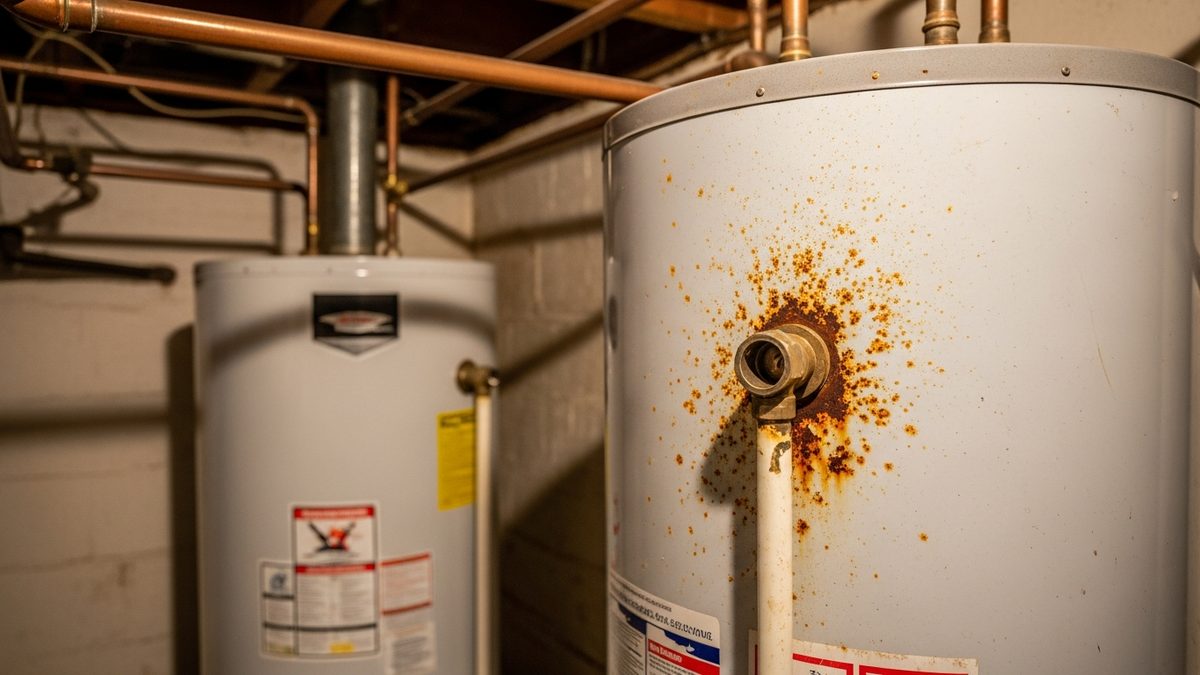
Your water heater just let you down — again. Maybe it stopped heating, maybe it started leaking, or maybe a plumber just handed you a repair estimate and now you're asking: fix it or replace it?
There is no single answer for every home, but there is a logical way to decide. Below you'll find the key factors, typical 2025–2026 costs for both options, and a simple rule plumbers use every day.
When to repair and when to replace
The age rule is the fastest filter. The U.S. Department of Energy says conventional storage water heaters last 10–15 years; tankless units last more than 20 years. [1] Use that as your baseline.
- Under 6 years old: Repair is usually the right call unless the tank body itself is cracked or leaking.
- 6–10 years old: Weigh the repair cost carefully. A small fix (thermostat, element, thermocouple) is often worth it. A big fix (gas valve, heat exchanger) usually is not.
- Over 10 years old (tank) or 15-plus years (tankless): Lean strongly toward replacement, especially after a second repair.
The 50% rule backs this up: if the repair quote is more than half the price of a comparable new unit and the heater is past its midpoint, replacement almost always wins financially.
To find your water heater's age, look at the serial number on the label. Brands like Rheem, A.O. Smith, and Bradford White encode the manufacture date in the first few characters — the manufacturer's website will explain how to read it. [2][3][4]
Most likely reasons to call a plumber (ranked by cost)
Understanding what's wrong before you get a quote helps you evaluate whether the price is fair.
- Thermostat or heating element (electric) — Most common electric failure. Usually fixable. $150–$400.
- Thermocouple or gas control valve (gas) — The thermocouple is cheap to replace; the gas valve is more expensive. $150–$600.
- Anode rod depletion — A worn-out rod leads to tank corrosion. Worth replacing on a mid-age unit. $150–$250.
- T&P valve replacement — Should be done when the valve leaks or is over 5 years old. $150–$300.
- Tank body leaking — Not repairable. If water is seeping from the tank shell, it is time for a new unit. Read more in Is a Leaking Water Heater Dangerous?
Repair cost table
| Repair | Typical Range (2025–2026) |
|---|---|
| Thermostat (electric) | $150 – $300 |
| Heating element (electric) | $200 – $400 |
| Thermocouple (gas) | $150 – $250 |
| Gas control valve (gas) | $300 – $600 |
| Anode rod | $150 – $250 |
| T&P valve | $150 – $300 |
| Expansion tank | $200 – $350 |
| Sediment flush | $100 – $200 |
Plumber labor runs $75–$150 per hour. Most of the repairs above take one to two hours.
Replacement cost table
| Type | Unit Cost | Installed Total |
|---|---|---|
| Gas tank, 40–50 gal | $400 – $900 | $900 – $1,800 |
| Electric tank, 40–50 gal | $350 – $700 | $700 – $1,400 |
| Heat pump water heater | $1,000 – $1,800 | $1,500 – $3,000 |
| Gas tankless (whole-house) | $700 – $2,000 | $1,500 – $4,500 |
| Electric tankless | $400 – $900 | $800 – $2,000 |
The DOE notes tankless units can be 24–34% more energy efficient for average households and last over 20 years — the higher upfront cost often pays off over time. [1] If you're having a complete hot water loss right now, check our guide on no hot water first — some causes are a free fix.
Troubleshoot it yourself (safely)
Electric heaters: Check the circuit breaker first — a tripped breaker is the most common sudden cause. Also press the red reset button on the upper thermostat and wait 30 minutes.
Gas heaters: Confirm the pilot is lit and follow the relight label on the unit. Check that the gas shutoff valve is fully open (handle parallel to the pipe).
Never touch the gas valve, gas supply lines, or T&P valve internals yourself.
Safety first
Scalding: The CPSC recommends setting your water heater to 120°F. [5] At 140°F water can scald in five seconds.
Gas and CO: A deteriorating gas burner can produce carbon monoxide — a colorless, odorless gas. If your CO detector sounds, leave immediately, leave a door open, and call 911 and your gas company from outside.
T&P valve — never cap it: This valve prevents a catastrophic tank explosion by releasing excess pressure. Never plug, cap, or disable it for any reason. [5] If it drips, have a plumber inspect it — but do not block it.
Electrical: Shut off the circuit breaker and verify with a non-contact tester before touching any element or thermostat wiring.
When to call a licensed plumber
- Tank is leaking from the body (not a fitting)
- Unit is over 10–12 years old and the repair quote is significant
- You smell gas near the water heater
- T&P valve is actively releasing water or steam
- Any work on gas lines, venting, or the gas valve itself
- You're switching fuel types or going from tank to tankless
Common mistakes
Patching a leaking tank. It cannot be done reliably — a leaking tank shell is always a replacement.
Putting money into a nearly dead unit. A $300 repair on a 13-year-old water heater often buys only one or two more years.
Skipping the permit. Most jurisdictions require a permit for replacement. Unpermitted work can become a costly problem when you sell the home.
Ignoring the anode rod. This sacrificial rod protects the tank from internal corrosion. Replacing it every 3–5 years (more often with a softener) can add years to tank life.
How to prevent premature failure
- Flush the tank every 6–12 months to clear sediment. [6]
- Check the T&P valve annually by briefly lifting the lever.
- Inspect the anode rod every 3–4 years and replace it when mostly depleted.
- Keep temperature at 120°F — lower mineral scaling, lower energy use.
- Install a water softener or sediment filter in hard water areas.
FAQ
How do I know if my unit is under warranty? Most tank heaters carry a 6-year parts warranty; premium models offer 10–12 years. Tankless units often cover the heat exchanger for 5–10 years. Check the manufacturer's site with your model number — a warranty can turn a big repair bill into a no-cost service call.
Can I do any of this myself? Resetting a breaker, relighting a pilot, and flushing sediment are all DIY-friendly. Replacing a heating element on an electric unit is possible for a careful homeowner who shuts off the breaker first. Gas valve work and T&P replacement should be done by a licensed plumber.
Is tankless worth it when I replace? Often yes if you plan to stay in the home for 7-plus years. The DOE puts the efficiency gain at 24–34% and the lifespan at 20-plus years. [1] Ask a plumber whether your gas line and venting are already sized for a tankless unit.
What is the 50% rule? If the repair quote is more than half the cost of a new comparable unit and the heater is past the midpoint of its life expectancy, replace it. The math rarely works out in favor of repairing at that point.
Get a free quote
Not sure whether to repair or replace? Contact Local Service Group for a free, no-obligation quote from a licensed plumber in your area.
Sources
- https://www.energy.gov/energysaver/tankless-or-demand-type-water-heaters
- https://www.hotwater.com/resources/find-your-product/
- https://www.energy.gov/energysaver/storage-water-heaters
Disclaimer
The information on this page is provided for general educational purposes only and is offered "as is" and "as available," without warranties of any kind, whether express or implied — including, without limitation, any warranties of accuracy, completeness, reliability, merchantability, or fitness for a particular purpose. It is not professional advice and is not a substitute for inspection, diagnosis, or repair by a licensed, qualified professional.
Home systems involving gas, electricity, water, refrigerant, fire, or structural components can be hazardous, and requirements vary by local code and jurisdiction. Any inspection, diagnosis, repair, installation, or other action referenced on this page should be performed by a licensed professional. You should not rely on this content to perform such work yourself. To the fullest extent permitted by law, [Company Name] and its owners, employees, and contributors assume no responsibility or liability for any injury, death, property damage, or other loss arising out of or in connection with the use of, or reliance on, this information.
If you smell gas or suspect a carbon monoxide leak, leave the area immediately and call 911 or your gas utility from a safe location.