Is a Leaking Water Heater Dangerous? What to Do Right Now
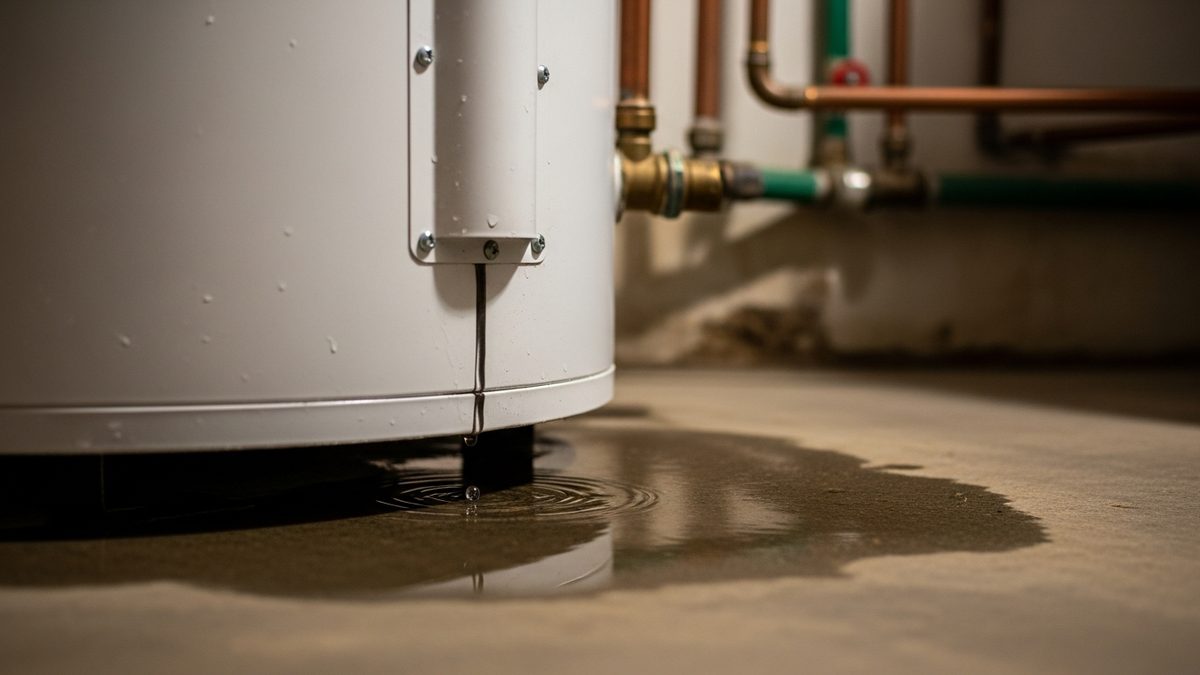
Yes — a leaking water heater can be dangerous, and it should never be ignored. How urgent it is depends on where the leak is coming from and what type of heater you have. Some leaks are a slow drip from a loose fitting that can wait until morning. Others — a bottom-of-tank leak, a spurting pressure-relief valve, or anything combined with a gas smell — need immediate action. This guide covers the real risks, how to read the situation, and the exact steps to shut things down safely.
Is a leaking water heater dangerous?
The short answer is: it can be, in several different ways.
Water damage and mold
Even a slow drip adds up fast. A steady leak onto drywall, subfloor, or wood framing can soak into hidden areas and stay wet long enough to grow mold — often within 24 to 48 hours in warm conditions. Mold remediation is expensive and disruptive. Catching a leak early is far cheaper than tearing out a wall.
A catastrophic tank failure is worse. A standard residential tank holds 40 to 80 gallons. If the tank splits, all of that water floods the space in minutes, potentially damaging flooring, walls, furniture, and anything stored nearby.
Scalding burns
Water heaters are typically set to 120°F, and some run hotter. Water at that temperature causes a serious burn in about five seconds. If a leak is spraying or pooling near an area where people walk, the risk of a scalding burn is real — particularly for children and older adults.
Pressure and the TPR valve
Every storage water heater is required by the International Plumbing Code (IPC Section 504.6) to have a temperature and pressure relief (TPR) valve. This safety device opens automatically when tank pressure exceeds 150 psi or water temperature climbs past 210°F — just below boiling. It prevents the tank from building up enough pressure to rupture.
If your TPR valve is discharging water through its drain pipe, that is not a normal drip — it means pressure or temperature inside the tank is reaching a dangerous level. A continuously discharging TPR valve or one that has been leaking for a while is a sign of a serious problem that needs a licensed plumber the same day. The CPSC has documented that when water heaters lack a properly functioning relief valve and water boils into steam, the resulting pressure buildup can cause the tank to rupture.
Gas water heaters: carbon monoxide risk
Gas water heaters burn natural gas or propane and vent combustion gases out of the home through a flue pipe. When the venting system is blocked, damaged, or improperly installed, those gases — including carbon monoxide (CO) — can back up into living spaces instead of exhausting outside.
CO is colorless and odorless. The CDC reports that more than 400 Americans die from unintentional CO poisoning each year, not including fire-related incidents, and more than 20,000 visit emergency rooms. A gas water heater that is malfunctioning, corroding, or has a cracked heat exchanger can be a CO source. As a real-world example, in 2022 the CPSC announced a recall of certain gas water heaters whose faulty control valves caused soot buildup on the burner and a risk of carbon monoxide poisoning — a reminder that a malfunctioning unit can become a CO source.
If you have a gas water heater and notice any leak, make sure your CO detector is working. If the alarm goes off or anyone feels dizzy, has a headache, or feels nauseated, leave the house immediately and call 911 from outside.
Electric water heaters: shock and fire risk
Electric heaters do not produce combustion gases, but water and electricity near each other create their own hazards. A leak that reaches wiring, the heating element connections, or the electrical panel can cause a short circuit, tripped breaker, or in a severe case, a fire. If you have an electric heater and water is pooling near the base, turn off the breaker for the water heater before you investigate.
Warning signs it's serious
Not all leaks are equal. These are the ones that call for immediate action:
TPR valve discharging water — Water dripping or running from the plastic pipe connected to the TPR valve on the side of the tank is a pressure or temperature emergency. Do not cap or plug that pipe. Call a plumber today.
Leak coming from the bottom of the tank — Puddles directly under the tank (not from a valve or connection, but from the tank body itself) usually mean the inner tank has corroded through. A corroded tank cannot be repaired — it needs to be replaced, and the longer it runs, the higher the flood risk.
Rusty or discolored hot water — Rust-colored water from your hot taps is a sign that the inside of the tank is corroding. This often precedes a tank-body leak by weeks or months.
A gas smell near the water heater — Natural gas has an added odorant that smells like rotten eggs or sulfur. If you detect this smell near the water heater, treat it as an emergency (see the shut-off steps below).
Water near electrical components — Any moisture near the wiring, junction box, or circuit panel serving an electric water heater warrants turning off power before going any further.
What to do right now
Follow these steps in order. If you smell gas at any point, skip to the gas-smell instructions below and do not touch any switches.
For a gas water heater
- Turn the gas control knob to PILOT or OFF. The knob is on the gas valve near the bottom of the tank. Turning it to PILOT stops the burner without fully cutting gas to the unit; turning it all the way to OFF shuts the unit down completely.
- Close the gas shutoff valve on the supply line. This is the valve on the gas pipe leading to the heater. Turn it so the handle is perpendicular (crosswise) to the pipe — that means it is closed.
- Turn off the cold-water supply. Find the cold-water inlet valve above the tank (usually on the right side, on the pipe going into the top of the heater). Turn it clockwise until it stops.
- If water is still flowing or the valve is stuck, shut off the main water supply for the whole house.
For an electric water heater
- Switch off the breaker. Go to your electrical panel and flip the breaker labeled for the water heater to the OFF position. This cuts power to both heating elements.
- Turn off the cold-water supply. Same as above — close the inlet valve above the tank clockwise until it stops.
- If water is still flowing, shut off the house main.
If you smell gas
Leave the house immediately. Do not flip any light switches, use your phone inside, or try to shut anything off — any spark can ignite accumulated gas. Once you are outside and away from the building, call your gas utility's emergency line or 911. Do not re-enter until the utility or fire department clears it as safe.
What's causing the leak
Once the water heater is safely shut down, knowing the source helps you understand what kind of repair or replacement is ahead.
TPR valve leaking — The valve may be doing its job (pressure is too high) or it may have simply worn out and is no longer sealing properly. A qualified plumber can test both scenarios. Never block or cap the discharge pipe.
Drain valve dripping — The drain valve at the bottom of the tank is used for flushing sediment. Over time the rubber washer inside it deteriorates. A slow drip from this valve is often the easiest and least expensive fix — sometimes a simple replacement valve solves it.
Loose or corroded inlet/outlet connections — The fittings where the cold water enters and hot water leaves the tank can loosen from years of thermal expansion and contraction, or corrode where dissimilar metals meet. Tightening or re-sealing these connections may stop the leak.
Tank corrosion — The inside of a steel tank is protected by a sacrificial anode rod that attracts corrosion instead of letting it attack the tank walls. When the anode rod depletes and is not replaced, the tank corrodes from the inside. Once the tank body is leaking, the tank must be replaced.
When to call a plumber — and repair vs. replace
Call a licensed plumber the same day if:
- The TPR valve is discharging water
- The leak is coming from the tank body (bottom puddle under the tank)
- You smell gas or CO detectors are alarming
- Water has reached electrical components
- The water heater is more than 10 years old and leaking
For minor leaks — a loose connection, a dripping drain valve — a plumber can often repair the issue in a single visit.
Repair vs. replace: Tank water heaters typically last 8 to 12 years for gas units and 10 to 15 years for electric units (Rheem, A.O. Smith). If your heater is under 8 years old and the leak is from a valve or fitting, repair usually makes sense. If it is 10 or more years old, is leaking from the tank body, or requires a repair that costs more than roughly half the price of a new unit, replacement is the smarter investment. A new unit also gives you the opportunity to right-size the tank and consider more efficient options.
If you are not sure what you are looking at, see our no hot water troubleshooting guide — it covers diagnosis steps for both gas and electric heaters that can help you describe the problem clearly to a plumber.
How to prevent leaks
A little maintenance goes a long way:
Annual anode rod inspection — The sacrificial anode rod is the single best defense against tank corrosion. Have it inspected every 2 to 3 years and replaced when it is heavily depleted (typically every 3 to 5 years depending on water chemistry).
Annual tank flush — Sediment accumulates at the bottom of the tank over time. It insulates the heating element, forces the heater to work harder, and accelerates corrosion. Flushing the tank once a year drains that sediment.
Test the TPR valve — Once a year, briefly lift or press the test lever on the TPR valve and confirm that water flows through the discharge pipe and stops when you release it. If the valve drips continuously afterward or no water flows when you test it, the valve needs to be replaced. A stuck-open or stuck-closed TPR valve is a safety hazard.
Know how old your heater is — The age of your heater is encoded in the serial number; the format varies by manufacturer but most use the first four characters to indicate year and week or month of manufacture. Check the manufacturer's website for the decode method. If your heater is past 10 years old, budget for replacement before it fails.
Install a leak detector or drain pan — A simple water sensor alarm near the base of the tank can alert you to a small leak before it becomes a large one. A drain pan with a floor drain connection can limit damage if a slow leak goes undetected.
FAQ
Can a leaking water heater explode? In rare but documented cases, yes. If the TPR valve fails or is blocked and pressure builds unchecked, a tank can rupture. This is the reason the TPR valve is required by code on every residential water heater. If your TPR valve is continuously discharging or has been disabled in any way, call a plumber immediately.
My water heater is only dripping a little. How long can I wait? It depends on where the drip is coming from. A very slow drip from the drain valve or a connection may be stable for a short time, but any leak should be evaluated within a day or two — leaks tend to get worse, not better. A drip from the tank body or a TPR discharge should be handled the same day.
Is a leaking electric water heater less dangerous than a gas one? Electric heaters do not carry a CO risk, which removes one serious hazard. However, water near high-voltage wiring is dangerous in its own right. Turn off the breaker before investigating, and call a plumber if the source of the leak is not immediately obvious.
How do I find my water heater's shut-off valve? The cold-water shut-off is on the pipe entering the top of the tank — usually the pipe on the right side. It is typically a ball valve (lever handle) or gate valve (round handle). Turn it clockwise to close. If you cannot find it or it will not turn, close the main water supply valve for the house instead.
Does homeowner's insurance cover water heater leaks? Policies vary widely. Sudden, accidental discharge (like a burst tank) is often covered; gradual leaks that could have been caught with maintenance typically are not. Check your policy and document the leak with photos before any repairs.
Get a licensed plumber near you
A leaking water heater is not a wait-and-see situation. Whether you need a valve replaced, a tank inspected, or a full water heater replacement, a licensed plumber can diagnose it quickly and safely. Use the form below to get a free, no-obligation quote from vetted pros in your area.
Sources
- U.S. Consumer Product Safety Commission — Usines Giant Factories Recalls Gas Water Heaters with Emerson Control Valves Due to Risk of Carbon Monoxide Poisoning (2022): https://www.cpsc.gov/Recalls/2022/Usines-Giant-Factories-Recalls-Gas-Water-Heaters-with-Emerson-Control-Valves-Due-to-Risk-of-Carbon-Monoxide-Poisoning
- International Code Council (ICC) — Water Heater Safety in the International Codes (IPC Section 504.6 TPR valve requirement): https://www.iccsafe.org/building-safety-journal/bsj-technical/water-heater-safety-in-the-international-codes/
- InterNACHI — TPR Valves and Discharge Piping (valve opens at 210°F / 150 psi): https://www.nachi.org/tpr-valves-discharge-piping.htm
- U.S. Department of Energy — Solar Water Heating System Maintenance and Repair (pressure relief valve testing guidance): https://www.energy.gov/energysaver/solar-water-heating-system-maintenance-and-repair
- Rheem Manufacturing — Water Heater Lifespan: When to Repair vs. Replace (8–12 year gas / 10–15 year electric lifespan): https://www.rheem.com/water-heating/articles/water-heater-lifespan-when-to-repair-vs-replace/
- A.O. Smith — When to Repair or Replace Your Water Heater: https://www.hotwater.com/info-center/when-to-repair-or-replace.html
Disclaimer
The information on this page is provided for general educational purposes only and is offered "as is" and "as available," without warranties of any kind, whether express or implied — including, without limitation, any warranties of accuracy, completeness, reliability, merchantability, or fitness for a particular purpose. It is not professional advice and is not a substitute for inspection, diagnosis, or repair by a licensed, qualified professional.
Home systems involving gas, electricity, water, refrigerant, fire, or structural components can be hazardous, and requirements vary by local code and jurisdiction. Any inspection, diagnosis, repair, installation, or other action referenced on this page should be performed by a licensed professional. You should not rely on this content to perform such work yourself. To the fullest extent permitted by law, [Company Name] and its owners, employees, and contributors assume no responsibility or liability for any injury, death, property damage, or other loss arising out of or in connection with the use of, or reliance on, this information.
If you smell gas or suspect a carbon monoxide leak, leave the area immediately and call 911 or your gas utility from a safe location.