Water Heater Leaking From the Bottom? What to Do Now
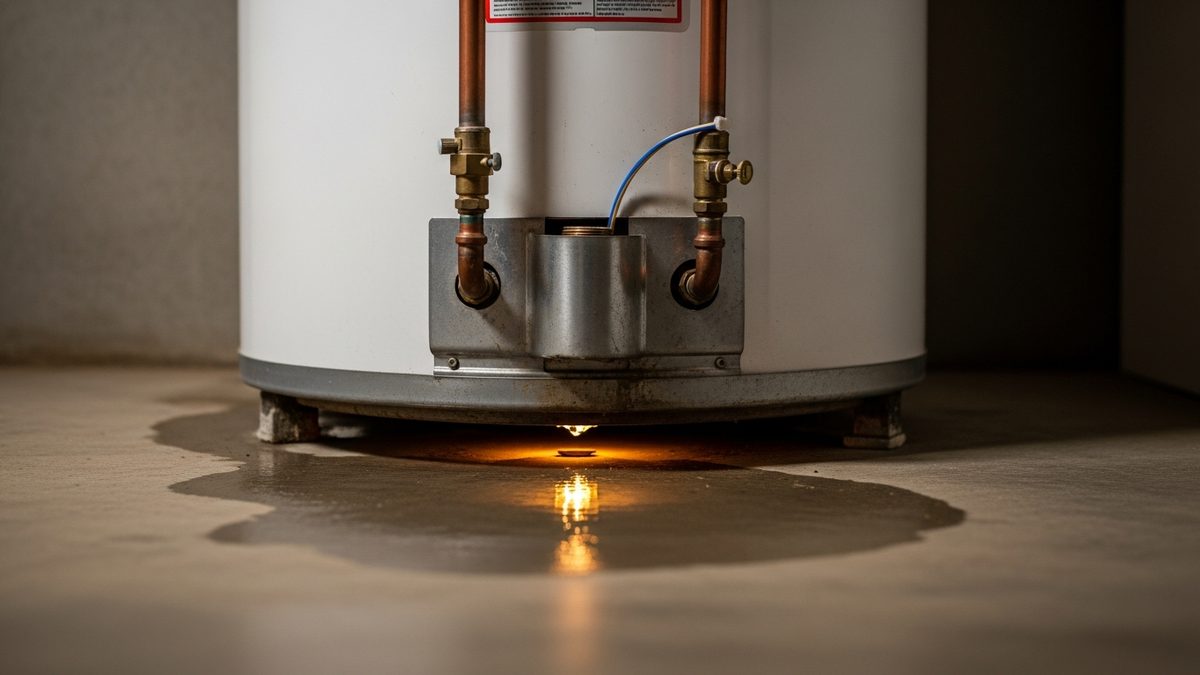
A puddle under your water heater could be a $15 drain valve fix — or it could mean the tank has corroded through and needs to be replaced. The difference matters a lot, and finding it takes less than 10 minutes. Here is how to shut things down safely, trace the source, and decide what to do next.
For gas risk, electrical hazard, and flood potential, see Is a Leaking Water Heater Dangerous?. Lost hot water too? Start with No Hot Water? Here's How to Troubleshoot It.
What to do right now
1. Shut off power or gas. Electric unit: flip the dedicated breaker to OFF. Gas unit: turn the gas control valve to PILOT — this stops the burner without snuffing the pilot. If you smell gas at any point, leave immediately and call your gas utility from outside.
2. Shut off the cold water supply. Turn the shut-off valve on the cold inlet pipe clockwise until it stops. This prevents more water from entering the tank.
3. Contain the water. Lay towels down or set a bucket under the drip. Mop up any standing water — it can work under flooring and into drywall within hours.
Find where it's leaking from
Dry the outside of the tank with a towel first, then work through each source below.
The drain valve
The drain valve sits at the very bottom of the tank and looks like an outdoor hose spigot. It is the most common cause of bottom leaks. Two things go wrong: sediment inside the valve body prevents it from closing (water drips from the spout), or the valve threads have worked loose (water seeps from the base where it threads into the tank). A loose valve may tighten with a gentle half-turn using a pipe wrench. A dripping spout can be temporarily capped with a brass garden hose end cap. If either problem persists, the valve needs replacing. Plastic drain valves on older budget units are especially prone to cracking or losing their rubber gasket.
The T&P relief valve and discharge tube
The temperature and pressure (T&P) relief valve is a safety device on the side of the tank, with a discharge tube running down toward the floor. Water at the base can be discharge that ran down from that tube outlet.
A.O. Smith's Technical Bulletin 52 explains that a T&P valve weeps or dribbles when it is relieving pressure — most often from thermal expansion in a closed plumbing system. It can also dump a large volume of water if the thermostat malfunctions and overheats the tank. Either symptom needs a licensed plumber, not a DIY fix.
Never cap or plug the discharge tube. It is the last line of defense against a dangerous pressure buildup. InterNACHI's standards explicitly prohibit blocking or capping the discharge pipe.
Cold and hot water connections at the top
A drip from either the cold inlet or hot outlet at the top of the tank can run down the outside and pool at the floor, mimicking a bottom leak. Wipe the tank dry and check both top connections for wet threads or mineral staining before assuming the base is the problem. Loose fittings can sometimes be tightened; corroded metal-to-metal joints may need a dielectric union.
Condensation (not a real leak)
Gas water heaters can form condensation on the outside when cold water enters a warm tank — droplets that drip to the floor but are not a true leak. To tell the difference, wipe the tank dry, lay paper towels around the base, and wait four to six hours without using hot water. Dry towels mean condensation. Wet towels mean a real leak.
The tank itself
If you have ruled out everything above and the bare steel wall at the bottom is wet, you are looking at internal corrosion. The tank's porcelain enamel lining cracks over time, and once the sacrificial anode rod inside is depleted, rust works through the steel wall.
There is no patch for a corroded tank. It must be replaced.
Which leaks are DIY vs. pro
| Leak source | DIY? | Notes |
|---|---|---|
| Drain valve — drip from spout | Sometimes | Hose cap as temp fix; replace valve for good |
| Drain valve — drip from base | Possibly | Tighten carefully; damaged threads need a plumber |
| Inlet/outlet connections | Sometimes | Tightening may help; corroded fittings need a pro |
| T&P valve weeping | No | Safety device — licensed plumber only |
| Tank wall leaking | No | Replacement required |
| Gas or electrical work | No | Licensed pro only |
Safety notes
- Water in the tank is stored at 120°F or higher. Shut off the cold supply and let it cool before handling any fittings.
- Electric units run on 240 volts. Turn off the breaker first.
- Gas smell near the unit means leave immediately — do not flip switches. Call your gas utility from outside.
- Never plug or cap a T&P discharge tube. It is a pressure-relief safety device.
Repair vs. replace — and what it costs
- Drain valve: $150–$300 installed.
- T&P valve: $150–$350 — a plumber should also diagnose why it was activating.
- Inlet/outlet fittings: $100–$250.
- Full tank replacement: $850–$1,800 installed for a standard unit in 2025–2026; tankless runs $1,500–$3,500.
Industry rule of thumb: if the repair tops 50% of replacement cost and the unit is 8-plus years old, replace it. A leaking tank past 10 years almost always makes more sense to replace.
How to prevent future leaks
- Flush the tank once a year to remove sediment that accelerates corrosion and can prevent the drain valve from fully closing.
- Check the anode rod every 2–3 years. A depleted rod leaves the tank steel unprotected. Ask a plumber to inspect it during routine service.
- Test the T&P valve annually. Lift the test lever briefly — water should rush into the discharge tube and stop. Continued dripping means the valve needs replacing.
- Add an expansion tank if you have a closed plumbing system (backflow preventers or pressure-reducing valves). It absorbs thermal expansion that would otherwise wear out the T&P valve early.
FAQ
Can I keep using the water heater if it's dripping at the bottom? A slow drain valve drip can wait a day or two, but a leaking tank needs to be shut down now — a failed tank can dump 40–80 gallons on your floor in minutes.
How do I tell the drain valve from the tank? Wipe everything dry: if water comes from the threaded fitting, it's the valve. If it seeps from the bare steel wall next to or below the fitting, it's the tank.
My T&P valve keeps dripping — can I just replace it? You can, but a new valve will wear out the same way if you don't fix the cause. Thermal expansion is usually the culprit; a plumber can add an expansion tank to address it.
How long does a water heater last? Most tank units last 8–12 years. Annual flushing and anode rod checks keep them toward the high end; neglected units often fail closer to 8.
Get it fixed today
Bottom leaks do not fix themselves — acting fast limits water damage to floors and walls. Get a free quote from a vetted local plumber. Local Service Group connects you with licensed pros in your area who can diagnose the problem and fix it the same day.
Sources
- A.O. Smith — Technical Bulletin 52: Leaking Temperature and Pressure Relief Valve
- InterNACHI — TPR Valves and Discharge Piping
- Angi — Cost to Repair a Hot Water Heater (2026 Data)
- Behler-Young — How to Differentiate Between Condensation and Leakage in Water Heaters
Disclaimer
The information on this page is provided for general educational purposes only and is offered "as is" and "as available," without warranties of any kind, whether express or implied — including, without limitation, any warranties of accuracy, completeness, reliability, merchantability, or fitness for a particular purpose. It is not professional advice and is not a substitute for inspection, diagnosis, or repair by a licensed, qualified professional.
Home systems involving gas, electricity, water, refrigerant, fire, or structural components can be hazardous, and requirements vary by local code and jurisdiction. Any inspection, diagnosis, repair, installation, or other action referenced on this page should be performed by a licensed professional. You should not rely on this content to perform such work yourself. To the fullest extent permitted by law, [Company Name] and its owners, employees, and contributors assume no responsibility or liability for any injury, death, property damage, or other loss arising out of or in connection with the use of, or reliance on, this information.
If you smell gas or suspect a carbon monoxide leak, leave the area immediately and call 911 or your gas utility from a safe location.