Tree Roots in Your Sewer Line: Signs, Risks, and Your Options
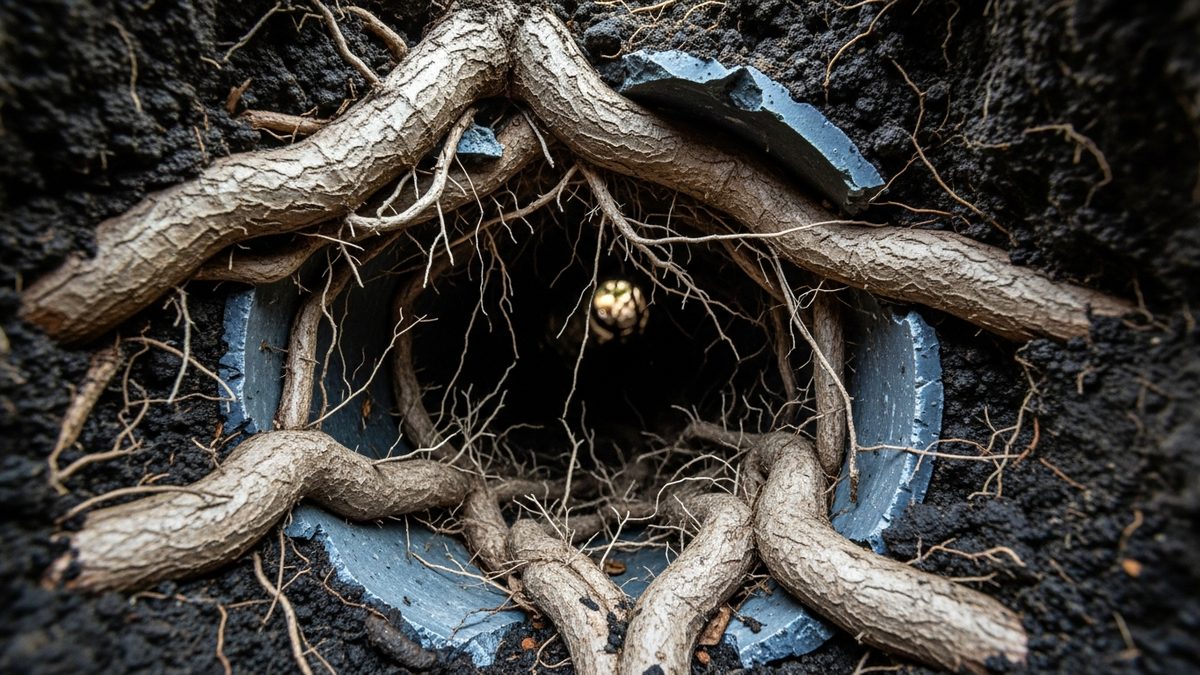
Tree roots are one of the leading causes of sewer line damage in American homes. They work quietly underground for months before anything inside the house goes wrong. By the time a drain backs up, the roots may already be well established — but the signs are recognizable, and there are solid options at every stage.
Signs tree roots are in your sewer line
Recurring slow drains or backups. A single sluggish drain usually means a local clog. But when slow drains show up throughout the whole house — kitchen, tub, and laundry all moving slowly — the problem is likely in the main sewer line. Roots narrow the pipe over time, choking flow to every fixture at once.
Gurgling toilets. Air trapped behind a partial blockage finds the nearest way out. If your toilet gurgles after running a sink on the same floor, something is restricting flow downstream.
Sewage smell in the yard. A healthy sewer pipe is sealed. If you catch a rotten-egg odor near the path of your sewer line, gases are escaping through cracks that roots have already opened.
Extra-green patches or soft spots over the line. Roots that breach a pipe create a slow leak. The nutrient-rich wastewater fertilizes the grass above it, making that strip noticeably greener. In worse cases, the soil begins to settle into a soft spot or small sinkhole.
Clogs that keep coming back. You snake the line, it clears, and three months later it backs up again. Mechanical clearing cuts roots but does not seal the pipe — they regrow through the same opening. If sewage is backing up on a repeating cycle, roots are a strong suspect.
Why roots get into sewer pipes
Roots do not punch through solid pipe. They get in through existing weak spots — a loose joint, a hairline crack, or a gap where two sections meet. Even a tiny leak releases moisture and nutrient-rich vapor into the soil. Roots grow toward that source, push through the opening, and expand from there.
North Carolina State University Cooperative Extension notes that tree roots only enter a sewer line if there was already a leak — the root exploits the damage, it does not create it.
Older pipe materials are especially at risk. Clay tile pipes, common before the 1980s, were laid in short sections with mortar joints that loosen over decades of ground movement. Orangeburg pipe — a tar-and-wood-fiber material used from the late 1940s through the early 1970s — softens and deforms with age. Cast iron corrodes from the inside out, developing hairline fractures as the walls thin. Modern PVC is far more resistant, but even newer lines can fail at poorly installed connections.
How a pro confirms it
The only reliable diagnosis is a sewer camera inspection. A licensed plumber feeds a waterproof camera through a cleanout access point and watches the live feed as it travels toward the street, revealing root location and severity, pipe material, and whether repair or replacement is the right call.
A residential inspection typically costs $100 to $600 — most jobs land in the $150 to $400 range. Many plumbers credit the fee toward the repair.
Your options to fix it
Mechanical root cutting (augering). A motorized auger with a root-cutting head chops through the roots and restores flow. Fast and affordable at $250 to $600, but roots regrow through the same openings within a year or two. Best used as a short-term fix or first step before a permanent repair.
Hydro jetting. High-pressure water (1,500 to 4,000 PSI) scours pipe walls and flushes root debris out of the line — more thorough than augering. Costs $350 to $1,200 for a residential line. Still does not fix the pipe itself.
Foaming root treatments. Products containing copper sulfate or dichlobenil kill active root tissue. They slow regrowth for a season or two but are a maintenance tool, not a fix. NC State Extension recommends them for minor intrusion in otherwise intact pipes, paired with regular upkeep.
Spot repair. If the camera finds one well-defined problem area, a plumber can excavate that section, replace it, and backfill. Less disruptive than full replacement. Typical cost: $1,000 to $4,000 depending on depth and access.
Pipe lining (CIPP — Cured-In-Place Pipe). A resin-saturated liner is inserted into the old pipe, pressed against the walls, and cured in place. The result is a seamless interior surface that seals existing cracks and blocks future root entry — without major digging. Works on pipes that are cracked but still structurally intact. Cost: roughly $90 to $250 per linear foot, or $5,000 to $15,000 for a typical residential line.
Pipe bursting or full replacement. When a pipe is too deteriorated to reline, it has to go. Pipe bursting is a trenchless method: a new pipe is pulled through the old one while a bursting head fractures and displaces the old pipe outward. Traditional open-cut excavation is the fallback when trenchless is not feasible.
- Pipe bursting: $3,500 to $20,000
- Open-cut replacement: $3,500 to $15,000+, plus landscaping and concrete restoration
Sources: HomeGuide, Angi — 2025-2026 data.
Safety and DIY limits
Raw sewage is a Category 3 biohazard containing E. coli, Salmonella, Hepatitis A, and other pathogens. Even brief skin contact carries real health risk, and sewage gases — including hydrogen sulfide — are toxic at higher concentrations.
Store-bought root killers do not fix the cracked pipe that let roots in; they only slow regrowth temporarily. Sewer work involves pressurized equipment, excavation, and raw waste. Leave it to licensed professionals.
What it typically costs
| Service | Typical Range (2025-2026) |
|---|---|
| Sewer camera inspection | $100 - $600 |
| Mechanical root cutting | $250 - $600 |
| Hydro jetting | $350 - $1,200 |
| Spot repair (one section) | $1,000 - $4,000 |
| CIPP pipe lining | $5,000 - $15,000 |
| Pipe bursting (trenchless) | $3,500 - $20,000 |
| Full open-cut replacement | $3,500 - $15,000+ |
Costs vary by region, pipe depth, soil conditions, and line length. Get at least two quotes from licensed sewer contractors before committing to a major repair.
How to prevent regrowth
Schedule annual jetting or treatment. For homes with a history of root intrusion, a yearly hydro jetting service or professional foaming treatment removes new growth before it builds up.
Plant trees at a safe distance. The University of Tennessee Extension recommends smaller-rooted species and keeping trees at least 10 feet from sewer lines — farther for large trees. Your local extension office can recommend species for your climate.
Install root barriers. Dense plastic or metal barriers set vertically in the soil redirect roots away from buried utilities. Most useful during new landscaping projects near an existing line.
Keep the pipe in good shape. Since roots only enter through existing leaks, maintaining the pipe is the best long-term prevention. A camera inspection every five to seven years catches small problems before they become expensive emergencies.
FAQ
Can tree roots really destroy a sewer pipe? Yes. Roots that enter through a crack expand inside the pipe over time and can eventually cause complete blockages or collapse older clay and Orangeburg lines. The longer it goes untreated, the worse the damage.
How fast do roots come back after treatment? Mechanical cutting alone typically sees regrowth within 6 to 18 months. Hydro jetting plus a foaming treatment can extend that to two or three years. Only pipe lining or replacement seals the entry points for good.
Will homeowners insurance cover this? Most standard policies exclude gradual damage, which root intrusion usually qualifies as. Some policies cover sudden sewer backups if you have a water-and-sewer-backup rider. Check your policy and call your agent before assuming anything.
How do I know what pipe material I have? A camera inspection reveals it directly. As a rule of thumb, homes built before 1980 commonly have clay, cast iron, or Orangeburg; homes after 1985 are more likely to have PVC.
Do I need to cut down the tree? Not necessarily. Removing the tree stops new growth but does not repair the pipe, and dead roots decay in the soil for years. Fix the pipe first. If the tree sits very close to the line and has caused repeated damage, discuss removal with an arborist alongside your plumber.
If your drains are showing any of these signs, do not wait for a full backup to force the issue. Get a licensed sewer professional to camera-inspect the line, understand what you are dealing with, and walk you through your options before the damage gets worse.
Ready to find a licensed sewer pro near you? Use the form on this page to get free quotes from qualified contractors in your area — no commitment, no pressure.
Sources
- North Carolina State University Cooperative Extension — "Tree Roots and Sewer Lines": https://union.ces.ncsu.edu/tree-roots-and-sewer-lines/
- University of Tennessee Institute of Agriculture — "Choosing Sewer Safer Trees" (SP628): https://utia.tennessee.edu/publications/wp-content/uploads/sites/269/2023/10/SP628.pdf
- InterNACHI — "Common Defects Found During a Sewer Scope Inspection": https://www.nachi.org/gallery/piping/common-defects-found-during-a-sewer-scope-inspection
- HomeGuide — "Sewer Line Replacement Cost (2026)": https://homeguide.com/costs/sewer-line-repair-cost
- Angi — "Roots in Pipes Removal Cost (2026)": https://www.angi.com/articles/roots-in-pipes-removal-cost.htm
Disclaimer
The information on this page is provided for general educational purposes only and is offered "as is" and "as available," without warranties of any kind, whether express or implied — including, without limitation, any warranties of accuracy, completeness, reliability, merchantability, or fitness for a particular purpose. It is not professional advice and is not a substitute for inspection, diagnosis, or repair by a licensed, qualified professional.
Home systems involving gas, electricity, water, refrigerant, fire, or structural components can be hazardous, and requirements vary by local code and jurisdiction. Any inspection, diagnosis, repair, installation, or other action referenced on this page should be performed by a licensed professional. You should not rely on this content to perform such work yourself. To the fullest extent permitted by law, [Company Name] and its owners, employees, and contributors assume no responsibility or liability for any injury, death, property damage, or other loss arising out of or in connection with the use of, or reliance on, this information.
If you smell gas or suspect a carbon monoxide leak, leave the area immediately and call 911 or your gas utility from a safe location.