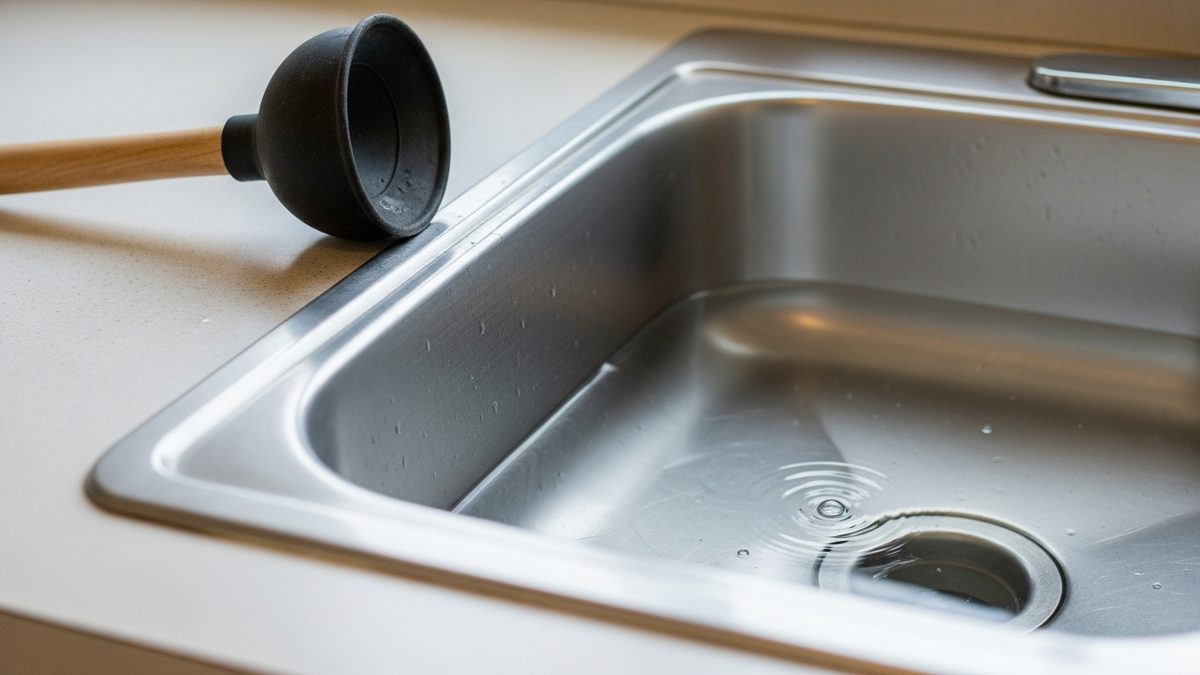
A slow or standing-water kitchen sink is one of the most common calls plumbers get. The good news: most kitchen clogs sit close to the drain, in the P-trap or the first few feet of pipe, and a homeowner with basic tools can clear them in under an hour. Work through the steps below from easiest to most involved, and you will clear most clogs before you ever need to pick up the phone.
For a broader look at drain problems throughout your home, see our guide on how to unclog a drain.
Why kitchen sinks clog
Kitchen drain pipes are a magnet for four types of buildup:
Grease, fats, and oils (FOG) — This is the number-one cause. Hot grease pours down the drain as a liquid, but it cools just a few feet into the pipe and hardens into a waxy film on the pipe walls. Each meal adds a thin layer. Over months, that film narrows the pipe until water backs up. Running hot water alongside the grease does not help — the grease simply moves further down the line before it solidifies, making it harder to reach.
Food particles — Even with a strainer or garbage disposal, small bits of food wash through. Starchy foods like pasta and rice absorb water and swell. Coffee grounds clump together and settle. Bits of eggshell and vegetable peels cling to grease that is already coating the pipe.
Coffee grounds — Coffee grounds do not dissolve. They collect in the P-trap and the trap arm, mixing with grease and forming a dense, wet plug. Toss grounds in the trash or compost instead.
Soap scum — Dish soap leaves a residue that, over time, bonds with minerals in hard water and grease already on the pipe walls. The result is a sticky layer that catches passing food particles and makes the problem worse.
What you'll need
- Kettle or large pot for boiling water
- Dish soap (plain liquid dish soap)
- Cup plunger (a flat-bottomed plunger, not a toilet flange plunger)
- Wet rag or small towel
- Adjustable pliers or channel-lock pliers
- Bucket
- Baking soda and white vinegar
- Hand drain snake (also called a drain auger), 15–25 feet
- Flashlight
Step by step
Step 1: Boiling water and dish soap
Start here for any grease-based clog, which is most kitchen clogs.
- Bring a full kettle or large pot of water to a boil.
- Squirt two or three good tablespoons of liquid dish soap directly into the drain.
- Pour the boiling water slowly and steadily into the drain in two or three stages. Pouring in stages gives the hot water time to work on the grease between pours.
- Run the hot tap for a minute and watch the drain. If it is flowing freely, you are done. If not, move to step 2.
Note for PVC pipes: If your home has older plastic supply lines or a plastic drain assembly, use the hottest tap water you can get rather than a full boil. Boiling water can soften or warp some PVC fittings over time. Most modern PVC drain pipe (schedule 40) tolerates boiling water fine, but if you are unsure, err on the side of very hot tap water.
Step 2: Plunge the drain
A cup plunger creates pressure that can dislodge soft clogs that heat alone did not clear.
- If you have a double sink, stuff a wet rag tightly into the other drain opening. This seals the second basin so your plunging pressure pushes toward the clog rather than escaping up through the second drain.
- Add enough water to the clogged basin to cover the bottom of the plunger cup — about two to three inches.
- Set the plunger firmly over the drain and plunge with short, forceful strokes — push down and pull up — for 20 to 30 seconds.
- Lift the plunger sharply on the last stroke and watch whether water drains. Repeat two or three times if needed.
Step 3: Clean out the P-trap
If plunging did not work, the clog is likely sitting in the P-trap — the curved section of pipe directly under the sink. This is a very common spot for grease and food to collect.
- Clear out the cabinet under the sink and place a bucket under the P-trap.
- Using adjustable pliers, unscrew the two slip-nut fittings that hold the P-trap in place. Turn them by hand if possible; use pliers only if they are stuck. Some water will spill out — that is normal.
- Remove the trap and dump it into the bucket. Look inside: if you see a dark, greasy plug or compacted food, you have found your clog.
- Rinse the trap thoroughly with hot water. Use a bottle brush or an old toothbrush to scrub the inside.
- Reattach the trap, making the slip nuts hand-tight, then snug with pliers — do not over-tighten plastic fittings.
- Run the water and check for leaks at both slip-nut joints. If it drains freely, you are done.
Step 4: Baking soda and vinegar
This method creates a fizzing reaction that can loosen light buildup and is good for maintenance or mild slowdowns. It is less effective on a solid grease plug than the steps above, but it is worth trying if you want to avoid the snake.
- Pour one cup of baking soda down the drain.
- Follow with one cup of white vinegar.
- Immediately cover the drain with a stopper or a rag to keep the fizzing action inside the pipe rather than bubbling out into the sink.
- Wait 15 minutes, then flush with a full kettle of hot water.
Step 5: Use a drain snake
If the clog is not in the P-trap, it is further down the line in the trap arm or the drain pipe inside the wall.
- With the P-trap still removed (from step 3), feed the snake cable directly into the opening in the wall — this gets you past the trap and right to where many stubborn clogs live.
- Feed the cable in slowly, cranking the handle clockwise to help it navigate the pipe.
- When you feel resistance, you have found the clog. Work the snake back and forth to break it up. Do not just punch through it — try to hook and pull out the blockage if possible.
- Pull the cable back slowly, wiping it clean with a rag as it comes out.
- Replace the P-trap, run hot water, and confirm the drain is clear.
Step 6: Check the garbage disposal
If you have a garbage disposal and water is backing up in the basin on the disposal side, the disposal itself might be the source — not the drain pipe. See the section below before snaking or calling a plumber.
A note on garbage disposals
A disposal that hums when you flip the switch but does not spin has a jammed grinding plate, not a drain clog. Running it repeatedly in this state will trip the thermal overload and can burn out the motor. Here is what to do instead:
- Turn off the disposal switch and unplug the unit (or flip the circuit breaker) before you touch anything.
- Look under the disposal unit for a small red reset button on the bottom center. If it has popped out, press it firmly to reset the motor.
- Use the small hex (Allen) wrench that came with your disposal — or a standard 1/4-inch Allen wrench — and insert it into the hex socket on the very bottom of the unit. Work it back and forth to manually free the plate.
- Reach into the drain opening with tongs (never your hand) to remove any food or debris blocking the grinding ring.
- Restore power and test.
If your disposal is making a grinding noise or draining slowly rather than humming, you may have a drain clog downstream of the unit, not a mechanical problem. Work through steps 1–5 above. For a full walkthrough of disposal problems, see our garbage disposal repair guide.
Never run a clogged or jammed disposal repeatedly trying to force it through. And never pour chemical drain cleaner into a disposal — see the next section.
What to avoid
Chemical drain cleaners — Products like Drano and Liquid-Plumr are caustic lye-based chemicals (sodium hydroxide). Professional plumbers routinely advise against them for several reasons:
- They can corrode older metal pipes and weaken PVC over time with repeated use.
- They are particularly harmful to garbage disposals, corroding the metal grinding components and rubber splash guard.
- If the clog does not clear, the chemical sits trapped in the standing water, and if a plumber later opens the drain, the caustic liquid can splash and cause serious burns.
- They are hazardous to handle, especially around children and pets.
Plain hot water, dish soap, a plunger, and a snake will outperform chemicals on a real kitchen grease clog anyway.
When to call a plumber
Most kitchen sink clogs clear with the steps above. Call a licensed plumber when:
- You have worked through all six steps and the drain still does not flow freely.
- Both basins of a double sink back up at the same time, or water backs up into the other basin when you drain one. This points to a clog deep in the shared drain line, beyond what a hand snake can reach from the sink.
- The clog comes back within a few weeks of clearing it. Recurring clogs often mean a partial blockage deeper in the drain system, or a pipe that has narrowed from years of grease buildup and needs hydro-jetting.
- You notice a sewage or rotten-egg smell from the drain, or gurgling sounds in other fixtures when you run the kitchen sink. These are signs of a problem in the main sewer line, not the kitchen branch line.
- You see water under the sink after reassembling the P-trap, or you notice wet drywall or cabinets — possible signs of a leak you made worse while working on the clog.
How to prevent kitchen clogs
Preventing clogs is much easier than clearing them. A few habits make a big difference:
- Never pour grease down the drain. Let bacon grease, cooking oil, and pan drippings cool in the pan, then pour them into a sealed container and throw them in the trash. Even small amounts add up fast.
- Use a sink strainer. A simple mesh basket strainer catches food, coffee grounds, and debris before they enter the pipe. Empty it after every meal.
- Flush the drain with hot water after washing greasy dishes. Run the hot tap for 30 to 60 seconds after finishing dishes to push any residual grease further through the system before it can congeal.
- Run a monthly hot-water flush. Once a month, boil a kettle of water and pour it slowly down the drain. This softens and moves along any thin grease buildup before it has a chance to thicken.
- Know what not to put in the disposal. Coffee grounds, pasta, rice, eggshells, and fibrous vegetables (celery, artichokes) all cause problems. Toss them in the trash or compost.
FAQ
How do I know if it is a drain clog or a garbage disposal clog? If the disposal side drains slowly but the other basin of a double sink drains normally, the problem is in the disposal or the drain directly below it. If both basins back up, the clog is in the shared drain line downstream of both basins.
Is it safe to use a drain snake if I have a garbage disposal? Yes, but remove the P-trap and feed the snake into the pipe from the wall side rather than through the disposal. This protects the disposal's internal components and gets your snake directly to the clog.
Can I use boiling water if I have PVC pipes? Schedule 40 PVC pipe — the white pipe used in most residential drain systems — can handle boiling water in occasional use. If you are concerned, use the hottest water from your tap instead, which will still melt light grease effectively.
Why does my kitchen sink keep clogging even after I clear it? Recurring clogs usually mean one of two things: a habit that keeps reintroducing the problem (pouring grease, coffee grounds) or a partial buildup deeper in the drain line that you are only temporarily clearing. A plumber with a hydro-jet can scour the pipe walls clean. Also audit what is going down the drain — sometimes a slow drip of cooking oil from a frequently used pan is enough to rebuild a clog quickly.
How long does it take to clear a kitchen clog? Most clogs clear in 30 minutes or less with boiling water, dish soap, and a plunger. Removing and cleaning the P-trap adds another 15 to 20 minutes. Using a drain snake from start to finish is typically a 45-minute job for a homeowner.
Get help from a vetted plumber
If you have worked through these steps and the sink is still clogged — or if you want a plumber to handle it from the start — we can connect you with a licensed, background-checked plumber in your area. Get a free quote with no obligation.
Get a free plumber quote near you
Sources
- This Old House — How You Can Unclog Any Drain
- This Old House — How to Prevent Sink Clogs
- This Old House — How To Repair a Kitchen Sink Drain Trap
- Family Handyman — How to Unclog a Kitchen Sink
- Family Handyman — How to Clean and Unclog a Kitchen Sink Drain
- InSinkErator (Emerson) — Fixing a Jammed Garbage Disposal
- Bob Vila — Clogged Kitchen Sink? 5 Steps to a Fresh Drain
Disclaimer
The information on this page is provided for general educational purposes only and is offered "as is" and "as available," without warranties of any kind, whether express or implied — including, without limitation, any warranties of accuracy, completeness, reliability, merchantability, or fitness for a particular purpose. It is not professional advice and is not a substitute for inspection, diagnosis, or repair by a licensed, qualified professional.
Home systems involving gas, electricity, water, refrigerant, fire, or structural components can be hazardous, and requirements vary by local code and jurisdiction. Any inspection, diagnosis, repair, installation, or other action referenced on this page should be performed by a licensed professional. You should not rely on this content to perform such work yourself. To the fullest extent permitted by law, [Company Name] and its owners, employees, and contributors assume no responsibility or liability for any injury, death, property damage, or other loss arising out of or in connection with the use of, or reliance on, this information.
If you smell gas or suspect a carbon monoxide leak, leave the area immediately and call 911 or your gas utility from a safe location.