Your air conditioner shuts off on a hot afternoon. The thermostat looks fine, but the house keeps warming up. Before you call for service, a reset is often the first thing to try — it takes a few minutes, costs nothing, and works more often than you might expect.
When a reset might help
A reset is worth trying after any of these situations:
- Power flicker or outage. A brief interruption can trip your AC's internal protection circuits even if the main breaker never fully tripped.
- Tripped breaker. If the breaker for your air conditioner has flipped to the middle or OFF position, a reset is the standard first step.
- Unit shut off on its own. Most modern air conditioners have built-in high-pressure or overload protection that cuts power to the compressor when it detects a problem. After the cause clears — an overheat on a scorching day, for example — the unit may need a manual reset to start again.
- Thermostat acting strange. Trane notes that a voltage spike can scramble a thermostat's settings or blank its display, which a reset will fix.
A reset is not a cure for mechanical failures or refrigerant problems. If your system is leaking, icing over, or making grinding noises, resetting it will not help. See AC running but not cooling for those situations.
How to reset your air conditioner
Work through these six steps in order. Skipping ahead — especially restarting the compressor too soon — can cause real and expensive damage.
Step 1 — Turn the thermostat to OFF. Set it all the way to OFF, not just a higher temperature. If the screen is blank, replace the batteries before going further.
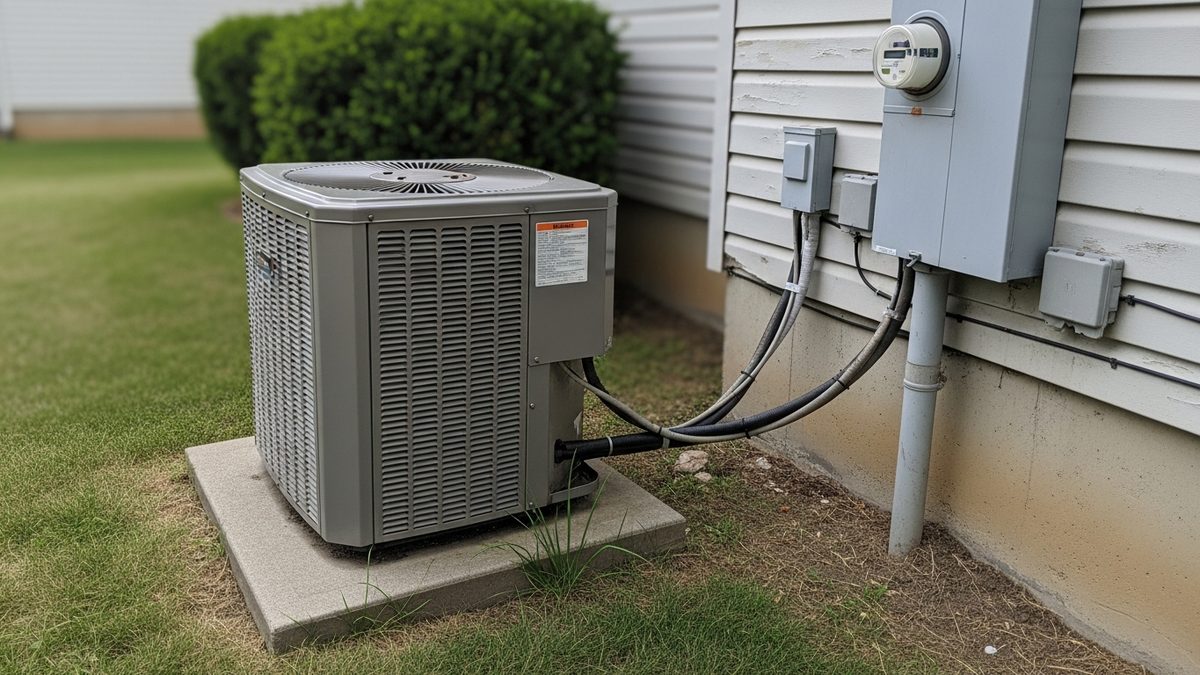
Step 2 — Turn off the AC at the breaker. Flip the double-pole AC breaker in your electrical panel fully to OFF. If there is a disconnect box on the wall near the outdoor condenser, pull that fuse block or flip it to OFF as well.
Step 3 — Wait 30 minutes. This is the step most people skip, and skipping it can damage the compressor. When an AC shuts down suddenly, refrigerant pressure is unequal across the system. Starting the compressor against that imbalance puts severe stress on it. Waiting 30 minutes lets pressure equalize and lets the thermal overload protector cool and reset. Carrier and Trane build a time-delay circuit into many modern units for this reason — but waiting the full 30 minutes is safest regardless.
Use the time to check the air filter and clear debris from around the outdoor unit.
Step 4 — Find the unit's reset button (if it has one). Walk to the outdoor condenser and look along the lower part of the cabinet, near where the wiring enters. Many units have a small red reset button — the high-pressure cutout. Press and hold it for about three seconds until it clicks. Not every unit has one, so if you do not see it, move on.
Step 5 — Turn the breaker back on. Flip the AC breaker to ON. Restore the outdoor disconnect if you turned it off.
Step 6 — Set the thermostat to COOL. Set it at least 2 to 3 degrees below the current room temperature. The outdoor unit should start within a minute or two. Let it run 15 minutes and confirm cold air is coming from the vents.
If the breaker trips again right away, do not reset it a second time. Repeated cycling can overheat the wiring — a technician needs to find the root cause.
Check the condensate safety switch / float switch
If the reset did not bring your AC back on and the unit won't turn on at all, check the condensate drain pan before assuming the worst.
As your AC cools the air it removes moisture, which drains through a condensate line below the air handler. If that line clogs, water backs up in the pan. Most modern air handlers have a float switch — a safety device that shuts the system off when the water level gets too high.
To clear it: find the indoor air handler, check the drain pan for standing water, vacuum it out with a wet-dry vac, and pour a cup of diluted bleach (one part bleach to 16 parts water) into the drain line access port to kill algae. Once the pan is dry and the float drops back down, the switch resets and the system should start. Trane lists a tripped condensate safety switch as a common reason an AC will not turn on.
If a reset doesn't work
A reset that does not hold is a diagnostic finding, not a failure. These are the most likely culprits:
- Bad capacitor. The capacitor gives the compressor and fan motor the jolt needed to start. A failed one is among the most common AC repairs, especially in hot climates.
- Failed contactor. This electrical switch inside the outdoor unit prevents power from reaching the compressor when it fails, even if everything else seems fine.
- Low or leaking refrigerant. Causes poor cooling and can freeze the coil. Requires an EPA Section 608 certified technician.
- Frozen evaporator coil. Carrier notes that ice on the indoor coil — from low refrigerant or restricted airflow — must thaw fully before the system can run again.
Safety notes
- Do not reach inside the outdoor unit with the power on. The capacitor can hold a charge even after the breaker is flipped.
- Do not cycle the breaker more than once. Repeated resets can overheat wiring and cause fires.
- If you smell burning or see scorch marks near the unit or panel, do not reset anything — call a technician.
- Turn both the breaker and the outdoor disconnect OFF before touching anything on the condenser.
When to call a pro
Call a licensed HVAC technician if the breaker trips again after one reset, the outdoor fan is not spinning, the unit hums but does not start, cold air does not come from the vents within 20 minutes, the condensate pan refills quickly, or you see ice on the refrigerant lines. A licensed technician can test the capacitor, contactor, and refrigerant charge — usually in a single visit.
FAQ
How often can I reset my AC? Once per episode. If it trips again, something is wrong. Repeated resets without finding the cause can damage the compressor.
Why the 30-minute wait? Starting the compressor against unequal refrigerant pressure puts stress on it. The wait lets pressure equalize and the thermal overload protector reset. Skipping it is one of the most common ways homeowners cause expensive compressor damage.
Can I just press the outdoor reset button and skip the other steps? The red button only re-arms the high-pressure cutout. You still need to set the thermostat to OFF and wait the full 30 minutes. Follow all six steps.
The breaker looks fine but nothing turns on — could it still be a power problem? Yes. A breaker can appear ON but have an internal fault. Try flipping it fully OFF and back ON. If you still get nothing, the breaker itself may need replacing — an electrician can test it in minutes.
My thermostat screen is blank after a power outage. Is it broken? Probably not. Replace the batteries first. If the display returns but shows wrong settings, remove the thermostat from the wall plate, pull the batteries for two minutes, then reinstall — Trane recommends this to clear glitches from voltage spikes.
If you have worked through all these steps and the system is still not right, it is time to bring in a professional.
Get a free quote from a vetted HVAC pro near you — no commitment required.
Sources
- Trane. AC Not Turning On? Try This. https://www.trane.com/residential/en/resources/troubleshooting/air-conditioners/ac-not-turning-on/
- Trane. HVAC Air Handler Overflow Switch. https://www.trane.com/residential/en/resources/troubleshooting/air-handlers/hvac-air-handler-overflow-switch/
- Trane. Frozen Evaporator Coil Causes. https://www.trane.com/residential/en/resources/blog/frozen-evaporator-coil-causes/
- Carrier. Will a Frozen AC Fix Itself? https://www.carrier.com/residential/en/us/products/air-conditioners/will-frozen-ac-fix-itself/
- Diversitech. What Is a Condensate Switch and How Does It Work? https://blog.diversitech.com/what-is-a-condensate-switch-and-how-does-it-work
- Beckett Corporation. What Is an HVAC Condensate Safety Switch and Why Do You Need Them? https://beckettus.com/articles/what-is-an-hvac-condensate-safety-switch-and-why-do-you-need-them/
Disclaimer
The information on this page is provided for general educational purposes only and is offered "as is" and "as available," without warranties of any kind, whether express or implied — including, without limitation, any warranties of accuracy, completeness, reliability, merchantability, or fitness for a particular purpose. It is not professional advice and is not a substitute for inspection, diagnosis, or repair by a licensed, qualified professional.
Home systems involving gas, electricity, water, refrigerant, fire, or structural components can be hazardous, and requirements vary by local code and jurisdiction. Any inspection, diagnosis, repair, installation, or other action referenced on this page should be performed by a licensed professional. You should not rely on this content to perform such work yourself. To the fullest extent permitted by law, [Company Name] and its owners, employees, and contributors assume no responsibility or liability for any injury, death, property damage, or other loss arising out of or in connection with the use of, or reliance on, this information.
If you smell gas or suspect a carbon monoxide leak, leave the area immediately and call 911 or your gas utility from a safe location.