My Central Air Conditioner Won't Turn On — Thermostat Blank, Nothing Works
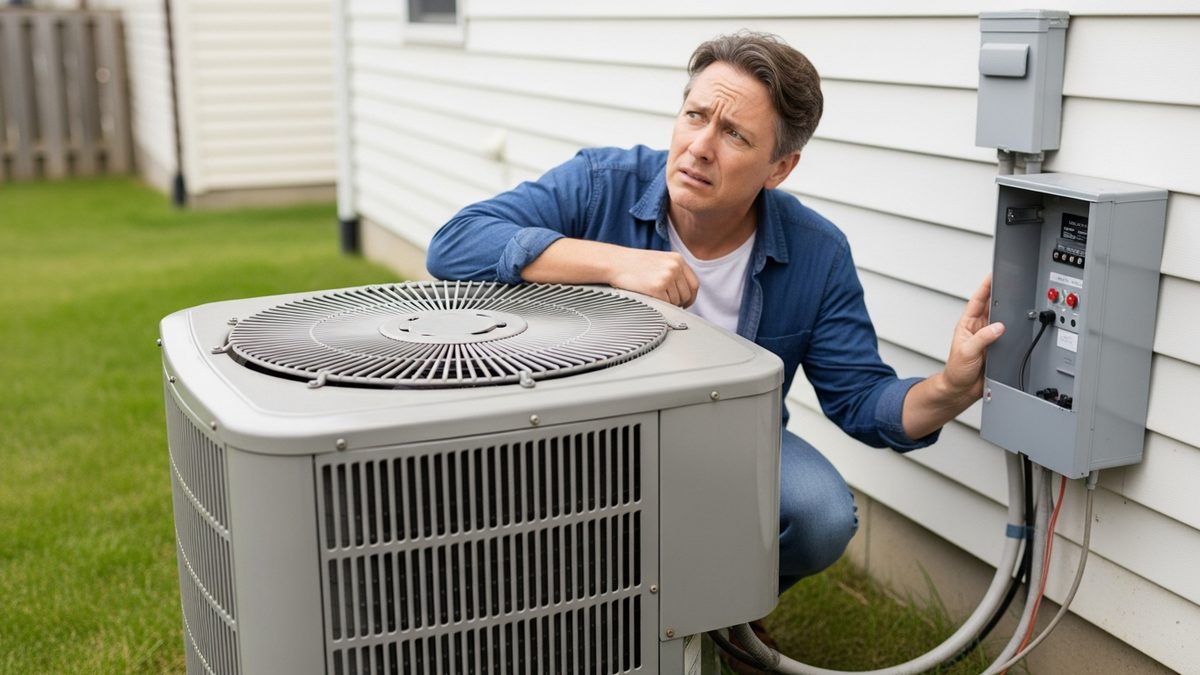
It's the hottest day of the summer, you walk over to bump the thermostat down, and the screen is completely dark. You check the outdoor unit — nothing. Indoor air handler — nothing. The whole system is silent. Before you panic or assume the worst, take a breath. A fully dead central AC is almost always caused by something upstream: a power problem, a tripped switch, or a safety device doing exactly what it was designed to do. This guide walks you through the most likely causes in plain language, what you can check yourself, and when it's time to hand it off to a pro.
Most likely causes
These are ranked from most to least likely when both the thermostat and the equipment are completely unresponsive.
-
Dead thermostat batteries or thermostat settings issue. If your thermostat runs on batteries, a blank screen is often nothing more than drained cells. Even hardwired thermostats can go dark if the indoor equipment has lost power — they draw their low-voltage operating power from the furnace or air handler, so when that unit goes down, so does the display.
-
Indoor unit lost power. Furnaces and air handlers have a wall-mounted power switch (it looks like a regular light switch) that is easy to bump off. They also have a door interlock — a small plunger safety switch hidden inside the access panel. If that panel isn't fully seated, the switch opens and cuts all power to the unit, which also kills the thermostat.
-
Tripped circuit breaker or blown fuse. Central air conditioning systems typically have two separate circuit breakers: one for the indoor unit and one for the outdoor condenser. Either one can trip after a power surge, a hot spell that strains the system, or a developing electrical fault. Older homes may have cartridge-style fuses at the outdoor disconnect box instead of breakers.
-
Condensate safety switch tripped. Many systems are fitted with a float switch in the drain pan or on the drain line. When condensate (the water the AC pulls from the air) backs up due to a clog, that switch cuts power to the system to prevent water damage to your ceiling or walls. If you see water near the indoor unit, this is a top suspect.
-
Clogged condensate drain line. The float switch above is the symptom; the clogged drain is usually the cause. Algae, sludge, and debris build up in the drain line over time and block the path water needs to exit the house.
-
Failed control components — transformer, low-voltage fuse, relay, or control board. Once the easy stuff is ruled out, a completely dead thermostat can mean the transformer that supplies 24-volt control power to the system has failed, or a low-voltage fuse on the control board has blown. This is a technician diagnosis, not a homeowner repair.
-
Bad capacitor. A failed start or run capacitor is one of the most common reasons an outdoor unit won't start — but it usually does not explain a blank thermostat. A capacitor problem more typically shows up as a humming outdoor unit that won't kick on while the thermostat is still alive. It's on this list because it can contribute to the overall no-start picture.
-
Failed contactor. The contactor is the electrical switch in the outdoor unit that lets power flow to the compressor and condenser fan. Like a bad capacitor, a failed contactor generally doesn't kill the thermostat — but it can prevent the outdoor unit from starting even when everything else looks fine.
-
A bigger electrical problem. Repeated breaker trips, scorched wiring, melted disconnect covers, or rodent damage can look like a simple "flip and reset" situation but may signal a serious fault. This is the category where small mistakes become fires.
Troubleshoot it yourself (safely)
Work through these steps in order — cheapest and easiest first, stopping before you ever need to open an energized compartment.
-
Check whether power is out more broadly. Are your lights on? Are neighbors affected? If there's a wider outage, this is a utility problem, not an HVAC problem yet.
-
Check the thermostat. Make sure it's set to COOL, the fan is set to AUTO, and the setpoint is below the current room temperature. If it runs on AA or 9V batteries, swap in fresh ones. If the thermostat wakes up and the system starts, you found it. If the display comes alive only on fresh batteries but goes blank again when you pull the batteries and rely on equipment power, that points to a loss of power from the furnace or air handler — keep going.
-
Check the indoor unit's power switch and access panel. Find the furnace or air handler (usually in a closet, utility room, basement, or attic). Look for a switch on the wall near it. Make sure it's in the ON position. Then check that the service access panel on the unit itself is fully closed and latched — if it's even slightly ajar, the door interlock opens and kills all power.
-
Check the circuit breaker panel. Open your home's main electrical panel and look for any breaker in the tripped position (partway between ON and OFF, or shifted slightly). If you find one, the DOE recommends waiting five minutes before resetting to let the system cool. Then reset it once, carefully. If it trips again immediately, stop — do not keep resetting it, and do not assume it's harmless.
-
Check the outdoor disconnect. Near the outdoor condenser, there should be a gray box on the wall — the disconnect. Make sure it's in the ON or closed position. If it has pull-out fuse blocks, and you're comfortable checking visually, look for obvious signs of heat damage, melting, or discoloration. If anything looks burned, leave it alone and call a pro.
-
Check the air filter. Pull the filter from the indoor unit or return-air grille. If it's gray and packed solid with dust, replace it. A severely restricted filter can cause a cascade of problems including frozen coils and shutdowns.
-
Look for water clues around the indoor unit. Shine a flashlight at the base of the unit, the drain pan, and (if it's in an attic) the ceiling below the emergency overflow pan. Wet spots, standing water, ceiling stains, or algae-green slime at the drain outlet all point to a condensate issue that likely tripped the float switch.
-
Clear the drain outlet if it's easily accessible. With the power to the system off at the breaker, use a wet/dry vacuum to suction the exterior end of the drain line (the pipe that exits through a wall or to the outside). You can also flush accessible areas with distilled white vinegar followed by clean water. If the drain outlet is inside an attic, behind a wall, or hard to reach safely, leave this to a pro.
-
Restore power and wait five minutes. There's a short anti-short-cycle delay built into most systems. Give it time. If the thermostat is now alive and the indoor blower runs but the outdoor unit stays silent, the problem has shifted to the outdoor side — power, capacitor, or contactor. If the thermostat is still blank, suspect a failed control transformer, low-voltage fuse, or control board.
-
Stop here. Anything beyond this point — testing live voltage, handling capacitors, diagnosing the control board, working on refrigerant — requires professional tools and training.
Safety first
Electrical shock is a real risk. Even "low-voltage" HVAC control wiring can surprise you, and the line-voltage side of the system (240V) can kill. OSHA notes that electrical work exposes people to shock, electrocution, fire, and arc-flash hazards. Don't open energized electrical compartments.
Capacitors can hold a lethal charge even when the power is off. Trane is direct about this: AC capacitors are high-voltage devices, and touching one without proper discharge training can cause serious injury or death. Don't touch the capacitor inside the outdoor unit — full stop.
Never keep resetting a tripped breaker. A breaker trip is the system telling you something is wrong. Repeatedly forcing it back on can cause a fire or damage equipment. Reset it once, cautiously. If it trips again, call a technician.
Don't bypass safety switches. Float switches and door interlocks exist for a reason. Defeating them removes a layer of protection against water damage or unsafe equipment operation.
Refrigerant is off-limits for DIY. Adding, removing, or testing refrigerant requires EPA Section 608 certification. Using the wrong refrigerant or venting any refrigerant is illegal and can cause injury, fire, or explosion.
When to call a licensed pro
Call a pro if any of the following are true:
- The breaker trips again after you reset it once
- A fuse blows a second time
- You see scorching, melting, or burn marks at any electrical component
- You smell burning insulation or plastic
- The thermostat stays blank even after fresh batteries and power checks
- There is standing water, ceiling stains, or active overflow from the drain pan
- The copper refrigerant lines are coated in ice
- The system is more than 15 years old and this is its second or third repair in recent memory
What needs a licensed pro regardless: Live-voltage testing inside equipment, replacing a capacitor or contactor, diagnosing a failed transformer or control board, cleaning an inaccessible evaporator coil, handling or charging refrigerant, and any repair on a system with repeated electrical faults.
Permits: Many jurisdictions require permits for HVAC replacement and related electrical work. Fairfax County, Virginia, for example, requires a mechanical permit for HVAC replacement or repair. Oak Creek, Wisconsin requires permits for installing or replacing residential air conditioners and mandates a licensed contractor for the work. Check with your local building department — don't assume a repair or replacement is permit-free.
What it typically costs
These are rough 2025–2026 U.S. consumer ranges, not quotes. Labor rates, emergency fees, system age, and regional code requirements can push costs in either direction.
| Item | DIY cost | Pro cost (parts + labor) |
|---|---|---|
| Thermostat batteries | $3–$9 | N/A |
| Air filter replacement | $5–$15 | Homeowner task |
| Drain line cleaning | Under $5 (vinegar + vac) | $75–$200 |
| Thermostat replacement | $15–$300 (unit only) | $100–$300 total |
| Capacitor replacement | $8–$45 (part only) | $200–$400 total |
| Contactor replacement | $15–$70 (part only) | $115–$320 total |
| Breaker replacement | $5–$20 (part only) | $100–$200 total (electrician) |
| Outdoor disconnect fuse | $10–$27 (part only) | Labor/diagnosis extra |
| General AC repair | — | $130–$2,000 depending on issue |
| Full central AC replacement | — | $3,000–$15,000+ installed |
Common mistakes to avoid
Jumping straight to "it must be the capacitor." When the thermostat is blank, the problem is almost always upstream — batteries, a tripped breaker, a door switch, an indoor power issue — not the outdoor unit. Start at the beginning.
Resetting the breaker over and over. One careful reset is reasonable; a second trip means stop and call. Continuing past that point turns a diagnosis problem into a fire hazard.
Missing the water clue. If there is water near the indoor unit or staining on a ceiling below an attic air handler, the float switch has probably saved you from water damage. Don't ignore it and start chasing thermostat problems.
Confusing fan-only mode with a working AC. If the thermostat fan is set to ON rather than AUTO, the blower will run even when the system isn't actually cooling. This can make things look more active than they are and send you down the wrong diagnostic path.
Opening the outdoor unit to poke around. Even with the disconnect pulled and the breaker off, capacitors can still hold a dangerous charge. Don't open the outdoor unit unless you have specific training.
How to prevent it
Most "totally dead" AC calls are preventable with consistent basic maintenance:
- Change the filter regularly — typically every 1–3 months, depending on your filter type and household. A choked filter is the root cause of frozen coils, reduced airflow, and added strain on every electrical component.
- Keep the condensate drain clear. Pour a cup of distilled white vinegar through the drain line service port every few months during cooling season, then flush with clean water. This discourages the algae growth that causes clogs and float-switch trips. (Some older guidance recommends diluted bleach — check with your installer for what works with your specific drain setup.)
- Give the outdoor unit room to breathe. Clear at least 2 feet of clearance around the condenser. Trim back shrubs, remove debris, and rinse the coil fins gently with a garden hose once a year.
- Schedule annual professional maintenance. A spring tune-up lets a technician check electrical connections, test capacitors and contactors, confirm refrigerant charge, and inspect safety switches before peak demand season — when an emergency call costs more and takes longer.
- Keep the access panel firmly in place. After any filter change or inspection, make sure the furnace/air-handler door is fully seated so the interlock switch stays closed.
FAQ
My thermostat screen is completely blank — is the AC broken? Not necessarily. A blank thermostat is most often caused by dead batteries (if battery-powered) or by the indoor furnace/air handler losing power. Check batteries, the indoor unit's wall switch, and the circuit breaker before concluding the thermostat or system has failed.
Can I reset the circuit breaker myself? You can try once, carefully, after waiting five minutes. If the breaker trips a second time, stop and call a technician. A recurring trip signals a fault in the system that needs diagnosis — forcing the breaker back on repeatedly risks fire and equipment damage.
Could a clogged drain line really shut the whole system down? Yes. Systems equipped with a condensate float or overflow switch will cut power to the cooling cycle — and sometimes the blower — when the drain backs up, specifically to prevent water damage. If you see moisture around the indoor unit or water stains on a ceiling below attic equipment, a clogged drain is a top suspect.
The outdoor unit is completely silent. Does that mean the capacitor failed? Not automatically. A silent outdoor unit can mean a tripped breaker, a blown fuse, an open disconnect, a float-switch shutdown, a bad contactor, or a control-power problem — not just a capacitor issue. In a "everything is dead" scenario, power and control problems rank higher than capacitor failure.
Can I replace the capacitor or contactor myself? This isn't recommended for most homeowners. Capacitors store high-voltage electrical energy and can discharge dangerously even when the power has been turned off. Both Trane and Carrier advise against DIY electrical repairs inside the AC system and recommend using a qualified technician.
How old is "too old" to repair? Trane puts the typical lifespan of a central air conditioner at around 15 years. If your system is approaching or past that mark and is racking up repair bills, a conversation about replacement often makes more financial sense than another fix — especially if the repair involves a major electrical or refrigerant component.
Get a free quote from a vetted pro near you
If your troubleshooting didn't turn up a simple fix — or you'd just rather hand this off to someone with the right tools and training — Local Service Group can connect you with a licensed HVAC professional in your area. Our network pros are vetted, and quotes are always free. Fill out the short form on our site and someone local will be in touch.
Sources
- U.S. Department of Energy, "Common Air Conditioner Problems" — https://www.energy.gov/energysaver/common-air-conditioner-problems
- U.S. Department of Energy, "Air Conditioner Maintenance" — https://www.energy.gov/energysaver/air-conditioner-maintenance
- Carrier, "AC Maintenance Guide" — https://www.carrier.com/us/en/residential/hvac-resources/air-conditioners/ac-maintenance/
- Carrier, "How to Clean AC Drain Line" — https://www.carrier.com/us/en/residential/hvac-resources/air-conditioners/how-to-clean-ac-drain-line/
- Carrier, "Understanding AC Capacitors" — https://www.carrier.com/us/en/residential/hvac-resources/air-conditioners/ac-capacitor/
- Carrier, "Air Conditioner Repair Details" — https://www.carrier.com/residential/en/us/products/air-conditioners/ac-repair/
- Carrier, "Central Air Conditioner Prices" — https://www.carrier.com/us/en/residential/hvac-resources/air-conditioners/prices/
- Carrier, "HVAC Replacement Cost" — https://www.carrier.com/us/en/residential/hvac-resources/hvac-replacement-cost/
- Carrier, "Thermostat Replacement Guide" — https://www.carrier.com/residential/en/us/products/thermostats/thermostat-replacement/
- Trane, "AC Not Turning On" — https://www.trane.com/residential/en/resources/troubleshooting/air-conditioners/ac-not-turning-on/
- Trane, "Air Conditioner Troubleshooting" — https://www.trane.com/residential/en/resources/troubleshooting/air-conditioners/
- Trane, "HVAC Air Handler Overflow Switch" — https://www.trane.com/residential/en/resources/troubleshooting/air-handlers/hvac-air-handler-overflow-switch/
- Trane, "Air Handler Not Turning On" — https://www.trane.com/residential/en/resources/troubleshooting/air-handlers/air-handler-not-turning-on/
- Trane, "Why Is My Thermostat Not Working?" — https://www.trane.com/residential/en/resources/troubleshooting/thermostat-controls/thermostat-not-working/
- Trane, "AC Capacitors: A Small Part with a Big Job" — https://www.trane.com/residential/en/resources/blog/air-conditioner-capacitors-what-they-are-and-why-theyre-such-a-big-deal/
- Trane, "How Long Do Air Conditioners Last?" — https://www.trane.com/residential/en/resources/troubleshooting/air-conditioners/how-long-do-air-conditioners-last/
- Honeywell Home / Resideo, "How do I fix a blank display on my TH2210DV/TH2110DV thermostat?" — https://www.honeywellhome.com/us/en/support/how-do-i-fix-a-blank-display-on-my-th2210dv-th2110dv-thermostat/
- Honeywell Home / Resideo, "Why won't my thermostat screen power up?" — https://www.honeywellhome.com/blogs/support/why-is-my-thermostat-screen-not-powering-up
- OSHA, "Electrical" — https://www.osha.gov/electrical
- OSHA, "Electric-Arc Flash Hazards" — https://www.osha.gov/electrical/flash-hazards
- U.S. EPA, "Section 608 Technician Certification Requirements" — https://www.epa.gov/section608/section-608-technician-certification-requirements
- U.S. EPA, "Stationary Refrigeration – Prohibition on Venting Refrigerants" — https://www.epa.gov/section608/stationary-refrigeration-prohibition-venting-refrigerants
- U.S. EPA, "Refrigerant Sales Restriction" — https://www.epa.gov/section608/refrigerant-sales-restriction
- U.S. EPA, "EPA Warning: Recharging Air Conditioners with Wrong Refrigerant Poses Injury and Fire Risks" — https://www.epa.gov/archive/epa/newsreleases/epa-warning-recharging-air-conditioners-wrong-refrigerant-poses-injury-and-fire-risks.html
- Fairfax County, Virginia, "Mechanical (MECHR) – Residential" — https://www.fairfaxcounty.gov/landdevelopment/permit-library/mechanical-residential
- Angi, "How Much Does AC Capacitor Replacement Cost? [2026 Data]" — https://www.angi.com/articles/how-much-does-it-cost-replace-ac-capacitor.htm
- Angi, "How Much Does an AC Contactor Replacement Cost? [2026 Data]" — https://www.angi.com/articles/ac-contactor-replacement-cost.htm
- Angi, "How to Clean an AC Drain Line Like a Pro" — https://www.angi.com/articles/how-clean-ac-drain-line.htm
- Angi, "2026 HVAC Repairs Cost" — https://www.angi.com/articles/how-much-hvac-repair-cost.htm
- Angi, "Cost to Replace Electrical Panel [2026 Data]" — https://www.angi.com/articles/cost-replace-circuit-breaker-box.htm
- HomeAdvisor, "How Much Does Thermostat Installation or Replacement Cost?" — https://www.homeadvisor.com/cost/heating-and-cooling/install-a-thermostat/
- Home Depot, AA batteries — https://www.homedepot.com/p/205587525
- Home Depot, 9V batteries — https://www.homedepot.com/p/202522012
- Home Depot, non-contact voltage tester — https://www.homedepot.com/p/329388239
- Home Depot, digital multimeter — https://www.homedepot.com/p/320822947
- Home Depot, 5-gallon wet/dry vacuum — https://www.homedepot.com/b/Garage-Shop-Vacuums-Wet-Dry-Vacuums/Wet-Dry-Vacuum/5-gal/N-5yc1vZc2f8Z1z1ph7oZ1z1szu6
- Home Depot, 1-inch MERV 8 filters — https://www.homedepot.com/b/Heating-Venting-Cooling-Air-Filters/16x25x1/MERV-8/N-5yc1vZc4kwZ1z199t4Z1z1w1z9/
- Walmart, distilled white vinegar — https://www.walmart.com/ip/10450998
- Lowe's, cartridge fuse — https://www.lowes.com/pd/Cooper-Bussmann-2-Pack-30-Amp-Time-Delay-Cartridge-Fuse/50054105
Disclaimer
The information on this page is provided for general educational purposes only and is offered "as is" and "as available," without warranties of any kind, whether express or implied — including, without limitation, any warranties of accuracy, completeness, reliability, merchantability, or fitness for a particular purpose. It is not professional advice and is not a substitute for inspection, diagnosis, or repair by a licensed, qualified professional.
Home systems involving gas, electricity, water, refrigerant, fire, or structural components can be hazardous, and requirements vary by local code and jurisdiction. Any inspection, diagnosis, repair, installation, or other action referenced on this page should be performed by a licensed professional. You should not rely on this content to perform such work yourself. To the fullest extent permitted by law, [Company Name] and its owners, employees, and contributors assume no responsibility or liability for any injury, death, property damage, or other loss arising out of or in connection with the use of, or reliance on, this information.
If you smell gas or suspect a carbon monoxide leak, leave the area immediately and call 911 or your gas utility from a safe location.