Do I Need a Panel Upgrade? Signs Your Electrical Panel Is Overloaded
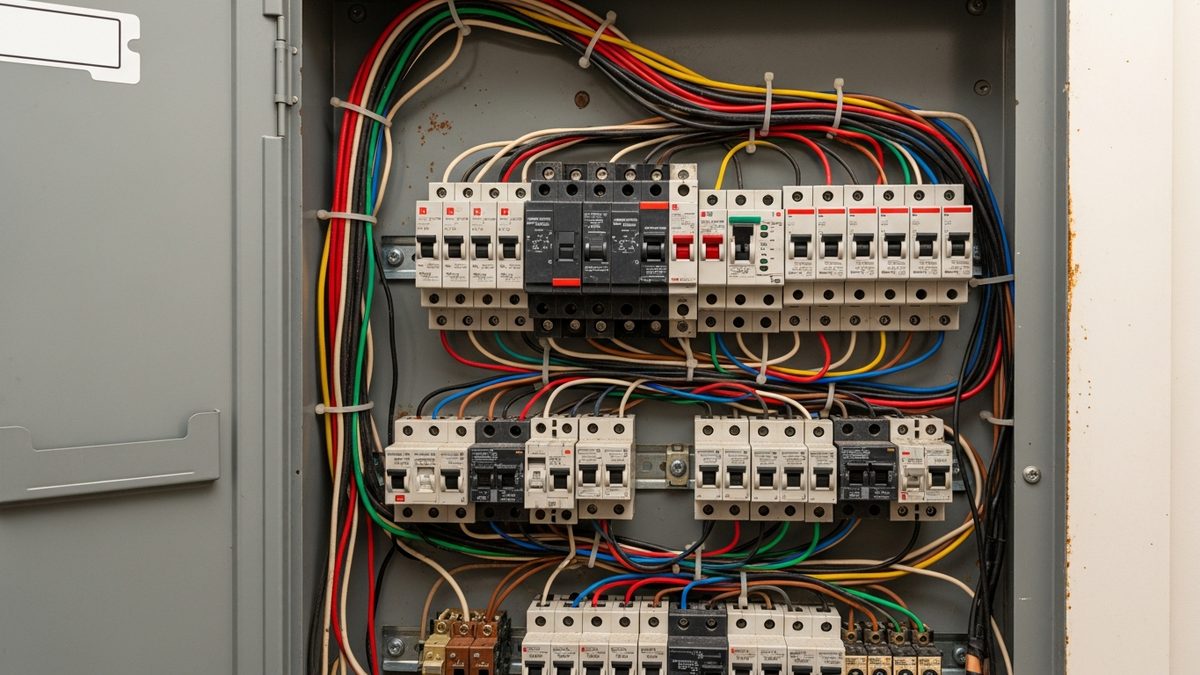
Your electrical panel splits incoming power into individual circuits and protects each one with a breaker. When it is sized right, you never think about it. When it isn't, the warning signs come fast — and some are serious safety hazards. Here is what to look for.
Signs your panel may need an upgrade
Breakers trip often. A breaker that trips now and then is doing its job. One that keeps tripping on the same circuit without an obvious cause means that circuit regularly overloads. Resetting the same breaker repeatedly is a signal, not a fix.
You rely on power strips and extension cords. Every device on a daisy-chained strip shares one breaker. A TV, gaming console, space heater, and lamp all on a single 15-amp circuit is a recipe for overheating. The Electrical Safety Foundation International (ESFI) recommends adding circuits rather than relying on extension cords long-term.
Lights dim when a big appliance starts. If lights flicker when the AC kicks on or the washer spins up, the panel is stretched. Large motors draw a surge at startup that an undersized panel can't supply without a voltage dip.
The panel is warm, buzzing, or smells hot. The outside of the cover should feel cool. Warmth is a warning. A buzzing electrical panel can point to loose connections or an arcing breaker. A burning smell is an emergency — call a licensed electrician immediately. ESFI estimates home electrical fires cause roughly 51,000 fires per year in the US, nearly 500 deaths, and $1.3 billion in property damage.
You have 60-amp or 100-amp service. Homes built before the 1970s often got 60-amp service; homes through the early 1990s frequently got 100-amp service. With central air, electric ranges, home offices, and EV chargers all competing for power, 100 amps is often not enough. The NEC and most electrical professionals point to 200-amp service as today's benchmark for a typical single-family home.
You still have a fuse box. Fuse boxes predate modern circuit breakers, cannot be easily expanded, and are a red flag for home insurers. A modern breaker panel is the only practical path forward.
You are adding an EV charger, heat pump, hot tub, or an addition. A Level 2 EV charger needs a dedicated 50-amp circuit; a heat pump or hot tub can require 60 amps or more. A licensed electrician will run a load calculation first, and the existing service often cannot handle the added demand.
You have a Federal Pacific, Zinsco, or other known problem panel. FPE Stab-Lok panels and Zinsco panels from the 1970s–80s have well-documented safety issues. Licensed contractors report FPE breakers can fail to trip during an overload, and Zinsco breakers have been known to weld to the bus bar so "off" does not cut power. The CPSC has previously investigated FPE's Stab-Lok breakers. If you have either brand, have it inspected — do not wait for symptoms.
What "overloaded" really means
Every panel has an amperage rating — 60A, 100A, 200A, or higher — and your home's total electrical demand must stay within it. When demand exceeds that limit, breakers are supposed to trip. An aging or faulty panel may not trip when it should, letting wiring overheat inside walls, which is a leading cause of electrical fires.
The NEC sets minimum installation standards adopted by most US jurisdictions. While the NEC does not mandate 200-amp service in every existing home, 200 amps is the standard for new construction and major renovations. All panel work must be permitted and pass inspection by your local authority having jurisdiction (AHJ) before power is restored.
What you can safely check (and not)
You can safely: look at the outside of the cover for scorch marks, rust, or corrosion; listen for buzzing; smell for any burning odor; and read the label inside the door for the brand and amperage rating.
Never open the panel cover, touch wiring inside, or try to add a breaker. Even with the main breaker off, the service entrance wires stay energized. Only the utility can de-energize those conductors.
Safety first
The interior of your panel carries 120 or 240 volts at potentially hundreds of amps — enough for a fatal shock in a fraction of a second. Loose connections can also cause an arc flash, a burst of intense heat. Warmth, buzzing, scorch marks, or a burning smell all warrant a call to a licensed electrician. Sparks or active burning are an emergency.
What a panel upgrade involves
- Load calculation. The electrician tallies demand from all existing and planned circuits to size the service correctly.
- Permit. Required before work begins in virtually every jurisdiction. Unpermitted electrical work can void insurance and cause problems at resale.
- Utility coordination. The utility disconnects power at the meter; this must be scheduled in advance.
- New panel and meter base. The old panel is removed and a new one installed, often with a new meter base and updated grounding.
- Inspection. A local inspector verifies code compliance before power is restored.
A full upgrade typically takes one to two days.
What it typically costs
Based on 2025-2026 industry pricing:
- 100-amp to 200-amp upgrade: roughly $1,300 to $3,500 for most homes; higher-cost markets can run beyond that
- Full service upgrade including new meter base and service entrance conductors: $2,500 to $5,000 or more
- Panel replacement in kind (same amperage, faulty panel replaced): $1,000 to $2,500
Your actual quote depends on home age, distance from meter to panel, permit fees, and utility coordination. Get at least two quotes from licensed electricians before committing.
Repair vs. upgrade
A single faulty breaker or loose connection can often be repaired without a full replacement — but only if the panel is properly sized, in good condition, and not a known problem brand. If your panel is 30 or more years old, undersized, or from a brand with documented issues, a full upgrade is the smarter investment. A repaired 40-year-old 100-amp panel is still a 40-year-old 100-amp panel.
FAQ
How do I know what size panel I have? Open the outer door covering the breaker handles. The amperage is printed on a label inside that door or stamped on the main breaker.
Can I add a subpanel instead of upgrading? A subpanel adds circuit slots but does not increase total service amperage. If your main panel is already near capacity, a subpanel alone will not solve the problem.
Will a panel upgrade raise my home's value? Generally yes. An outdated or undersized panel can be flagged during a home inspection, giving buyers leverage to negotiate the price down.
My panel is Federal Pacific — is it definitely dangerous? The CPSC investigated FPE's Stab-Lok breakers, and independent testing found elevated failure rates. Most electrical professionals recommend an inspection and, in most cases, replacement.
Do I need to be home during the upgrade? Be available when the utility disconnects and reconnects power and for the final inspection walkthrough; you do not need to be present the entire time.
If any of these signs sound familiar, the next step is a phone call — not a DIY project. A licensed electrician can inspect your panel, run a load calculation, and tell you what your home needs.
Get a free quote from a licensed electrician near you. Local Service Group connects homeowners with vetted electrical contractors — no obligation.
Sources
- Home Electrical Fires — Electrical Safety Foundation International (ESFI)
- Don't Overload Your Home — ESFI
- Commission Closes Investigation of FPE Circuit Breakers — U.S. Consumer Product Safety Commission (CPSC)
- Schneider Electric Recalls 1.4 Million Electrical Panels — CPSC
- NEC Requirements for Panelboards and Load Centers — Electrical Technology
- 200-Amp Panel Upgrade Cost 2026 — Vons Electric
- Cost to Upgrade Electrical Panel — This Old House
Disclaimer
The information on this page is provided for general educational purposes only and is offered "as is" and "as available," without warranties of any kind, whether express or implied — including, without limitation, any warranties of accuracy, completeness, reliability, merchantability, or fitness for a particular purpose. It is not professional advice and is not a substitute for inspection, diagnosis, or repair by a licensed, qualified professional.
Home systems involving gas, electricity, water, refrigerant, fire, or structural components can be hazardous, and requirements vary by local code and jurisdiction. Any inspection, diagnosis, repair, installation, or other action referenced on this page should be performed by a licensed professional. You should not rely on this content to perform such work yourself. To the fullest extent permitted by law, [Company Name] and its owners, employees, and contributors assume no responsibility or liability for any injury, death, property damage, or other loss arising out of or in connection with the use of, or reliance on, this information.
If you smell gas or suspect a carbon monoxide leak, leave the area immediately and call 911 or your gas utility from a safe location.