Buzzing Sound From Your Electrical Panel: Is It Dangerous?
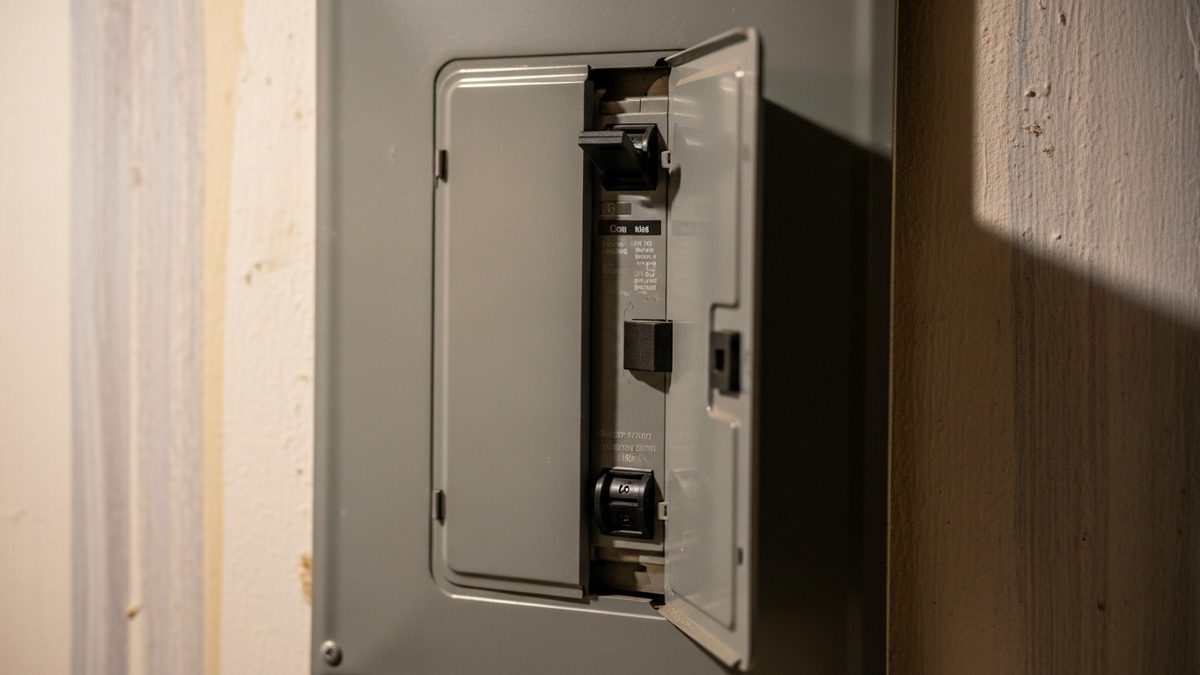
If your breaker panel is making a buzzing or humming sound, here's the short answer: a faint, steady hum is usually harmless. Loud buzzing, crackling, sizzling, or a hum paired with a burning smell or warm cover is not normal and needs professional attention today.
Is a buzzing electrical panel dangerous?
It depends on the sound.
A faint, low-pitched hum is often normal. Electricity flowing through breakers and wiring naturally produces some vibration and noise. If a large appliance like an air conditioner or electric dryer is running, the panel may hum slightly more than usual. This kind of soft, steady sound that's only noticeable when you're standing right next to the panel is generally nothing to worry about.
Loud buzzing, crackling, or sizzling is a different story. These sounds can indicate an active electrical fault — a failing breaker, a loose connection, or arcing. Arcing is when electricity jumps across a gap or a damaged connection instead of flowing cleanly through the wire. According to the Electrical Safety Foundation International (ESFI), arcing faults start more than 30,000 home fires in the United States every year, causing hundreds of deaths and injuries and over $700 million in property damage.
The U.S. Consumer Product Safety Commission (CPSC) explicitly lists "sizzles/buzzes" as a warning sign for the electrical panel section of a home. If that sound is loud, irregular, or accompanied by any other symptom, treat it as a hazard until proven otherwise.
Warning signs that mean act now
Stop what you're doing and call a licensed electrician if you notice any of the following alongside the buzzing:
- Loud, persistent buzzing — noticeably louder than a faint background hum, or a buzzing you can hear from a few feet away
- Crackling or sizzling sounds — these suggest electricity is arcing or jumping across a gap, which generates intense heat
- A burning smell near the panel — the CPSC identifies odors from overheated wiring insulation as a specific danger sign; heated or burning wires have a sharp, acrid smell
- A panel cover that feels warm or hot to the touch — parts of your electrical system can run warm, but should never be painful to touch
- Scorch marks, discoloration, or melting — any visible blackening or burn marks on the panel face, individual breakers, or nearby wall is a serious red flag
- Lights flickering — particularly if tied to a specific circuit, can signal an unstable connection inside the panel
If you notice a burning smell, visible smoke, or sparks, treat this as a potential emergency. See the next section.
Also see: a breaker that keeps tripping or a hot or burning-smelling outlet — both can share the same underlying causes as a noisy panel.
What to do right now
Do not open the panel cover. This is the most important rule. See the section below for why.
Here's what you can and should do:
-
Stay calm and assess from outside the panel. Look for scorch marks, smell for burning, and place the back of your hand near (not on) the panel cover to check for heat. Do not touch the panel directly.
-
If you smell burning, feel unusual heat, see smoke, or hear crackling — treat it as an emergency. Turn off the main breaker if you can do so safely using only the front-mounted handle, without reaching inside or touching anything other than the main switch. Then leave the area, call a licensed electrician immediately, and call 911 if there is any sign of fire or smoke.
-
Stop using circuits that seem affected. If lights on a particular circuit are flickering or a breaker is making noise, turn off devices on that circuit and avoid using it until a professional has inspected the panel.
-
Do not keep resetting a tripping breaker that is paired with buzzing, heat, or a burning smell. The CPSC specifically cautions homeowners against repeatedly resetting a breaker without finding the underlying cause.
-
Schedule a professional inspection as soon as possible — even if the sounds are subtle. A licensed electrician can safely remove the panel cover and diagnose faults that are invisible from the outside.
What causes panel buzzing
Several things inside a panel can produce buzzing or humming:
Failing or loose breaker. A breaker that is worn out, damaged, or not fully seated can vibrate when current flows through it, producing a buzzing sound that may worsen under load. A bad breaker can also allow more heat than the circuit is rated for.
Loose neutral or ground connection. The neutral bus bar inside the panel connects the white wires that return current to the source. A loose connection at this bar — or at any wire terminal — can cause electrical resistance, heat buildup, and arcing. Loose connections are a leading cause of arc-related panel fires.
Overloaded circuit. When a circuit is pushed beyond its rated capacity, the breaker may buzz or hum as it approaches its trip threshold. Chronic overloads wear out breakers faster.
Arcing. This is the most serious cause. As the CPSC notes, an arc fault is a high-power discharge of electricity across a gap in the wiring or at a loose connection. The heat generated by arcing can ignite nearby materials before a standard breaker detects a problem. Crackling or sizzling sounds coming from a panel are often the sound of arcing.
Transformer hum from the utility service. Occasionally, a steady 60Hz hum originates from the utility transformer feeding your home rather than from the panel itself. This is normal — but it can mask other sounds. If you're unsure, an electrician can tell the difference.
Why you should never open the panel yourself
Even with the main breaker switched off, electrical panels are not safe to open without training and proper equipment.
The CPSC states directly: "The installation involves working within electrical panel boxes that are usually electrically live, even with the main circuit breakers turned off." The lines coming into your home from the utility company remain energized at all times — only the utility can disconnect that power.
OSHA confirms that arc flash temperatures can exceed 35,000 degrees Fahrenheit — nearly four times the temperature of the sun's surface. Critically, OSHA also notes that arc flash danger does not require high voltage: even a 120/208-volt residential system can create an arc flash with enough energy to cause fatal burns or ignite clothing. A dropped tool, a slipped hand, or a momentary contact between the wrong parts is all it takes to trigger an arc.
This is not a job for a homeowner, regardless of experience.
When to call a licensed electrician
Call a licensed electrician if any of the following apply:
- The buzzing or humming is loud, irregular, or has gotten worse
- You hear crackling, sizzling, or popping from the panel
- You smell burning near the panel at any time
- The panel cover feels warm or hot
- You see scorch marks or discoloration on or around the panel
- Lights are flickering and a panel sound accompanies it
- A breaker keeps tripping alongside any of the above symptoms
- Your home is 40 or more years old and the panel has never been inspected — the CPSC recommends inspection for homes that age
Do not wait for a "more convenient" time. Arcing and overheating conditions can cause a fire before any visible sign appears.
How to prevent it
You cannot prevent all panel issues, but you can reduce risk:
- Don't overload circuits. Running too many high-draw devices on the same circuit stresses both the wiring and the breaker. If a circuit trips repeatedly, the right fix is a dedicated circuit — not resetting it indefinitely.
- Get a professional panel inspection every 10 years, or after any major home renovation, appliance addition, or water exposure. ESFI recommends inspections for older homes and any home with a history of electrical problems.
- Ask your electrician about AFCI protection. Arc-fault circuit interrupters are designed to detect the kind of low-level arcing that standard breakers miss. The CPSC has noted that AFCIs can help prevent a significant share of electrical fires. They should be installed by a licensed electrician.
- Test AFCI and GFCI breakers monthly. Use the test button on the device itself. Protection that has silently failed provides no protection at all.
- Have smoke detectors on every level. ESFI reports that 65 percent of home fire deaths happen in homes without working smoke detectors. Early warning is your last line of defense if a panel fault does start a fire.
FAQ
Q: My panel makes a soft hum. Should I be worried?
A: A faint, steady hum that you can only hear right next to the panel — especially when a large appliance is running — is usually normal electrical vibration. If the hum is loud enough to hear across the room, has changed recently, or comes with any other symptom (heat, odor, flickering lights), have it checked by a licensed electrician.
Q: My breaker is buzzing but not tripping. Is that safe?
A: Not necessarily. A buzzing breaker that isn't tripping may indicate a failing breaker that is no longer opening the circuit when it should, or a loose connection that is generating heat and noise without drawing enough fault current to trip. Both scenarios are worth a professional evaluation. A breaker that fails to trip is more dangerous than one that trips too often.
Q: What does arcing in a panel sound like?
A: Arcing typically sounds like crackling, sizzling, or rapid popping — similar to the sound of a damp log burning in a fire. It may be intermittent. Any crackling or sizzling from a panel should be treated as an emergency.
Q: Can I turn off the main breaker myself to make the panel safe?
A: You can shut off the main breaker using the front-mounted handle, and doing so cuts power to most of the panel. However, the wires feeding into the top of the main breaker from the utility are always energized. Flipping the main breaker does not make the inside of the panel safe to open. Only a licensed electrician or your utility company can make those lines safe.
Q: Should I call 911 or an electrician first?
A: If there is smoke, visible flames, or a burning smell you cannot localize and eliminate immediately — call 911 first, evacuate, and then call an electrician. If the situation is a buzzing sound or warmth without active fire or smoke, call a licensed electrician as an urgent, same-day matter.
Get a free quote from a vetted local electrician
Buzzing, crackling, burning smells, or a warm panel cover are not problems to put off. Electrical panel faults can cause fires that start behind walls — often with no warning until damage is already done.
Local Service Group connects homeowners with licensed, vetted electricians in their area. There is no fee to request a quote. Get a free estimate from a qualified local pro today.
Sources
-
U.S. Consumer Product Safety Commission. CPSC Guide to Home Wiring Hazards. https://www.cpsc.gov/s3fs-public/518.pdf
-
U.S. Consumer Product Safety Commission. Preventing Home Fires: Arc Fault Circuit Interrupters (AFCIs). https://www.cpsc.gov/s3fs-public/5133(1).pdf
-
Electrical Safety Foundation International. Home Electrical Fires. https://www.esfi.org/home-electrical-fires/
-
Electrical Safety Foundation International. Arc-Fault Circuit Interrupters (AFCIs): Prevent Electrical Fires. https://www.esfi.org/arc-fault-circuit-interrupters-afcis-prevent-electrical-fires/
-
Occupational Safety and Health Administration. Electrical: Electric-Arc Flash Hazards. https://www.osha.gov/electrical/flash-hazards
Disclaimer
The information on this page is provided for general educational purposes only and is offered "as is" and "as available," without warranties of any kind, whether express or implied — including, without limitation, any warranties of accuracy, completeness, reliability, merchantability, or fitness for a particular purpose. It is not professional advice and is not a substitute for inspection, diagnosis, or repair by a licensed, qualified professional.
Home systems involving gas, electricity, water, refrigerant, fire, or structural components can be hazardous, and requirements vary by local code and jurisdiction. Any inspection, diagnosis, repair, installation, or other action referenced on this page should be performed by a licensed professional. You should not rely on this content to perform such work yourself. To the fullest extent permitted by law, [Company Name] and its owners, employees, and contributors assume no responsibility or liability for any injury, death, property damage, or other loss arising out of or in connection with the use of, or reliance on, this information.
If you smell gas or suspect a carbon monoxide leak, leave the area immediately and call 911 or your gas utility from a safe location.