Whole-House Power Surge After a Flicker? Protecting Your Electronics
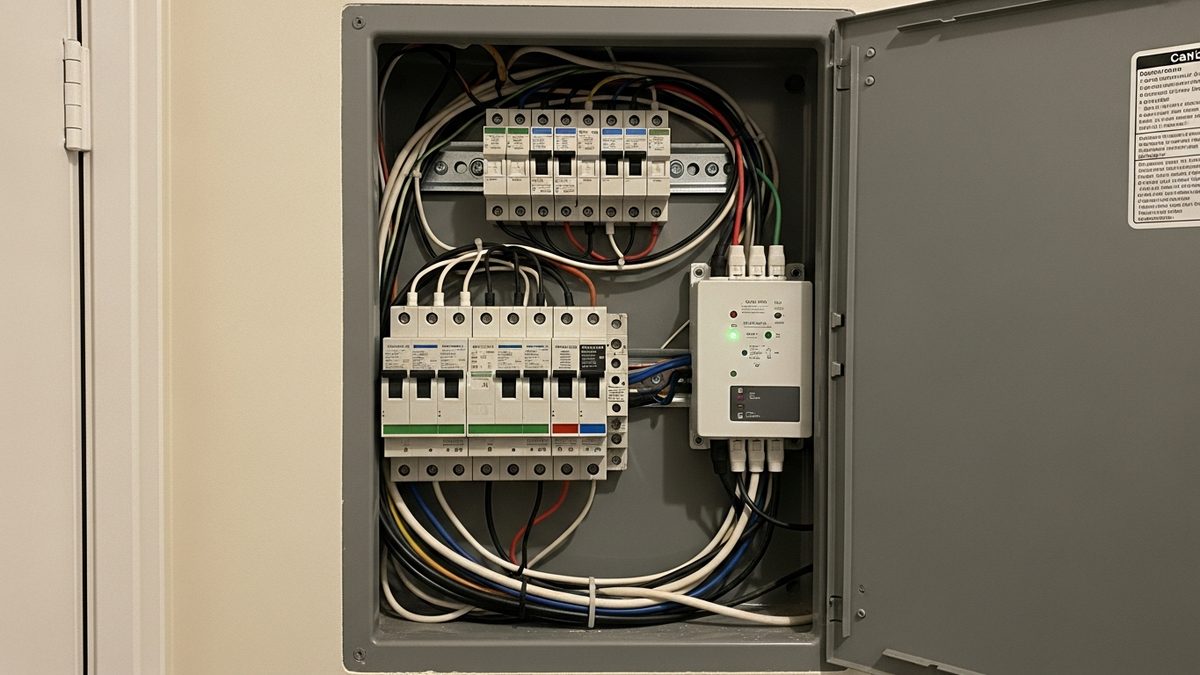
The lights flicker, something buzzes, and then you notice the microwave clock is blank, the router is dead, and your TV will not turn on. Or things keep working but several appliances start acting strange over the next few days. What you likely experienced is a whole-house power surge — a sudden, brief spike in voltage that can damage or destroy electronics, appliances, and even wiring.
Some surges are minor and harmless. Others — especially those caused by a "lost neutral" from your utility feed — can push voltages well above 240 volts onto circuits designed for 120 volts, frying everything connected to them within seconds. Knowing what happened and what to do next can save you thousands of dollars in equipment and repairs.
Most likely causes, ranked
1. Utility events — switching and grid activity
The most common source of surges is the power utility itself. When the grid switches between power sources, a substation fails and reconnects, or high-demand equipment comes on and off the line, a voltage spike travels through the distribution system and into homes. These are usually brief and moderate, but they happen frequently — according to a 2024 survey by the Electrical Safety Foundation International (ESFI), 73% of commercial and industrial facilities experienced a surge event, and residential homes face similar exposure.
2. A downed power line or transformer event nearby
A tree branch falling on a line, a car hitting a utility pole, or a transformer blowing can send a large surge into nearby homes before the utility's protective equipment responds. These events are often local — your neighbors may be affected too. Check your utility company's outage map.
3. Lost neutral — the most dangerous cause
This is the scenario that causes the most severe damage. Your home receives power as a 240-volt "split phase" system: two 120-volt legs (L1 and L2) with a neutral wire balancing them. If that neutral wire is lost or broken — due to corrosion on the underground service cable, a damaged connection at the utility transformer, or a broken connection at the weatherhead where wires enter your home — the voltage balance collapses.
When the neutral is lost, the two legs no longer share voltage equally. Instead, voltage redistributes based on the resistance of whatever is plugged in. Lights and low-wattage devices on one leg can see voltages well above 120 volts — sometimes reaching 200 volts or more — while devices on the other leg get almost nothing. The result: light bulbs glow extremely bright and then burn out, one half of your home seems to lose power while the other acts strangely, and sensitive electronics can be destroyed in seconds.
A lost neutral is a utility-side emergency. If lights in your home are wildly different brightnesses, if some devices are destroying themselves while others have no power, or if you hear a loud buzzing from lights or appliances, shut off your main breaker and call your utility immediately. Do not attempt to restore power until the neutral is confirmed repaired.
For more on what happens when half the house loses power, see our guide on half the house lost power.
4. Large appliances cycling on inside your home
Air conditioners, refrigerators, well pumps, and similar large motors create small internal surges every time they start up. These "internal surges" are low-level — rarely enough to damage a well-protected device — but over months and years they degrade unprotected electronics. The ESFI notes that fuses, breakers, GFCIs, and ordinary power strips do not protect against these surges.
5. Lightning
A direct lightning strike near your home is the most extreme surge scenario. Lightning carries enormous energy and can travel through electrical lines, phone lines, cable TV lines, and even plumbing. Even a nearby strike that does not directly hit your home can induce a surge large enough to damage electronics. No surge protector eliminates lightning risk entirely, but a properly installed whole-house surge protector dramatically reduces the damage.
Signs electronics were damaged by a surge
- Devices that were on during the event no longer power up
- Devices that power on but behave erratically or display unusual error messages
- A burning smell from an outlet, power strip, or device
- Appliances that "work" but have internal components (like a compressor or motor) that are now louder or less efficient
- Smart home devices, modems, or routers that are dead even though they appear undamaged externally
- HVAC equipment that runs but does not heat or cool properly — the control board may have been damaged
What to do right now
1. Document everything immediately. Before unplugging or discarding anything, take photos or video of every device that was affected. Note what was on during the event and what was plugged in. You will need this for insurance claims and for the electrician's diagnosis.
2. Check for burning smells or visible damage. Walk through the house and smell outlets, power strips, and devices. Look for scorch marks on outlet faceplates. If you find any, do not restore power to those circuits — turn off the relevant breakers and call an electrician.
3. Assess the nature of the surge. If only one circuit or room was affected, a circuit-level event (like a tripped GFCI or a single bad appliance) is more likely. If the entire house was affected — especially if lights were unusually bright before things went dark — a utility-side event including a possible lost neutral is more likely. Call your utility if you suspect the latter.
4. Reset breakers carefully. After a major surge, some breakers may have tripped. Before resetting them, unplug or turn off sensitive electronics. Reset breakers one at a time and watch for any sparking, unusual sounds, or devices that seem to be acting wrong.
5. Contact your homeowner's insurance. Surge damage is often covered under homeowner's insurance policies, subject to your deductible. Document damage before discarding anything.
Safety first — when to STOP and call a pro
- Any burning smell from outlets, wiring, or the electrical panel. This is a fire hazard. Turn off the affected circuit at the panel and call an electrician.
- Lights that were extremely bright during the event. This is a classic lost-neutral signature. Shut off the main breaker and call your utility immediately.
- Appliances or outlets that feel hot after the event. Indicates possible ongoing arcing or damaged wiring. Circuit off, call an electrician.
- Visible damage to the weatherhead (the entry point where the utility lines connect to your home) or the meter base. This is utility territory — do not touch it; call the utility.
- Any outlet or panel that sparks, buzzes, or makes unusual sounds after the event. Turn off power to that area and call an electrician.
When to call a licensed electrician vs. your utility
Call your utility if:
- Neighbors also lost power or had flickering during the same event
- Your meter or weatherhead shows visible damage
- You suspect a lost neutral (extreme voltage swing, lights going very bright)
- The utility's outage map shows an event in your area
- You smell something burning outside near the service entrance
Call a licensed electrician if:
- Outlets, wiring, or the panel show any sign of damage after the event
- A breaker won't stay on after you reset it
- You want to have your whole-home wiring assessed for damage
- You want to install a whole-house surge protective device (Type 2 SPD)
- Internal appliances or HVAC equipment are behaving differently post-surge
How to protect your home going forward
Whole-house surge protector (Type 2 SPD)
A whole-house surge protective device is mounted at or inside your main electrical panel. According to the 2020 National Electrical Code (NEC section 230.67), any new dwelling unit service installation now requires a Type 1 or Type 2 SPD. The ESFI is direct: ordinary power strips, GFCIs, fuses, and breakers do not protect against surges.
A Type 2 SPD intercepts voltage spikes before they travel to your outlets. Look for a UL 1449-listed device rated for at least 40 kA per mode. Installation takes about two hours for a licensed electrician. Cost ranges from $70 to $700 for the unit, with labor bringing the all-in cost to an average of $300 (typical range $70–$700, per HomeAdvisor 2025 data).
Point-of-use surge protectors
Whole-house protection does not eliminate the need for point-of-use surge protectors at sensitive equipment. Think of it as two lines of defense: the whole-house device absorbs the bulk of a surge, and the point-of-use strip handles whatever gets through.
For televisions, computers, home theater equipment, and smart home hubs, use a surge protector strip with a clamping voltage of 400 volts or lower and a joule rating of 1,000 or more. Look for UL 1449 listing. Budget strips from discount stores often provide little real protection — the UL 1449 label is the key qualifier.
Replace point-of-use surge protectors every three to five years, or sooner after a major surge event. Surge protectors have a finite capacity to absorb energy; after a big hit, they may look functional but provide no real protection.
What it typically costs (2025–2026)
- Whole-house Type 2 SPD installation: $70–$700 for the unit; all-in average $300, typical range $70–$700 (HomeAdvisor, 2025)
- Licensed electrician labor: $50–$100/hour; whole-house SPD installation typically takes 1–2 hours
- Point-of-use surge protector strips: $20–$80 for a quality UL 1449-listed strip; avoid sub-$15 strips for valuable equipment
- Electrical inspection after a surge event: $100–$400 (HomeAdvisor 2025 data for electrical inspection)
Common mistakes
Relying only on a power strip. A standard power strip is just a multi-outlet extension cord. Even strips labeled "surge protector" vary wildly in actual protection. The only meaningful qualification is UL 1449 listing with a stated joule rating and clamping voltage.
Not replacing surge protectors after a major event. A surge protector that absorbed a large spike is likely depleted. It may light up and pass power just fine, but provide zero protection going forward. If you had a significant surge event, replace point-of-use protectors.
Assuming the utility is responsible for damage. Utility companies have varying liability policies for surge damage caused by their equipment. File a claim, but do not assume you will be compensated. Homeowner's insurance is often the better path, and a whole-house SPD prevents the damage in the first place.
Waiting to install a whole-house SPD. The NEC now requires them in new construction, and for good reason. Retrofitting one onto an existing panel is a straightforward two-hour job for an electrician. Waiting until after a surge event means the damage is already done.
Not checking the panel after a surge event. A surge can damage wiring and circuit breakers silently — no smoke, no obvious sign. If you had a significant whole-house event, having an electrician check the panel and main wiring is worth the cost.
How to prevent it
- Install a whole-house Type 2 SPD at your main panel. This is the single most effective step.
- Use quality point-of-use surge protectors (UL 1449 listed, 1,000+ joules) for TVs, computers, and home theater equipment.
- Unplug sensitive equipment during thunderstorms if you live in a lightning-prone area. Even the best surge protectors have limits.
- Have your service entrance inspected every 10–15 years. Corroded neutral connections at the weatherhead or meter base are a common cause of lost-neutral events.
- Check that your utility provides a good ground. A proper ground path is what allows a surge protector to do its job. An electrician can verify your grounding system is adequate.
FAQ
Q: Can a power surge damage my HVAC system?
A: Yes. HVAC systems have electronic control boards, variable-speed motors, and compressors that are all vulnerable to surge damage. In fact, HVAC equipment is one of the more expensive surge casualties because control board replacement can cost several hundred dollars, and a damaged compressor can cost thousands. A whole-house SPD protects these hardwired systems; point-of-use strips do not reach them.
Q: How do I know if my surge protector is still working?
A: Most quality surge protector strips have an indicator light that goes out when the surge protection has been depleted. If the indicator is off or the strip lacks one, replace it if it is more than three to five years old or if it has been through a known surge event.
Q: Should I call my utility or an electrician first after a big surge?
A: If neighbors were also affected, or if you suspect a utility-side problem (lost neutral, downed line, transformer issue), call the utility first — they need to fix their equipment before anything inside your home can be safely evaluated. Once the utility confirms their feed is normal, an electrician can assess your home's wiring and panel.
Q: Does homeowner's insurance cover surge damage?
A: Many standard homeowner's policies cover sudden and accidental damage from a power surge, subject to the deductible. Some policies exclude certain electronics or require separate riders. Review your policy and file a claim promptly — document everything with photos before discarding any damaged equipment.
Q: What is the difference between a Type 1 and Type 2 surge protector?
A: A Type 1 device is installed on the supply side of the main breaker, before power even reaches your panel — it provides the highest level of external surge protection and is typically installed by the utility or at service entry. A Type 2 device is installed at or inside the main panel and is the standard whole-house option for residential retrofits. For most homeowners adding surge protection after the fact, a Type 2 device is the practical and code-compliant choice.
Get a free quote
Whether you want a whole-house surge protective device installed, need a post-surge electrical inspection, or have appliances that are acting strangely after a recent flicker, a licensed electrician can help. Get a free, no-obligation quote from a vetted pro in your area today.
Sources
- Electrical Safety Foundation International — Surge Protective Devices: https://www.esfi.org/program/surge-protective-devices/
- Electrical Safety Foundation International — Surge Protective Devices: Benefits and Misconceptions (2024 Survey): https://www.esfi.org/surge-protective-devices-survey-benefits-misconceptions/
- Electrical Safety Foundation International — Home Electrical Fires: https://www.esfi.org/home-electrical-fires/
- HomeAdvisor — How Much Does a Whole-House Surge Protector Cost? [2025 Data]: https://www.homeadvisor.com/cost/electrical/whole-house-surge-protector/
- National Fire Protection Association — Electrical Home Fire Safety: https://www.nfpa.org/education-and-research/home-fire-safety/electrical-safety-in-the-home
Disclaimer
The information on this page is provided for general educational purposes only and is offered "as is" and "as available," without warranties of any kind, whether express or implied — including, without limitation, any warranties of accuracy, completeness, reliability, merchantability, or fitness for a particular purpose. It is not professional advice and is not a substitute for inspection, diagnosis, or repair by a licensed, qualified professional.
Home systems involving gas, electricity, water, refrigerant, fire, or structural components can be hazardous, and requirements vary by local code and jurisdiction. Any inspection, diagnosis, repair, installation, or other action referenced on this page should be performed by a licensed professional. You should not rely on this content to perform such work yourself. To the fullest extent permitted by law, [Company Name] and its owners, employees, and contributors assume no responsibility or liability for any injury, death, property damage, or other loss arising out of or in connection with the use of, or reliance on, this information.
If you smell gas or suspect a carbon monoxide leak, leave the area immediately and call 911 or your gas utility from a safe location.