Every spring and early summer, homeowners across the country encounter swarms of winged insects indoors and have the same anxious question: is that a termite? The answer matters more than most people realize. Termites cause an estimated $5 billion in property damage in the United States each year, according to the USDA Forest Products Laboratory, and most of that damage happens invisibly—inside walls, under floors, and in structural framing—long before any swarm appears.1
If what you are seeing is a flying ant, you can relax. If it is a termite swarmer, you need to act. Here is exactly how to tell the difference.
Why Swarmers Appear in the First Place
Both termites and ants produce winged reproductives called alates or swarmers. These are not the workers that damage wood—they are the future kings and queens of new colonies. Swarmers emerge from a mature colony in large numbers, fly briefly to mate, shed their wings, and attempt to start new colonies.
Seeing swarmers indoors is significant. It means a mature colony is already present nearby—either in your home or very close to it. Outdoor swarms near your foundation deserve the same attention.
Termite swarmers typically emerge in spring (some species in fall), often triggered by warm, humid days following rain. Carpenter ant swarmers also peak in spring, typically a bit later in the season than subterranean termites.
The Three Features That Tell Them Apart
You do not need a magnifying glass or an entomologist. Three body features give you a definitive answer.
1. Wings
This is the most reliable visual clue.
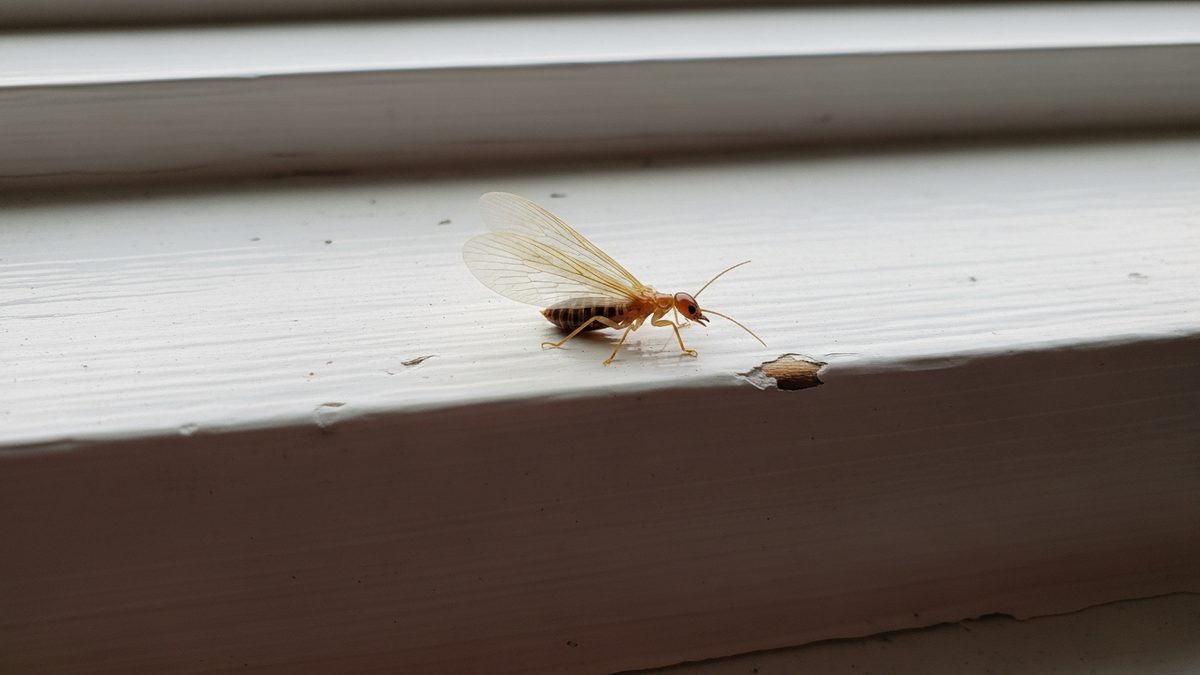
Termite swarmers have four wings that are all the same size and roughly the same shape. The front and rear wings are equal in length, and both extend well past the tip of the abdomen. When at rest, all four wings lie flat along the back and look like one long wing pair. Shed wings found near windowsills or on floors are a common sign of a termite swarm inside the home.
Flying ants also have four wings, but the front pair is noticeably larger than the rear pair. If you look closely at a captured insect, the front wings are clearly bigger. This unequal wing pair is one of the most reliable distinguishing features, according to NC State Extension entomologists.2
2. Antennae
Termites have straight, beaded antennae—they look like a tiny string of pearls and run in a relatively straight line from the head.
Ants have elbowed or bent antennae. There is a distinct, sharp angle or "elbow" partway along the antenna. This elbowed shape is a defining characteristic of all ants and is absent in termites.2
3. Waist (Body Shape)
Termites have a broad, tube-like body with no noticeable waist constriction. The thorax (middle section) and abdomen flow into each other in a smooth, thick shape.
Ants have a pinched waist with one or two distinct nodes (bumps) between the thorax and abdomen. This hourglass shape is visible even to the naked eye and is the classic visual difference most people have heard described.
A quick summary: equal wings + straight antennae + thick waist = termite. Unequal wings + bent antennae + pinched waist = ant.
What to Do If You Find One
Capture a specimen. Before anything else, catch one or two insects in a sealed plastic bag or glass jar. Do not crush them. A pest management professional or your local cooperative extension office can identify the species from a physical sample. Phone photos often work too, but a specimen is more reliable.
Search for shed wings. Termite swarmers shed their wings almost immediately after landing. Finding a pile of equal-length wings near a windowsill, door threshold, or light fixture is one of the strongest indicators of a termite swarm inside the home. Ant wings stay attached unless the ant is dead or was killed.
Look for other signs. If you confirm termites, look for additional evidence: mud tubes on foundation walls (subterranean termites build these pencil-diameter earthen tubes to travel between soil and wood), hollow-sounding wood when tapped, blistering or bubbling paint on wood surfaces, and frass (termite droppings, which look like tiny pellets of sawdust) near wood structures.
For a full breakdown of what other evidence to look for, see our guide on signs of termites.
Why Mistaking a Termite for an Ant Is Costly
Carpenter ants are destructive too—they excavate galleries in damp or rotted wood—but they do not eat wood. The damage they cause is typically slower and more localized than subterranean termite damage.
Subterranean termites feed on cellulose 24 hours a day, 365 days a year. A mature colony can contain hundreds of thousands of workers, all silently consuming structural framing, floor joists, and wall studs. The wood surfaces often look intact while the interior is hollowed out. By the time swarmers appear, the colony is several years old and significant damage may already be done.
Homeowners who dismiss swarmers as "just ants" can go another one, two, or three years before the damage becomes obvious—and by then, repairs can easily run into five figures.
When to Call a Pro
Call a licensed pest management professional if:
- You have captured or photographed a suspected termite swarmer
- You find shed equal-length wings near windows or doors
- You find mud tubes on your foundation or in your crawl space
- You hear faint clicking or rustling sounds inside walls (soldier termites bang their heads against tunnel walls as an alarm signal)
- You tap on wood framing or flooring and it sounds hollow
Do not wait for swarmers to appear again. A qualified pest inspector will do a thorough inspection of your foundation, crawl space, and accessible structural framing. If termites are confirmed, treatment options include liquid termiticide barriers applied to the soil and bait station systems placed around the perimeter.
What It Typically Costs
A professional termite inspection typically costs $75 to $150, though many pest control companies offer free inspections. Treatment costs depend on the type of treatment and the size of the home:
- Liquid soil treatment (termiticide barrier): $1,000 to $2,500 for an average home
- Bait station system: $1,200 to $3,500 installed, plus annual monitoring fees
- Fumigation (drywood termites, less common in northern states): $2,000 to $8,000 or more
These costs are substantially lower than structural repairs from untreated termite damage, which can easily reach $10,000 to $30,000 or more in severe cases.
Common Mistakes
Panicking and spraying with a consumer insecticide. Over-the-counter sprays may kill the swarmers you can see, but the colony in the soil or the wood is entirely unaffected. Worse, disturbing the swarm may cause the colony to retreat deeper, making inspection harder.
Assuming one swarm means a small problem. The presence of swarmers means the colony is already mature—typically three to five years old for subterranean termites. The colony is not new; you just got your first visible signal.
Only inspecting where you saw the swarm. Swarmers are attracted to light and may fly from their entry point before you see them. The actual colony entry point may be across the room or on another floor level.
Skipping the annual inspection after treatment. Termite bait systems and soil treatments require monitoring. A treated home can be re-infested if the barrier is breached by landscaping changes, new construction nearby, or soil erosion.
How to Reduce Termite Risk
- Keep wood mulch at least 6 inches away from the foundation and soil line.
- Do not store firewood against the house or in the crawl space.
- Fix leaking gutters, downspouts, and plumbing quickly—moisture in wood dramatically increases termite risk.
- Ensure crawl space ventilation is adequate and vapor barriers are intact.
- Maintain a 6-inch gap between soil and any wood siding or framing.
- Have your home inspected annually by a licensed pest professional, especially if you live in a high-termite-pressure region (the Southeast, Gulf Coast, Southwest, and Pacific Coast have the highest activity).
Frequently Asked Questions
Do termites swarm every year? A mature colony will typically swarm annually, usually in spring. If you saw swarmers last year and took no action, this year's swarm is a second warning from the same (now larger) colony.
I only saw two or three winged insects. Should I be worried? Possibly. Swarms can be large or small depending on colony size and conditions. Even a few swarmers indoors warrant capturing a specimen and getting a professional inspection.
Can termites infest a home with a concrete slab foundation? Yes. Subterranean termites enter through expansion joints in concrete, gaps where pipes penetrate the slab, cracks in the concrete, and through weep holes in brick veneer. No foundation type is immune.
Do flying ants cause structural damage? Carpenter ants excavate galleries in moist or damaged wood, which can worsen existing decay. However, they do not eat wood the way termites do, and the structural risk from carpenter ants is generally lower. They do indicate a moisture problem that needs addressing.
What states have the worst termite problems? According to the USDA, the highest-risk zones run from Virginia south through Florida and west through Texas and California. States in the Deep South see year-round activity. Northern states see termite activity but at lower intensity, and the most common species there is the eastern subterranean termite.
Get a Free Quote
If you found swarmers and want a professional to take a look, a local pest control expert can inspect your home and tell you exactly what you are dealing with. Request your free estimate today.
Sources
Disclaimer
The information on this page is provided for general educational purposes only and is offered "as is" and "as available," without warranties of any kind, whether express or implied — including, without limitation, any warranties of accuracy, completeness, reliability, merchantability, or fitness for a particular purpose. It is not professional advice and is not a substitute for inspection, diagnosis, or repair by a licensed, qualified professional.
Home systems involving gas, electricity, water, refrigerant, fire, or structural components can be hazardous, and requirements vary by local code and jurisdiction. Any inspection, diagnosis, repair, installation, or other action referenced on this page should be performed by a licensed professional. You should not rely on this content to perform such work yourself. To the fullest extent permitted by law, [Company Name] and its owners, employees, and contributors assume no responsibility or liability for any injury, death, property damage, or other loss arising out of or in connection with the use of, or reliance on, this information.
If you smell gas or suspect a carbon monoxide leak, leave the area immediately and call 911 or your gas utility from a safe location.
Footnotes
-
USDA Forest Products Laboratory — Detecting and Identifying Termites in a Structure ↩
-
NC State Extension — Termite Swarmers: What Do They Mean for You? ↩ ↩2