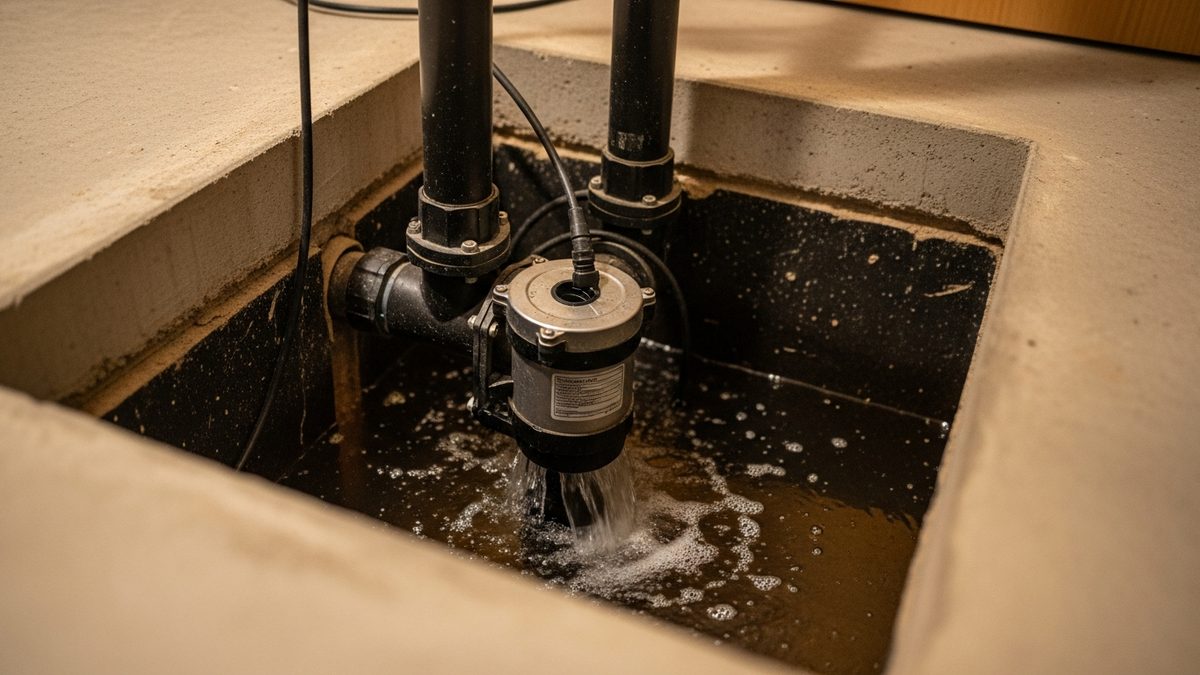
A sump pump is designed to run when it needs to and stop when it does not. If yours is running constantly — or cycling on and off every few minutes around the clock — something is wrong. At best it is wasting electricity and wearing out the motor faster than it should. At worst, it is a sign that the pump cannot keep up with the water coming in, or that water it already pumped out is finding its way right back into the pit.
The encouraging news is that most causes of a constantly running sump pump are identifiable and fixable. This guide covers the six most common reasons, how to diagnose each one yourself, what is safe to check on your own, and when it is time to call a plumber.
If your pump is completely dead and will not run at all, see our related guide on sump pump not working.
Why does a sump pump run non-stop?
A normally functioning sump pump follows a simple cycle: groundwater flows into the sump pit, the rising water lifts a float switch, the switch tells the motor to start, the pump moves the water out through a discharge pipe, the water level drops, the float falls, and the motor stops. Each part of that cycle has to work for the pump to behave correctly.
When the pump runs without stopping, one or more steps in that cycle have broken down. These are the six most likely culprits, roughly in order of how often they occur.
Cause 1: Stuck or failed float switch
The float switch is the most common cause of a pump that will not shut off. The float is a small bobber — either a ball on a rod or a cylindrical piece connected to the pump body — that rises and falls with the water level in the pit. When the water drops below the shutoff level, the float should drop with it and signal the motor to stop.
If the float is stuck in the "on" position, the motor keeps running even after the pit is empty.
How this happens: vibration from the pump motor can cause the pump assembly to shift over time, wedging the float against the pit wall or against the pump body itself. In tight pits, the float can also become tangled in the power cord. Either way, the switch never gets the chance to fall and cut the motor.
What to check: Cut power to the pump first (unplug or switch off the breaker). Reach into the pit and try to move the float by hand. It should swing or slide freely through its full range of motion without hitting anything. If it is pressed against the pit wall or pinched, reposition the pump so the float clears. A zip tie or a small standoff can keep it away from the wall.
If the float moves freely but the pump still runs constantly when power is restored, the internal switch mechanism may have failed and the float assembly needs replacement.
Cause 2: Failed check valve — water cycling back into the pit
The check valve is a one-way valve installed in the discharge line, typically on the vertical pipe just above the pump. Its job is to prevent water that has already been pumped out from flowing back down into the pit when the motor shuts off.
When the check valve fails — or was never installed — water drains back down the discharge pipe and refills the pit after every pump cycle. The rising water triggers the float again, the motor starts, pumps it out, shuts off, the water drains back, and the cycle repeats indefinitely.
This is sometimes called "pump cycling" and is easy to diagnose by timing the pump. If it runs for 15 to 30 seconds, shuts off for 15 to 30 seconds, then immediately starts again, a failed check valve is almost always the cause.
What to check: With the pump off, look at the check valve fitting on the discharge pipe above the pump. Look for dripping or seeping water coming back down the pipe shortly after the pump shuts off. Most residential check valves are held in place with hose clamps and can be removed and replaced in under 30 minutes. Check valves for residential pumps cost $10 to $30 at hardware stores.
Cause 3: Undersized pump for the amount of water coming in
If the pump is correctly sized for average conditions but your property has a high water table, or if recent heavy rain or snowmelt has dramatically increased groundwater pressure, the pump may simply be working as hard as it can and still losing ground. It is not broken — it is overwhelmed.
An undersized pump running constantly will eventually burn out its motor from the sustained load. Submersible sump pump motors are rated for duty cycles; continuous run is not within their design parameters.
How to tell: If the pit is nearly full of water even while the pump is running, the pump cannot keep up with the inflow. Measure the pit level while the pump runs. If it stays at or near the top, inflow is exceeding the pump's capacity.
What to do: For a one-time flood event caused by extraordinary rain, this may resolve on its own. If your basement sits in an area with a persistently high water table — meaning the pit refills quickly any time there is significant rain — a larger pump or a secondary backup pump running in parallel is the right solution. Pump sizing is rated in gallons per hour (GPH); a plumber can calculate the right size based on your pit and local conditions.
Cause 4: Clogged or blocked discharge line
The discharge line carries water from the pump to the outdoors, terminating at the side of the house, in a dry well, or in a drainage area several feet from the foundation. If this line is blocked, water has nowhere to go — the pump runs, but nothing gets pumped out.
Blockages can come from:
- Debris or leaves packed into the exterior termination point
- Ice plugging the pipe in freezing temperatures (one of the most common winter problems)
- A small animal or rodent nest at the discharge end
- Sediment or mud buildup inside the line over years of use
A frozen discharge is particularly dangerous because many pumps will continue running even when blocked, leading to motor burnout in a matter of hours.
What to check: Go outside and find the discharge pipe termination point. Clear any obvious debris from the opening. In winter, check whether the end of the pipe is encased in ice. If it is frozen, do not pour hot water directly on the pipe — bring the pump itself indoors temporarily or call a plumber who can safely clear the line. After any blockage is cleared, confirm the pump ejects water freely.
Cause 5: Broken or worn impeller
The impeller is the spinning component inside the pump housing that actually moves water. If the impeller is cracked, worn, or jammed with gravel, silt, or debris from the pit, the motor will run — and you will hear it — but the pump will not move water effectively.
A pump with an impeller problem often sounds normal (or slightly louder than normal) but does not reduce the water level in the pit. This is also the scenario where continued running is most likely to cause rapid motor burnout, since the motor is working against resistance.
What to check: While the pump is running, watch the water level in the pit. If it is not dropping (or dropping far more slowly than it should), the impeller may be the problem. Shut off power, remove the pump from the pit, and inspect the intake screen and impeller housing for packed debris. Some homeowners can clear this themselves; if the impeller itself is cracked or broken, the pump typically needs to be replaced rather than repaired.
Cause 6: High water table or continuous groundwater inflow
In some locations — particularly homes near bodies of water, in flood zones, or built on soil with poor drainage — the water table simply sits high year-round. During wet seasons, groundwater seeps into the sump pit continuously, and the pump may need to run almost constantly just to manage normal inflow. This is not a failure of the pump; it is the pump doing exactly what it is supposed to do under difficult conditions.
However, continuous operation shortens pump life significantly. If your pump runs constantly in wet seasons, consider:
- A higher-capacity pump rated for sustained operation
- A battery backup pump running in tandem so neither unit shoulders the full load alone
- An exterior French drain or perimeter drainage system that intercepts water before it reaches the pit
A licensed waterproofing contractor can evaluate whether exterior drainage improvements are feasible for your property.
Troubleshoot it yourself (safely)
Follow these steps in order before calling anyone:
- Check the discharge line outside. Clear any visible blockage at the termination point. In winter, look for ice.
- Shut off power. Check the float. With the pump unplugged, manually move the float through its full range. Ensure it does not touch the pit wall, pump body, or power cord at any point in its travel.
- Restore power and watch the cycle. If it pumps and shuts off but the motor restarts within a minute, suspect the check valve.
- Inspect the check valve. Look for backflow down the discharge pipe after the motor stops.
- Watch the pit level while the pump runs. If the level is not dropping, suspect a blocked or damaged impeller.
Safety first
Water and electricity are a dangerous combination. Follow these rules before any hands-on inspection:
- Always unplug the pump or switch off its dedicated breaker before touching the pump, the float, or anything in the pit.
- Never put your hands in pit water while the pump is plugged in.
- Do not stand in water while working near any electrical outlet or appliance.
- If the area around the sump pit smells of sewage, stop and call a plumber — sewer backflow requires professional handling.
- Sump pits can be confined spaces with limited air circulation. Keep your face away from the pit opening for extended periods.
When to call a pro
Call a licensed plumber or waterproofing professional if:
- The float is free, the check valve is intact, and the discharge is clear — but the pump still will not shut off
- The pump runs but the pit level does not drop
- The discharge line is frozen and you cannot safely clear it
- The pump is making new noises — grinding, rattling, or loud humming — suggesting a damaged motor or impeller
- The pump is 7 to 10 years old and showing any of the above problems (proactive replacement beats an emergency flood)
- You need to assess whether your current pump is properly sized for your groundwater conditions
What it typically costs (2025–2026)
Float switch replacement: $75 to $150 for the part; $150 to $350 total with labor.
Check valve replacement: $10 to $30 for the part; $100 to $200 total with a plumber.
Sump pump repair (various causes): $400 to $550 on average for professional repair, depending on the component and your location.
Full pump replacement: $645 to $2,120 for most residential installations, with the national average around $1,365 per HomeAdvisor's 2025 data. A straightforward swap in an accessible basement lands on the lower end of that range.
Battery backup pump installation: $150 to $600 for the unit plus $100 to $300 for installation.
Water damage restoration: If the pump fails and the basement floods, restoration typically runs $1,400 to $5,000 or more, not counting damaged belongings or mold remediation.
(Sources: HomeAdvisor sump pump installation cost data, 2025; Angi sump pump repair data, 2026.)
Common mistakes
Running the pump while the discharge is blocked. Even a few hours of continuous operation against a blocked discharge line can burn out a motor. If you suspect a frozen or clogged line, shut off the pump before it destroys itself.
Ignoring the cycling pattern. A pump that cycles every few minutes is clearly not behaving normally, but homeowners often dismiss it as "the water table being high." Sometimes that is true — but check the check valve first, because it is a $15 fix.
Not testing after the repair. After you reposition a float, replace a check valve, or clear the discharge line, pour a bucket of water into the pit and confirm the pump runs the full cycle cleanly before assuming the fix worked.
Skipping the backup system. A constantly running pump is close to burnout. If you do not have a battery backup and your pump fails during a storm, you are looking at a flooded basement. Install a backup before this one quits.
Delaying replacement on an old pump. A pump that is 8 or more years old and showing problems is a good candidate for proactive replacement. The cost of a new pump is a fraction of the cost of a basement flood plus restoration.
How to prevent a constantly running sump pump
Test the pump quarterly. Pour five gallons of water into the pit and watch the full cycle. You will catch a sticky float or slow shutoff before it becomes a problem.
Inspect and clean the pit annually. Remove gravel, silt, and debris from the pit floor so they cannot clog the intake or jam the impeller.
Install a check valve if you do not have one. A missing check valve guarantees cycling. If the plumber who installed your pump skipped it, have one added — it is a simple, inexpensive fitting.
Extend the discharge line away from the foundation. If the pipe terminates too close to the house, expelled water can soak back through the soil and re-enter the pit. The discharge should terminate at least 10 to 20 feet from the foundation, sloping away from the house.
Install a battery backup pump. This protects against both power outages and primary pump failure. Models from Zoeller and Wayne Water Systems offer widely available residential options.
Replace the pump proactively around the 7-year mark. Most submersible pumps are rated for 7 to 10 years of typical use. Replacing a functioning but aging pump on a schedule is far less expensive than an emergency replacement after a failure.
FAQ
Is it normal for a sump pump to run constantly during heavy rain? Running frequently during a hard storm is normal. Running non-stop without any break for 12 or more hours — especially if the rain has eased — suggests either an inflow problem (very high water table), an undersized pump, or a failed check valve that is recycling water.
Can a sump pump burn out from running too long? Yes. Submersible pump motors are not designed for indefinite continuous operation. Most will overheat and fail within hours to days if they cannot complete a normal cycle. A burnt-out motor means a full pump replacement, which is why catching the underlying cause matters.
How do I know if my check valve is bad? Shut the pump off and watch the discharge pipe above the pump. If water drains visibly back down the pipe within 30 to 60 seconds of shutoff, the check valve is not holding. You should hear a click or thud from the valve disc seating when the pump stops; if you do not hear it, suspect valve failure.
My pump runs for 30 seconds, stops for 30 seconds, and repeats all night. What is that? This is classic check valve failure or short-cycling. The pump empties the pit, shuts off, then water drains back in through the bad valve and immediately triggers it again. Replace the check valve.
How long should a sump pump run per cycle? This varies by pit size and pump capacity, but a typical residential cycle lasts anywhere from 15 seconds to a few minutes to empty the pit, followed by a quiet period until groundwater refills to the trigger level. If every "quiet" period is under a minute, something is wrong.
A sump pump that runs without stopping is telling you something. Most of the time it is a simple fix — a sticky float, a $15 check valve, or a plugged discharge line. But if the motor is allowed to run itself to death before you act, you are looking at a full replacement and possibly a flooded basement.
Get a free quote from a licensed plumber near you. Local Service Group connects homeowners with vetted plumbing and waterproofing professionals who can diagnose a constantly running pump and fix it before the motor quits.
Sources
- Angi — "Here's Why Your Sump Pump Is Constantly Running": https://www.angi.com/articles/sump-pump-constantly-running.htm
- HomeAdvisor — "How Much Does Sump Pump Replacement Cost? [2025 Data]": https://www.homeadvisor.com/cost/plumbing/install-a-sump-pump/
- Basement Systems — "The Sump Pump Is Running Nonstop: Causes and Solutions": https://www.basementsystems.ca/waterproofing/problems/sump-pump-repair/running-constantly.html
- Zoeller Pump Company — Residential Sump Pump Products: https://www.zoellerpumps.com
- Wayne Water Systems — Residential Sump Pump Products and Resources: https://www.waynepumps.com
- U.S. Environmental Protection Agency — "A Brief Guide to Mold, Moisture and Your Home": https://www.epa.gov/mold/brief-guide-mold-moisture-and-your-home
- Ready.gov (FEMA / U.S. Department of Homeland Security) — Floods: https://www.ready.gov/floods
Disclaimer
The information on this page is provided for general educational purposes only and is offered "as is" and "as available," without warranties of any kind, whether express or implied — including, without limitation, any warranties of accuracy, completeness, reliability, merchantability, or fitness for a particular purpose. It is not professional advice and is not a substitute for inspection, diagnosis, or repair by a licensed, qualified professional.
Home systems involving gas, electricity, water, refrigerant, fire, or structural components can be hazardous, and requirements vary by local code and jurisdiction. Any inspection, diagnosis, repair, installation, or other action referenced on this page should be performed by a licensed professional. You should not rely on this content to perform such work yourself. To the fullest extent permitted by law, [Company Name] and its owners, employees, and contributors assume no responsibility or liability for any injury, death, property damage, or other loss arising out of or in connection with the use of, or reliance on, this information.
If you smell gas or suspect a carbon monoxide leak, leave the area immediately and call 911 or your gas utility from a safe location.