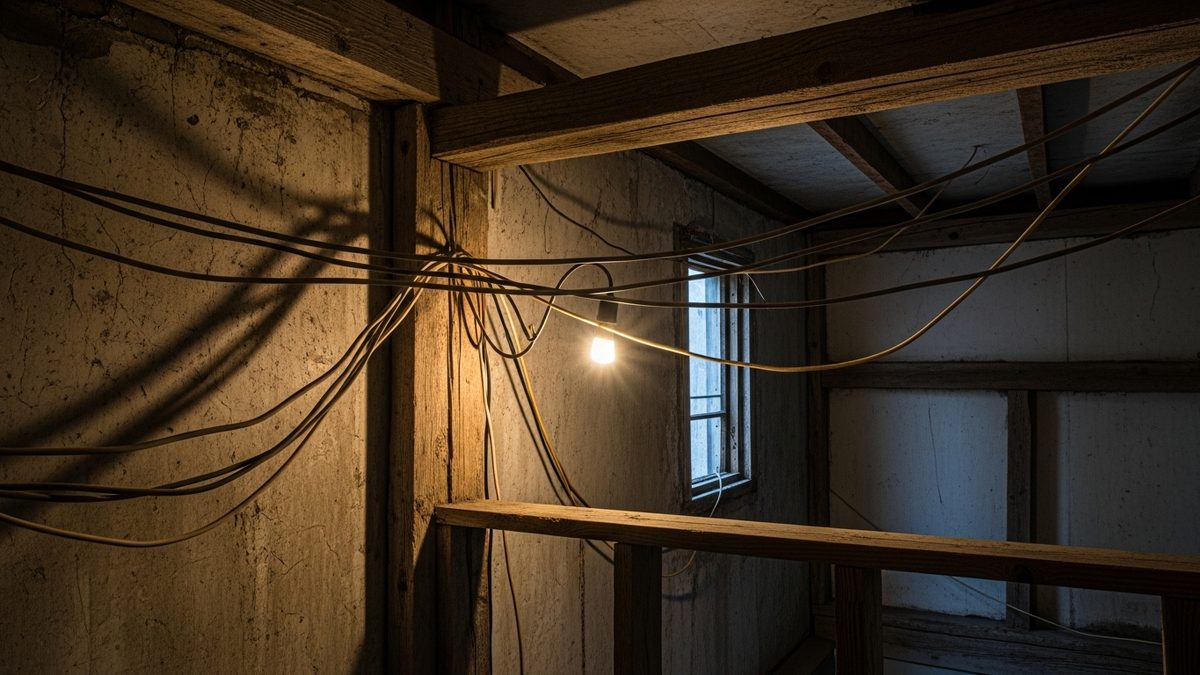
Knob-and-tube wiring is not automatically dangerous. A system that was installed correctly, never modified, never covered by insulation, and still has intact wire coverings can keep working safely. The problem is that most K&T systems in use today don't meet all of those conditions — and that's where the real risk lives.
If your home was built before 1950 and you're not sure whether your wiring has been tampered with or buried under insulation over the decades, that uncertainty alone is reason enough to call a licensed electrician for a look.
What is knob-and-tube wiring?
Knob-and-tube (K&T) wiring was the standard method for wiring American homes from roughly the 1880s through the 1940s. The name comes from the two ceramic components used: porcelain knobs nailed to framing to hold wires in place, and porcelain tubes inserted through holes in joists and studs so wires could pass through wood safely.
A few things set K&T apart from modern wiring:
- The hot wire and neutral wire run as separate, individual conductors spaced several inches apart, allowing each to shed heat into open air.
- There is no ground wire. Modern wiring has three conductors — hot, neutral, and ground. K&T has two.
- The original insulation is rubber and cloth, not modern thermoplastic. These materials break down over time.
The porcelain hardware is nearly indestructible. The wire insulation is not.
Is it dangerous?
The International Association of Certified Home Inspectors (InterNACHI) puts it plainly: K&T wiring "is not inherently dangerous. The dangers from this system arise from its age, improper modifications, and situations where building insulation envelops the wires."
Here are the specific failure modes that create real risk:
Brittle or cracked insulation. The rubber and cloth coverings weren't built to last a century. As they degrade, bare wire can arc against wood framing. A 1990 U.S. Consumer Product Safety Commission (CPSC) study of 149 residential electrical fires found that deterioration due to aging contributed to 17 percent of fires — and that homes over 40 years old experienced fires at roughly three times the rate of homes 11 to 20 years old.
No ground wire. Grounding provides a safe path for fault current. Without it, a wiring failure has nowhere controlled to go. Ungrounded wiring can't safely power three-prong appliances and offers no surge protection. The risk is especially high in wet areas — kitchens, bathrooms, and laundry rooms.
Unsafe DIY modifications. The same CPSC study found that improper alterations contributed to 37 percent of fires. K&T wiring is old enough that several generations of homeowners have spliced into it. Common problems include extension cords spliced directly to the system, conductors wrapped with masking tape, and circuits extended with mismatched cable.
Overloading from modern demand. K&T was designed for a time when a home's electrical load meant a few lights and an iron. Plugging today's appliances into that system strains conductors sized for far lighter loads. Oversized fuses — swapped in to stop nuisance blowouts — make this worse by removing the protection that would otherwise cut power before the wiring overheats.
Covered by thermal insulation — the biggest risk. K&T wiring is designed to release heat into open air around it. When attic insulation is blown in or rolled over K&T wires, that heat has nowhere to go. The conductors overheat, insulation breaks down faster, and fire risk climbs sharply. The 2008 National Electrical Code (NEC) Section 394.12 specifically prohibits K&T wiring in spaces insulated with loose, rolled, or foam-in-place materials. Many energy upgrades on older homes have accidentally created exactly this condition.
Warning signs to take seriously
- Warm or hot outlet or switch cover plates
- Flickering or dimming lights without a clear cause
- Fuses that blow repeatedly on the same circuit
- A burning or hot-plastic smell at any outlet, switch, or panel
- Two-prong (ungrounded) outlets throughout the home
- Dead outlets or switches with no tripped breaker
Any of these calls for a licensed electrician, not a hardware store run.
Insurance and code issues
Many homeowners insurance carriers won't cover a home with active K&T wiring. Those that do often charge higher premiums, require a professional inspection first, or apply coverage limitations. Mortgage lenders increasingly require K&T to be evaluated or replaced before closing. If you sell a home with K&T wiring, you must typically disclose it — failing to do so can void an insurance claim and create legal exposure.
From a code standpoint, existing K&T wiring doesn't have to be removed. But it cannot be used in any new work. You can't legally extend a K&T circuit to add an outlet or fixture. Any new wiring must meet current NEC grounded-conductor requirements, which means renovation work often triggers an upgrade.
Should you keep it or replace it?
Continued use may be reasonable when: a licensed electrician has confirmed insulation is intact, the wiring hasn't been covered by thermal insulation, no unsafe modifications are present, and the home's electrical load is modest.
Replacement makes sense when: wire insulation is cracked or brittle anywhere, insulation has been blown into spaces with K&T runs, there's evidence of past DIY splicing, you're renovating and adding circuits anyway, or an insurer has declined coverage.
Partial rewiring of specific areas — such as kitchens, bathrooms, or an insulated attic — is sometimes a practical middle step. Experts generally recommend replacing the full system at once when possible, because connecting new wiring to existing K&T creates additional hazards if done imprecisely.
For related context on another wiring type found in older homes, see our guide on aluminum wiring and its fire risk.
What a pro will do
An electrician's inspection will cover the condition of wire insulation in accessible areas — attic, basement, crawl space, and exposed runs — along with evidence of overheating, improper splices, insulation coverage, and overfusing at the panel.
If replacement is the recommendation, the scope depends on your home. A full rewire involves running new grounded cable throughout, upgrading the panel if needed, and bringing outlets and circuits to current code. In homes with attic and basement access, wires can often be fished through walls without opening them fully. Lath-and-plaster construction makes the work more involved.
This is not a DIY project. K&T work requires permits and inspections. Unpermitted electrical work can void your insurance and must often be redone at your expense when you sell. Always hire a licensed, insured electrician experienced with older wiring systems.
Cost to replace
Full knob-and-tube rewiring typically runs $12,000 to $35,000, or roughly $8 to $17 per square foot, depending on home size, accessibility, and local labor rates (HomeGuide, 2026).
| Component | Typical range |
|---|---|
| New wiring, outlets, and switches | $8,600 – $10,800 |
| Rewiring labor | $2,400 – $20,800 |
| Panel upgrade (if needed) | $800 – $2,500 |
| Permits and inspections | $300 – $1,100 |
Drywall or plaster repair adds cost where walls must be opened. Some states offer assistance programs or interest-free loans for K&T removal — check with your state's housing or energy office.
FAQ
Does K&T wiring have to be removed? No law requires complete removal of existing K&T. Some local jurisdictions have stricter rules — check with your building department. Replacement is strongly recommended when the system has been modified, covered by insulation, or shows deterioration.
Can I get homeowners insurance with knob-and-tube wiring? Sometimes, but many carriers won't cover it, and those that do often charge more or require an inspection first. Disclose it upfront when shopping for coverage.
Is it safe to add insulation if I have K&T wiring? Not without an electrician's sign-off. The 2008 NEC prohibits K&T from being covered by loose-fill, rolled, or spray-foam insulation. Some states allow it under specific conditions, but a licensed electrician must certify the system is safe first.
Can a handyman work on K&T wiring? No. Electrical work requires a licensed electrician and permits in virtually every US jurisdiction. Unpermitted work creates safety risks and can void insurance coverage.
How do I know if my K&T is still active? Check exposed wiring in the attic, basement, or crawl space. Active K&T shows individual cloth- or rubber-covered wires running along framing, held by ceramic knobs. If you're not sure, an electrician can trace which circuits are live.
Talk to a licensed electrician near you
If your home might have knob-and-tube wiring, the right first step is an inspection by a licensed electrician. They can assess insulation condition, identify unsafe modifications, check for coverage by thermal insulation, and tell you plainly whether you're looking at a monitoring situation or a replacement project. Get quotes from two or three licensed pros with experience in older homes before making a decision.
Sources
- U.S. Consumer Product Safety Commission (CPSC) — "What Causes Wiring Fires in Residences?" Fire Journal, January/February 1990. Smith, Linda E. and McCoskrie, Dennis A. cpsc.gov
- InterNACHI (International Association of Certified Home Inspectors) — "Knob-and-Tube Wiring." Gromicko, Nick, CMI and Shepard, Kenton. nachi.org
- HomeGuide — "Cost to Replace Knob and Tube Wiring" (2026). homeguide.com
- National Electrical Code (NEC) 2008 — Section 394.12, Concealed Knob-and-Tube Wiring. National Fire Protection Association.
Disclaimer
The information on this page is provided for general educational purposes only and is offered "as is" and "as available," without warranties of any kind, whether express or implied — including, without limitation, any warranties of accuracy, completeness, reliability, merchantability, or fitness for a particular purpose. It is not professional advice and is not a substitute for inspection, diagnosis, or repair by a licensed, qualified professional.
Home systems involving gas, electricity, water, refrigerant, fire, or structural components can be hazardous, and requirements vary by local code and jurisdiction. Any inspection, diagnosis, repair, installation, or other action referenced on this page should be performed by a licensed professional. You should not rely on this content to perform such work yourself. To the fullest extent permitted by law, [Company Name] and its owners, employees, and contributors assume no responsibility or liability for any injury, death, property damage, or other loss arising out of or in connection with the use of, or reliance on, this information.
If you smell gas or suspect a carbon monoxide leak, leave the area immediately and call 911 or your gas utility from a safe location.