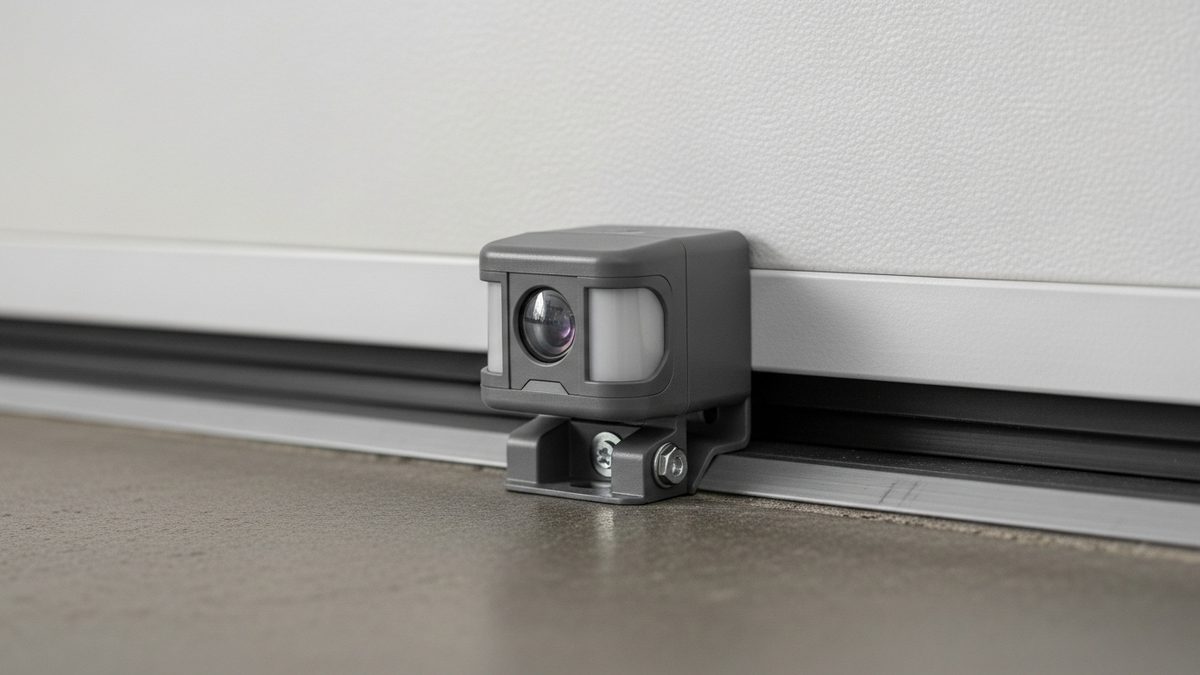
You press the button, the door starts to close, and then — just before it reaches the floor, or sometimes right away — it reverses and heads back up. It's one of the more frustrating garage door problems because the door is technically working; it's just not finishing the job. The reversal behavior is actually a built-in safety feature, so when it triggers unexpectedly, it means something has told the opener to stop. This guide breaks down the most common causes, what you can check yourself, and when the problem calls for a pro.
Most likely causes
These are ranked from most common to least common.
-
Misaligned or dirty photo-eye safety sensors. This is by far the most common reason a garage door reverses before closing. Since 1993, federal rules have required all automatic residential openers to include an external entrapment protection device — usually a pair of photo-eye (infrared) sensors mounted about six inches off the floor on each side of the door opening (CPSC, 1993). One sensor sends an infrared beam; the other receives it. If that beam is broken — by an object, a spider web, a smudge on the lens, or a bumped bracket — the opener immediately reverses the door as if something were in the way. On most Chamberlain, LiftMaster, and similar openers, the overhead light will flash roughly ten times when the sensors are the problem (Chamberlain Group).
-
Close-force setting too sensitive. The opener has a force adjustment that controls how much resistance the motor will push against before deciding something is wrong. If that setting is too low, the door may reverse just from the friction of cold weather, a slightly warped panel, or stiff rollers — even when the path is completely clear. This is a programmable setting that can drift or be bumped out of range.
-
Travel limit set too short. The down-travel limit tells the opener how far the door needs to travel to reach the floor. If that limit stops the door a few inches above the ground, the opener may interpret the remaining resistance from the floor seal or tracks as an obstruction and reverse. You may notice the door stopping consistently at the same point every time (Genie Company travel limits guide).
-
Physical obstruction in the door's path. A garden hose, a child's toy, a pile of leaves against the wall, or a trash can lid sitting just inside the sensor line can all trigger a reversal. The sensors detect it before the door touches it.
-
Worn or damaged rollers. Worn steel rollers can create enough extra resistance as the door moves down — especially in cold weather — that the opener's force sensor reads it as a blockage. Nylon rollers run more quietly and smoothly and are worth upgrading to if your rollers are original to a door that is ten or more years old.
-
Bent or dirty track. If the track is slightly bent, has built-up grime, or the door panels are rubbing against the track edges, friction increases and the opener may reverse before reaching the bottom.
-
Sensor wiring problem. If the wiring from the sensors to the opener unit is pinched, chewed by a rodent, or has a loose connection at either end, the sensor beam will appear to fail even when the lenses are clean and aligned. This is less common but worth checking if cleaning and realigning the sensors doesn't help.
For a broader look at opener issues — including a door that won't move at all — see our companion guide on garage door won't open or close.
Troubleshoot it yourself (safely)
Work through these steps before calling a technician.
-
Clear the immediate area. Remove anything stored near the sides of the door, along the floor path, and within a foot of both sensors. Even a garden stake leaning against the wall can clip the beam.
-
Check the sensor LEDs. Look at both sensors while the door is closed. The sending sensor (usually amber LED) should be steadily lit. The receiving sensor (usually green LED) should also be steadily lit. A blinking or off LED means the beam is not making a clean connection.
-
Clean the sensor lenses. Use a dry or slightly damp cloth to wipe both lenses. Road dust, cobwebs, and humidity can coat the lens enough to scatter the beam.
-
Realign the sensors. Loosen the wing nut holding the sensor bracket — just enough to let the bracket move. Slowly rotate the sensor until the LED goes from blinking to steady. Re-tighten the wing nut. Do the same on the other side if needed (Chamberlain sensor alignment).
-
Check for direct sunlight on the receiving sensor. Afternoon sun can flood the lens with enough light to overwhelm the infrared beam. If this is the issue, a small cardboard shade taped above the sensor will confirm it. A technician can install a proper sunshield.
-
Check sensor wiring. Follow the wires from each sensor up to the opener unit. Look for cuts, pinches, or spots where the wire staples may have pierced the insulation. If the insulation is damaged, a technician should replace that wire run.
-
Test the down-travel limit. If the sensors check out, the door may simply be stopping short of the floor. Consult your owner's manual for the down-limit adjustment procedure. On most older openers this is a small screw; on newer ones it is a programming sequence. Adjust in small increments — one full turn or one button press at a time.
-
Test the close-force setting. Try pushing up gently on the door as it closes. If the door reverses with very little pressure, the force is set too low. Increase it one step at a time per your manual, then re-test. Do not set force so high that the door fails the 2x4 auto-reverse test.
Safety first
- Never bypass or cover the sensors. They exist to protect children, pets, and anyone who might walk under a closing door. Taping over them, bending them away, or disconnecting them is dangerous and may violate the safety standard that has applied to all openers since 1993 (CPSC standard).
- Test the auto-reverse monthly. Lay a 2x4 flat on the ground in the door's path and press close. The door should reverse within two seconds of contact. If it does not, stop using the opener and call a technician.
- High-tension springs are a professional-only repair. If you notice the door moving unevenly, if one side seems lower than the other, or if you hear a loud bang, a spring or cable may be the real problem. Do not put your hands near the spring assembly.
- Keep fingers away from moving parts. The hinges and rollers are pinch hazards any time the door is in motion.
When to call a pro
Contact a licensed garage door technician if:
- You have cleaned and realigned the sensors and the reversal continues.
- The wiring at the sensors or the opener unit shows damage.
- The door reverses at different points each time (inconsistent reversal suggests a mechanical issue rather than a sensor issue).
- The door is visibly crooked or one side hangs lower than the other — this often means a broken spring or cable.
- The opener makes grinding, popping, or scraping noises as the door moves.
- Adjusting force or travel limits per the manual doesn't produce stable results.
What it typically costs (2025–2026)
| Repair | Typical range |
|---|---|
| Sensor realignment (service call + labor) | $75–$150 |
| Sensor replacement (pair, installed) | $100–$200 |
| Force or limit adjustment | $75–$125 |
| Roller replacement (all rollers, installed) | $150–$250 |
| Track cleaning and realignment | $100–$200 |
| Wiring repair or replacement | $100–$250 |
Sources: Angi, 2026; Angi roller costs; HomeAdvisor, 2025.
Common mistakes
- Continuing to use the door while bypassing the sensors. Even temporarily, this is a serious safety risk.
- Cranking the close-force way up to override the reversal. If you increase force enough to prevent the reversal, you may also disable the protection that stops the door from crushing an obstacle. Always re-do the 2x4 test after any force adjustment.
- Forgetting to check for sunlight. A sensor that works fine in the morning and fails every afternoon is almost always a direct-sunlight problem.
- Over-tightening the sensor wing nut. If you clamp down too hard, the bracket can flex and knock the sensor off alignment again. Snug — not tight — is the right feel.
- Replacing the opener without fixing the underlying issue. If the track, rollers, or door balance are the real culprits, a new opener will reverse for the same reasons the old one did.
How to prevent it
- Wipe sensor lenses every three months. It takes 30 seconds with a dry cloth and catches most recurring problems before they happen.
- Keep the area near both sensors clear. Store nothing within two feet of the sensor brackets.
- Lubricate rollers and hinges twice a year with a silicone spray or white lithium grease. Well-lubricated rollers create less resistance and reduce the chance of a false force-reversal (Clopay).
- Inspect sensor wiring once a year. A quick visual check for pinched or cracked insulation can catch a problem before it causes repeated service calls.
- Test the auto-reverse monthly as recommended by the International Door Association and major manufacturers.
FAQ
Why does my door reverse immediately without going down at all? This usually means the sensors are not communicating at all — either badly misaligned, completely blocked, or one sensor has a broken wire. The opener sees the beam as blocked from the moment you press close and reverses before the door moves.
Will direct sunlight really make my door reverse? Yes. Infrared sensors can be overwhelmed by strong afternoon sunlight hitting the lens at the right angle. Moving the sensor slightly or adding a small shade over the lens usually fixes it.
My sensor LEDs are both solid green. Why is the door still reversing? Both lights being lit doesn't always mean the beam is clean — a weak or dirty signal can still cause intermittent reversals. Try cleaning the lenses even when the lights look fine. If that doesn't help, the close-force setting or travel limit is likely the cause.
Can I adjust the sensors myself? Yes — loosening the bracket, aiming the sensor until the LED goes steady, and re-tightening is a safe DIY task. Anything beyond that — wiring repairs, spring or cable work — should go to a pro.
How do I know if the problem is the sensors or the spring? Sensor problems almost always cause the door to reverse on the way down, usually from the start of travel or from the same point each time. A broken spring typically prevents the door from opening at all, or causes obvious sagging on one side. If you can open the door fully and it only fails when closing, sensors are the far more likely cause.
Get a free quote
Dealing with a garage door that keeps reversing? Local Service Group connects homeowners with vetted local pros. Request a free quote today.
Sources
- https://www.cpsc.gov/Newsroom/News-Releases/1993/Safety-Commission-Publishes-Final-Rules-For-Automatic-Garage-Door-Openers
- https://www.cpsc.gov/Regulations-Laws--Standards/Voluntary-Standards/Topics/Garage-Door-OperatorsGate-Operators
- https://support.chamberlaingroup.com/s/article/How-to-align-safety-reversing-sensors-1484145609323
- https://store.geniecompany.com/blogs/genie-blog/how-to-set-the-up-and-down-travel-limits-of-your-genie-garage-door-opener
- https://www.clopaydoor.com/residential/support/steel-garage-doors-care-and-maintenance
- https://www.angi.com/articles/most-common-garage-door-repair-costs.htm
- https://www.angi.com/articles/garage-door-roller-replacement-cost.htm
- https://www.homeadvisor.com/cost/garages/repair-a-garage-door/
Disclaimer
The information on this page is provided for general educational purposes only and is offered "as is" and "as available," without warranties of any kind, whether express or implied — including, without limitation, any warranties of accuracy, completeness, reliability, merchantability, or fitness for a particular purpose. It is not professional advice and is not a substitute for inspection, diagnosis, or repair by a licensed, qualified professional.
Home systems involving gas, electricity, water, refrigerant, fire, or structural components can be hazardous, and requirements vary by local code and jurisdiction. Any inspection, diagnosis, repair, installation, or other action referenced on this page should be performed by a licensed professional. You should not rely on this content to perform such work yourself. To the fullest extent permitted by law, [Company Name] and its owners, employees, and contributors assume no responsibility or liability for any injury, death, property damage, or other loss arising out of or in connection with the use of, or reliance on, this information.
If you smell gas or suspect a carbon monoxide leak, leave the area immediately and call 911 or your gas utility from a safe location.