Dishwasher Not Draining at the End of the Cycle? Here's How to Fix It
Safety notice: Turn off the dishwasher and disconnect it from power — either unplug it under the sink or flip the breaker for the kitchen circuit — before reaching inside or removing any components. Never reach into standing water near an electrical appliance without confirming power is off.
Opening your dishwasher after a cycle to find an inch of murky water sitting at the bottom is frustrating, but it is also one of the more fixable appliance problems out there. In most cases, the drain is simply clogged somewhere along the line, and a homeowner with basic tools can clear it in 30–60 minutes.
This guide covers every common cause in order of how often it shows up, plus a step-by-step approach for checking each one.
If you recently had your garbage disposal replaced or installed and the dishwasher suddenly stopped draining, jump straight to cause #6 — it is almost certainly your culprit.
Most likely causes (ranked by frequency)
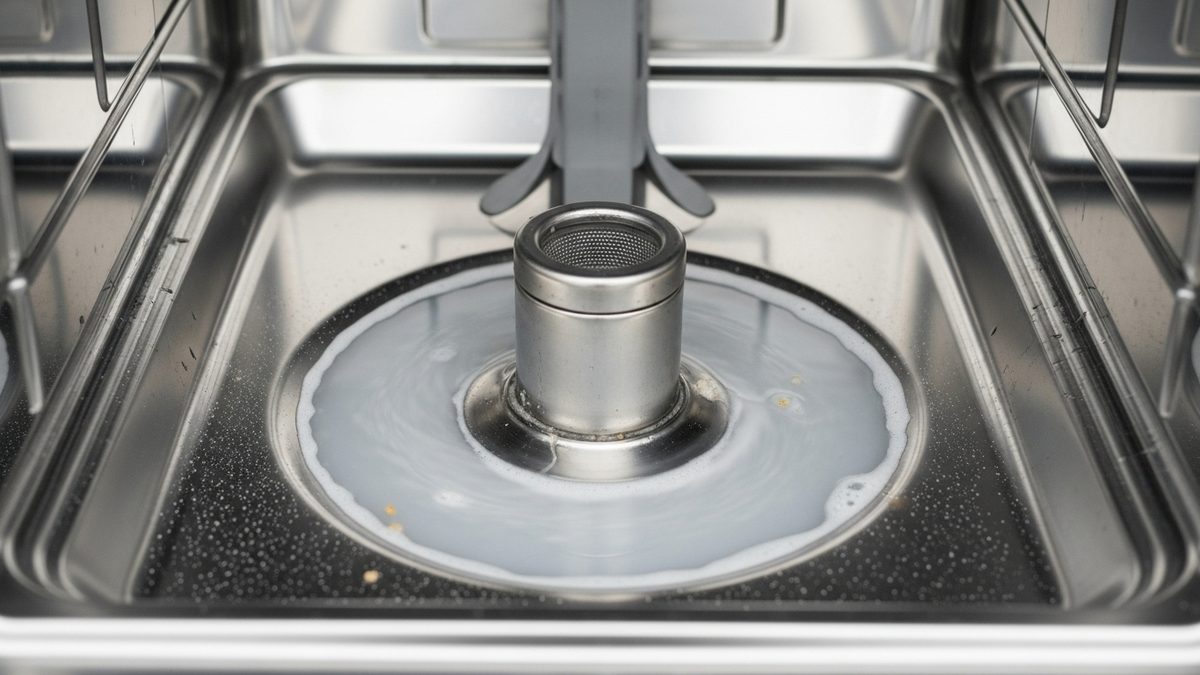
1. Clogged filter and sump area Modern dishwashers — especially those made in the last 10 years — use a manual filter system rather than a hard food disposer. The filter sits in the bottom of the tub and catches food particles before they can reach the drain pump. When the filter gets loaded up with grease, food debris, and mineral deposits, it restricts drainage dramatically. This is the most common cause of a dishwasher not draining, and it is also the easiest to fix.
2. Food debris blocking the drain basket or sump Even with the filter cleaned, larger debris — a piece of broken glass, a food label, a pop-top ring — can fall into the sump area around the filter and physically block the drain opening. The filter looks clean but something is plugging the hole beneath it.
3. Kinked or clogged drain hose The corrugated drain hose runs from the bottom of the dishwasher to the garbage disposal or the drain tailpiece under the sink. It can kink when the dishwasher is pushed in too far or get partially blocked by grease buildup on the inside walls. A partial kink still lets some water through, so the dishwasher may drain slowly during the cycle but leave water behind at the end.
4. Clogged air gap Many local plumbing codes require an air gap — a small chrome or plastic fitting mounted on the countertop or sink deck near the faucet. Its job is to prevent dirty drain water from siphoning back into the clean dishwasher water supply. The air gap itself can clog with debris, which restricts drainage. If you have an air gap and your dishwasher is not draining fully, this is one of the first things to check.
5. Blocked garbage disposal inlet or knockout plug The dishwasher drain hose connects to a side port on the garbage disposal. Two things can block this: (a) a buildup of grease and food inside the disposal inlet, and (b) on brand-new disposal installations, the knockout plug. When a new disposal ships from the factory, a plastic plug blocks the dishwasher inlet port. That plug must be knocked out before the drain hose is connected. If a plumber or installer forgot to do this, the dishwasher will never drain. This is a very common mistake on new disposal installs.
6. Failing drain pump or pump impeller The drain pump pushes water out through the drain hose. If the pump motor is failing, you may hear a humming or buzzing sound at the end of the cycle without water actually leaving the tub. A broken or jammed pump impeller (the spinning part inside the pump) produces similar symptoms. This is a component repair that usually requires a technician, though the impeller can sometimes be cleared of a jam by hand.
7. Faulty check valve A check valve (also called a flapper valve or ball valve on some models) sits in the drain line and prevents water from flowing backward from the disposal back into the dishwasher. If the check valve sticks open, water from the disposal drains back into the dishwasher tub between cycles — making it look like the dishwasher never drained, even though it did. If it sticks closed, it prevents draining altogether.
Troubleshoot it yourself (safely)
What you'll need: rubber gloves, a towel or two, a shallow pan or baking sheet, needle-nose pliers, a screwdriver, and optionally a pipe cleaner or small wire brush.
Step 1 — Remove standing water. You cannot access the filter or sump with water in the tub. Use a cup and a towel or a small wet/dry vacuum to remove as much water as possible. Lay a towel on the floor in front of the unit to catch drips.
Step 2 — Clean the filter. On most dishwashers, the filter is in the bottom of the tub near the spray arm. It usually has two parts: a coarse mesh outer filter and a fine cylindrical inner filter. Turn the inner filter counterclockwise and lift both pieces out (check your owner's manual for your specific model). Rinse them under hot running water, scrubbing with a soft brush to remove grease. Do not use a scouring pad — it can damage the mesh. Reinstall and confirm they are fully seated.
Step 3 — Inspect the sump for debris. With the filter out, shine a flashlight into the sump opening. Look for glass, bones, small utensils, or any foreign object. Use needle-nose pliers — not your bare fingers — to remove anything you find.
Step 4 — Check the air gap (if you have one). Remove the chrome cover on the air gap fitting at the sink. Lift the plastic cap underneath. Clean out any debris with a small brush or pipe cleaner. Reconnect and run a test cycle.
Step 5 — Inspect the garbage disposal and knockout plug. If the dishwasher was draining fine until a new disposal was installed, the knockout plug almost certainly was not removed. Turn off power to the disposal, disconnect the drain hose from the disposal inlet, and look into the inlet port with a flashlight. If you see a solid plastic disc, that is the knockout plug. Use a screwdriver and hammer to knock it inward, then remove the piece with pliers. Reattach the drain hose.
If the disposal is not new, check for grease buildup at the inlet port and clean it out. Run the disposal for 30 seconds before running the dishwasher — a packed disposal can back up into the dishwasher drain.
Step 6 — Inspect and straighten the drain hose. Pull the dishwasher out a few inches (turn off power first). Look at where the drain hose exits the back of the unit and traces to the sink cabinet. Make sure the hose is not kinked. The hose should form a high loop under the sink — the top of the loop should be as high as possible (ideally secured near the top of the cabinet with a clip) to create a natural anti-siphon barrier. A sagging hose allows water to drain back in.
Step 7 — Test with a short drain cycle. Reassemble everything, restore power, and run just the drain cycle (consult your owner's manual — most models let you run a drain-only cycle, or you can start a cycle and then cancel it, which typically triggers a drain). Listen for the pump running and watch whether the water level drops.
Safety first
- Power off first, always. Water and electricity are dangerous together. Flip the breaker or unplug the unit before touching anything inside.
- Wear rubber gloves. Broken glass in the sump is a common hazard. Never reach in bare-handed without first looking carefully with a flashlight.
- Watch your back. Pulling the dishwasher out requires disconnecting the drain hose and potentially the water supply line. Have towels ready and shut off the water valve under the sink first.
- Do not run drain cleaner through the dishwasher. Chemical drain cleaners are not designed for dishwasher pumps and can damage seals and plastic components.
When to call a licensed pro
Call a licensed appliance technician when:
- You have cleaned the filter, cleared the sump, checked the air gap, and confirmed the disposal is clear — and the dishwasher still does not drain.
- You hear a humming or buzzing from the pump area at the end of the cycle but no water movement — the pump motor may be burned out.
- The drain hose appears clear but water still backs up — the check valve may need replacing.
- The dishwasher is showing an error code related to drainage (common on Bosch, LG, Samsung, and Whirlpool models — check the owner's manual for the specific code).
Repair vs. replace: Filter cleaning and drain hose adjustments cost almost nothing. A drain pump replacement typically runs $150–$350 in parts and labor. On a dishwasher under 8–10 years old, that is usually worth doing. On an older unit with other signs of wear — rusted racks, faded tub, door latch issues — a new ENERGY STAR certified model that saves about 5,800 gallons of water over its lifetime may be the better investment, per EPA data.
If a clogged or broken garbage disposal is part of the problem, our guide on garbage disposal repair covers that in detail.
What it typically costs (2025–2026 estimates)
| Repair | Typical cost range |
|---|---|
| Service call / diagnostic | $75 – $150 |
| Filter cleaning (DIY) | $0 (your time only) |
| Air gap replacement | $50 – $120 |
| Drain hose replacement | $75 – $175 |
| Knockout plug removal (new disposal) | Often included in disposal install |
| Check valve replacement | $100 – $200 |
| Drain pump motor replacement | $150 – $350 |
| New ENERGY STAR dishwasher (standard) | $400 – $900+ |
Common mistakes to avoid
- Skipping the filter for months. Filters should be cleaned at least once a month if you run the dishwasher daily. Many homeowners do not realize their dishwasher has a manual filter and never clean it.
- Running the dishwasher without running the disposal first. If your drain hose connects to the garbage disposal, always run the disposal for 15–30 seconds before starting the dishwasher. A packed disposal will back water into the dishwasher.
- Not securing the high-loop on the drain hose. Without a proper high loop or air gap, used water can siphon back into the tub between cycles, leaving a small amount of dirty water that looks like the machine never drained.
- Forcing the dishwasher back in without checking the hose. Pushing the unit in too quickly kinks the drain hose. Slide it in slowly and check behind with a flashlight.
- Using the wrong detergent or too much detergent. Excess suds can overwhelm the drain pump and leave a soapy residue that eventually clogs the sump.
How to prevent drain problems
- Clean the filter monthly, or more often if you wash heavily soiled dishes.
- Run the garbage disposal before every dishwasher cycle.
- Scrape plates before loading — big pieces of food overwhelm the filter faster.
- Run a dishwasher cleaner tablet or a cup of white vinegar in an empty hot-water cycle once a month to cut grease and mineral buildup in the drain circuit.
- Check the drain hose every year when you clean behind the unit, and confirm the high-loop is still secured.
- Replace an old plastic air gap cap if you notice cracking or discoloration.
Frequently asked questions
Is it normal for some water to stay at the bottom of the dishwasher? A small amount — roughly one to two cups — is normal. Most dishwashers intentionally leave a thin film of water to keep the pump seals from drying out. If you see more than that, or if the water is dirty or soapy, there is a drainage issue.
My new garbage disposal was just installed and now the dishwasher won't drain. What happened? Almost certainly the knockout plug was not removed from the disposal's dishwasher inlet port. This is one of the most common installer oversights. See Step 5 in the troubleshooting section above — it is a 10-minute fix.
Can I use a drain snake on a dishwasher drain hose? No. The corrugated drain hose is too narrow and fragile for a standard snake. If the hose is clogged, disconnect it, flush it from both ends with hot water, or replace it. Drain hose replacement is inexpensive.
How do I know if the drain pump is bad? If you hear a humming sound from the bottom of the unit at the end of a cycle but no water is leaving the tub, the pump is either jammed (possibly clearable) or the motor has failed. A technician can confirm this quickly with a voltage test.
Why does my dishwasher smell bad when it doesn't drain fully? Standing water mixed with food particles becomes a breeding ground for bacteria quickly. Cleaning the filter and sump usually resolves the smell. Running a hot-water cleaning cycle with a commercial dishwasher cleaner or a cup of white vinegar once a month prevents it from coming back.
Need help with your dishwasher?
If you have worked through these steps and the machine still won't drain, a licensed appliance technician can diagnose it quickly. Contact Local Service Group for a free quote and we'll connect you with a qualified pro in your area.
Sources
- ENERGY STAR (U.S. EPA/DOE) — Dishwasher efficiency, water savings, and best practices: https://www.energystar.gov/products/dishwashers
- U.S. Department of Energy — Energy Saver: Dishwashers: https://www.energy.gov/energysaver/dishwashers
- Whirlpool Corporation — Dishwasher owner support and troubleshooting: https://www.whirlpool.com/dishwashers.html
- LG Electronics USA — Dishwasher help library and troubleshooting: https://www.lg.com/us/support/help-library
- Samsung Electronics USA — Dishwasher support home: https://www.samsung.com/us/support/
Disclaimer
The information on this page is provided for general educational purposes only and is offered "as is" and "as available," without warranties of any kind, whether express or implied — including, without limitation, any warranties of accuracy, completeness, reliability, merchantability, or fitness for a particular purpose. It is not professional advice and is not a substitute for inspection, diagnosis, or repair by a licensed, qualified professional.
Home systems involving gas, electricity, water, refrigerant, fire, or structural components can be hazardous, and requirements vary by local code and jurisdiction. Any inspection, diagnosis, repair, installation, or other action referenced on this page should be performed by a licensed professional. You should not rely on this content to perform such work yourself. To the fullest extent permitted by law, [Company Name] and its owners, employees, and contributors assume no responsibility or liability for any injury, death, property damage, or other loss arising out of or in connection with the use of, or reliance on, this information.
If you smell gas or suspect a carbon monoxide leak, leave the area immediately and call 911 or your gas utility from a safe location.