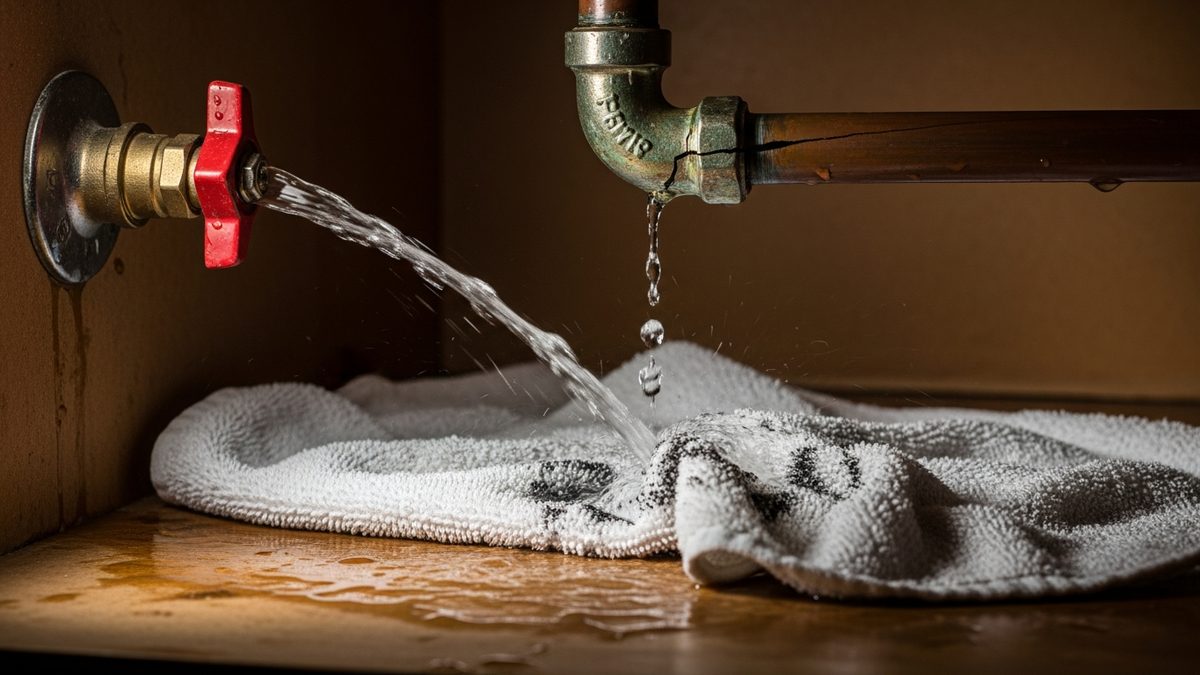
A burst pipe doesn't give you much warning. One minute everything is fine; the next, water is running down a wall or pooling across the floor. Move fast and in the right order and you can limit the damage dramatically. Wrong sequence, and a $500 pipe repair becomes a $15,000 restoration job — or a life-safety hazard.
Here are the correct steps, in order.
What to do right now (first 5 minutes)
Work through these steps in order. Do not skip ahead.
1. Shut off the main water supply. Every second water keeps flowing, more saturates your walls and floors. Find your main shutoff valve and turn it clockwise until it stops. Lever-style ball valves: rotate 90 degrees so the handle is perpendicular to the pipe. (See the section below on where to find it.)
2. Open the cold-water faucets throughout the house. After shutting off the main, open a few faucets starting at the lowest floor. This drains water still sitting in the pipes — routing it out of a faucet you control instead of through the break. Flush toilets once or twice to clear the tank lines.
3. Cut power to any affected areas — safely. Water and electricity are a deadly combination. Go to your breaker panel and switch off circuits for the wet rooms before you walk through standing water. If the breaker panel is in the flooded area, do not touch it — leave the house and call your utility's emergency line. When in doubt, stay out.
4. Move valuables out of harm's way. Once water is off and electricity is safe, quickly move rugs, furniture, electronics, and documents off wet floors. Every minute counts because soft materials absorb moisture fast.
5. Start removing standing water. Use towels, a wet/dry vacuum, or a mop and bucket. The faster water comes up, the less it soaks into subfloor, drywall, and insulation. Open windows and run fans to push air through the space.
6. Document everything before you clean up. Take photos and video of all visible damage — the pipe, water stains, wet flooring, damaged belongings — before you throw anything away or dry things out. Wide shots and close-ups both. Note the time and date. This is your insurance claim evidence.
7. Call a licensed plumber. Call as soon as the immediate emergency is under control. Many offer 24-hour emergency service. You can wrap the break loosely with pipe tape or a clamp kit while you wait, but treat that as a stopgap only — not a real fix.
Safety first
Electrical hazards near water
Water conducts electricity well enough to kill. If water has reached wall outlets, ceiling fixtures, or major appliances, treat the area as a live electrical zone until you've shut off the breaker. Never enter standing water in a room with live circuits. Warning signs: lights still on, buzzing or popping sounds, or a tingling sensation when touching a surface. If any of these are present, leave and call 911 before re-entering.
Natural gas
If you smell a rotten-egg or sulfur odor at any point, stop everything. Get everyone out immediately, leave the door open on the way out, and call 911 and your gas utility from outside. Do not flip any light switches or electrical devices as you exit.
Where to find your main water shutoff
Knowing this before a crisis is one of the most valuable things you can do as a homeowner. Common locations:
- Basement or crawl space: In most single-family homes, look on the interior wall facing the street, near where the main water line enters the house.
- Utility or mechanical room: In homes without a basement, check near the water heater or furnace.
- Garage: Common in warmer-climate homes, along an exterior wall.
- Under a sink or behind an access panel: Typical in condos and townhouses.
- Outside near the foundation: Some homes have the valve on an exterior wall.
- Curb stop at the street: Every property has a utility shutoff at the street, but it requires a special key and is a last resort if the interior valve fails.
Do a walkthrough today. Find the valve, confirm it turns freely, and show every adult in your household where it is.
When to call a plumber (and your insurer)
Call a plumber immediately if: you can't find or operate the shutoff, water keeps flowing after you turn it off, the break is inside a wall or slab, you hear running water but can't find the source, or the pipe is a main or sewer line.
Call your insurer the same day. Most standard homeowners policies cover sudden, accidental water damage from a burst pipe — but not damage from ignored slow leaks or obvious neglect. Have your photos ready, note when it happened, and ask whether an adjuster needs to visit before major repairs begin.
What it typically costs
Costs depend heavily on location, access, and how quickly water was stopped.
Pipe repair (2025–2026):
- Accessible patch or short section: $150–$500
- Inside a wall or ceiling: $300–$1,000
- Main or sewer line: $1,300–$5,000+
- Typical average: ~$500
Water damage restoration:
- Minor (caught fast): $1,400–$5,000
- Moderate (subfloor/drywall): $5,000–$15,000
- Extensive with mold: $15,000–$25,000+; national average ~$3,900
Mold remediation adds $10–$25/sq ft if drying is delayed. The pipe repair is usually the cheapest line item — speed is the real cost-control tool.
Common mistakes to avoid
Waiting to see if it gets worse. It will. A soaked wall cavity that dries in four hours causes a fraction of the damage of one wet for four days.
Not knowing where the shutoff is — or finding out it's corroded and stuck. Test yours once a year.
Walking into a flooded room without cutting power first. Always flip the breakers before you wade in.
Skipping photos. Once cleanup starts, the insurance evidence is gone. Photograph everything first.
Only drying the surface. Saturated drywall and subfloor breed hidden mold. Fans and dehumidifiers need to run for days, not hours.
How to prevent burst pipes
The best burst pipe is one that never happens:
- Never set your thermostat below 55°F when leaving during cold weather.
- Let cold-water faucets drip during hard freezes — moving water resists freezing.
- Open cabinet doors under sinks to let warm air reach pipes on exterior walls.
- Disconnect and drain garden hoses before the first freeze every fall.
- Wrap exposed pipes in garages, attics, and crawl spaces with foam pipe sleeves.
- Have a plumber inspect your system every two years to catch corroded joints early.
For a deeper dive on winter-specific preparation, see our guide on how to prevent pipes from freezing.
FAQ
How quickly does mold grow after water damage? The EPA warns mold can begin growing on wet materials within 24 to 48 hours. Thorough drying needs to start right away. If materials stay wet beyond two days, bring in a professional restoration company.
Does homeowners insurance cover a burst pipe? Most standard policies cover sudden and accidental water damage. What's typically not covered: a slow leak that was ignored, outside flooding (requires separate flood insurance), or damage from obvious neglect like leaving the home unheated. Call your insurer the same day.
What if the pipe is in the wall and I can't find the break? Signs: sudden drop in pressure, a soft or wet spot on the wall, a musty smell, or a spiking water bill. Shut off the main and call a plumber — most carry leak-detection tools that pinpoint breaks without unnecessary demolition.
Can I stay home during repairs? For a minor single-room repair, usually yes. If there is widespread damage, electrical concerns, or visible mold, a restoration professional or adjuster may recommend staying elsewhere until the home is fully dried and repaired.
Get a free quote from a vetted plumber near you
A burst pipe is not the time to guess or delay. Local Service Group connects homeowners with vetted, licensed plumbers in their area — at no cost to you. Get your free quote today and have a qualified pro assess the damage and get your plumbing back to normal.
Sources
- American Red Cross — Preventing and Thawing Frozen Pipes: https://www.redcross.org/get-help/how-to-prepare-for-emergencies/types-of-emergencies/winter-storm/frozen-pipes.html
- U.S. Environmental Protection Agency — Mold Cleanup in Your Home: https://www.epa.gov/mold/mold-cleanup-your-home
- U.S. Environmental Protection Agency — A Brief Guide to Mold, Moisture and Your Home: https://www.epa.gov/mold/brief-guide-mold-moisture-and-your-home
- National Association of Insurance Commissioners — Will My Homeowners Insurance Policy Cover Water Damage From a Burst Pipe?: https://content.naic.org/article/will-my-homeowners-insurance-policy-cover-water-damage-burst-pipe
- Insurance Institute for Business and Home Safety (IBHS) — Winter Ready Guide (via NAIC): https://ibhs.org/winter-ready/
- Angi — How Much Does a Burst Pipe Cost to Repair? (2025 Data): https://www.angi.com/articles/burst-pipe-repair-cost.htm
- HomeAdvisor / Angi — How Much Does Water Damage Restoration Cost? (2026 Data): https://www.homeadvisor.com/cost/disaster-recovery/repair-water-damage/
Disclaimer
The information on this page is provided for general educational purposes only and is offered "as is" and "as available," without warranties of any kind, whether express or implied — including, without limitation, any warranties of accuracy, completeness, reliability, merchantability, or fitness for a particular purpose. It is not professional advice and is not a substitute for inspection, diagnosis, or repair by a licensed, qualified professional.
Home systems involving gas, electricity, water, refrigerant, fire, or structural components can be hazardous, and requirements vary by local code and jurisdiction. Any inspection, diagnosis, repair, installation, or other action referenced on this page should be performed by a licensed professional. You should not rely on this content to perform such work yourself. To the fullest extent permitted by law, [Company Name] and its owners, employees, and contributors assume no responsibility or liability for any injury, death, property damage, or other loss arising out of or in connection with the use of, or reliance on, this information.
If you smell gas or suspect a carbon monoxide leak, leave the area immediately and call 911 or your gas utility from a safe location.