AC Frozen or Iced-Over Coil? Here's What It Means and What to Do
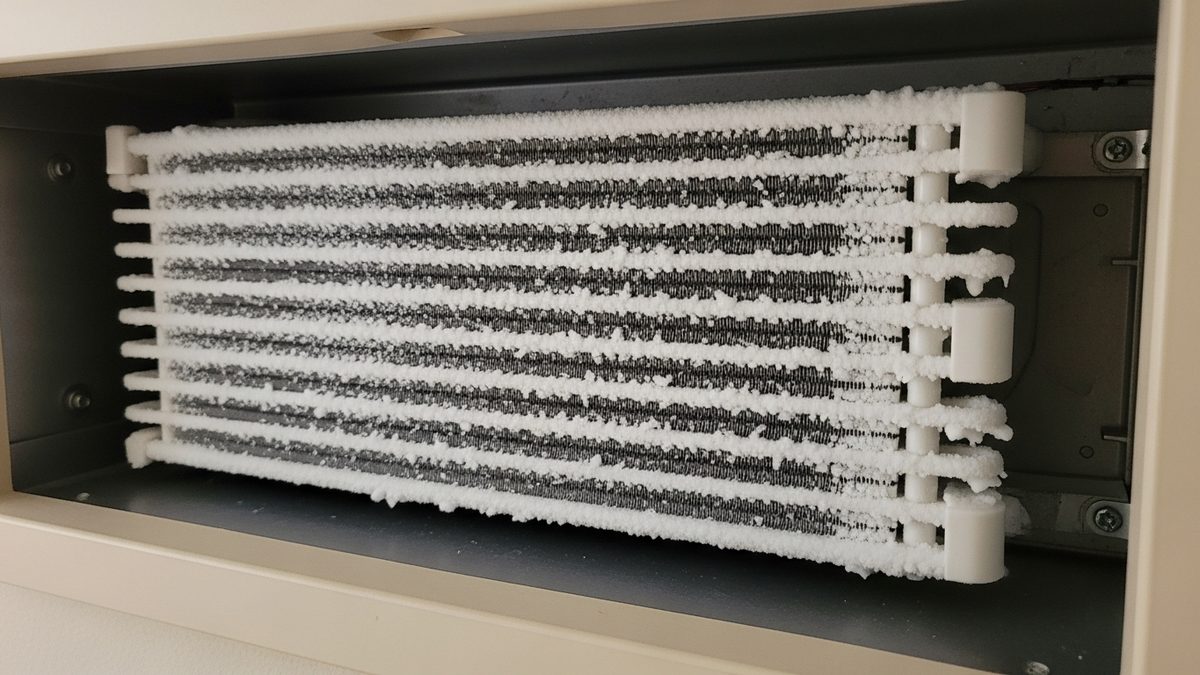
Seeing ice on your air conditioner in the middle of summer feels backwards. But that white crust building up on the indoor unit — or the frost coating the refrigerant line running outside — is your system telling you something is wrong. Ice on an AC coil always means either airflow is restricted or refrigerant isn't behaving the way it should. Neither problem fixes itself. In fact, running a frozen AC long enough can burn out the compressor, which is one of the most expensive parts in the whole system.
The good news: if you catch it early, the fix is often something you can start yourself — like swapping a clogged filter. Here's what's happening, what to do first, and when to hand it off to a pro.
Why AC coils freeze
Your AC's evaporator coil sits inside the air handler (the indoor unit). Warm air from your home passes over it, the refrigerant inside the coil absorbs that heat, and the now-cooled air goes back into your living space. The coil needs a steady supply of warm air to stay above freezing. Take that warm air away — or mess with the refrigerant — and the moisture in the air starts turning to ice on the coil surface.
Restricted airflow is the most common cause. When not enough warm air reaches the coil, the coil temperature drops below 32°F and freezes. The main culprits:
- Dirty air filter. A clogged filter chokes airflow. Trane recommends changing filters every 30 to 90 days depending on household conditions.
- Closed or blocked vents. Shutting supply vents in unused rooms feels like a money-saver, but it backs up pressure in the duct system and reduces flow across the coil.
- Dirty blower fan. Dust buildup on the blower wheel slows it down and cuts airflow even with a clean filter.
- Dirty evaporator coil. A layer of grime on the coil itself acts as insulation and blocks heat transfer, same as shutting the warm air off.
Low refrigerant (a leak). Refrigerant isn't fuel — it doesn't get used up. If levels are low, there's a leak somewhere. Low refrigerant drops the pressure inside the coil, which drops the temperature below freezing. Carrier notes that running a system with low refrigerant is one of the fastest routes to a frozen coil and compressor damage.
Running the AC when it's too cold outside. Most central air conditioners aren't designed to run when outdoor temperatures drop below about 60°F. The system can't balance pressures properly at low ambient temps, and the coil ices over.
Blower or fan motor problems. If the blower motor is failing or a capacitor is weak, the fan may spin too slowly to move enough air — even though the system appears to be running fine.
What to do right now
1. Turn the AC off at the thermostat. Don't just switch modes — turn the system fully off (or to "off" on the cooling setting). Continuing to run a frozen system can push liquid refrigerant back to the compressor, which can destroy it.
2. Set the fan to ON (not AUTO). This keeps the blower running without the cooling cycle. The fan circulates room-temperature air over the coil and speeds up the thaw significantly.
3. Let it thaw completely. Depending on how much ice built up, this can take two to 24 hours. Don't rush it.
4. Never chip or scrape the ice. The aluminum fins on the coil are thin and bent easily. Damage to the fins further restricts airflow and can turn a simple fix into a costly coil replacement.
5. Check and replace the air filter right now. If it's gray and matted, it's overdue. A fresh filter takes two minutes and costs a few dollars. This alone fixes a surprising number of freeze-ups.
6. Put towels around the base of the air handler. As ice melts, water will drain through the condensate pan. If the pan is full or the drain line is clogged, it can overflow. Watch for water on the floor around the unit.
Step-by-step troubleshooting
Once the coil is fully thawed — no visible ice anywhere on the unit or refrigerant lines — work through these steps before restarting:
- Inspect the filter. Replace it if it's dirty or hasn't been changed in more than 90 days.
- Check every supply and return vent in the house. Make sure all vents are open and nothing (furniture, rugs, boxes) is blocking them.
- Look at the condensate drain line. It's usually a PVC pipe exiting near the indoor unit. If it's clogged, the overflow can trip a safety switch and shut the system down — or cause water damage.
- Restart the system and watch it for 30 minutes. If cooling resumes and no ice returns over several hours, a dirty filter was likely the cause.
- If ice comes back, shut it off again. Recurring freezing after a filter change points to a refrigerant leak, dirty coil, or blower issue — all of which need a technician.
Related: why your AC is running but not cooling covers other scenarios where your system runs but can't keep up.
Safety note
Melting ice produces water, and water near electrical components is a hazard. If you see water pooling around the base of your air handler or dripping near wiring or the electrical panel, don't reach in. Turn the system off at the breaker and call a pro.
On refrigerant: under EPA Section 608 of the Clean Air Act, only technicians who hold EPA Section 608 certification are legally permitted to purchase, handle, and recharge refrigerants. This isn't a DIY task — not just because of the legal requirement, but because refrigerant under pressure can cause frostbite and eye injury if mishandled. If you suspect a leak, leave the refrigerant work entirely to a licensed HVAC technician.
When to call a pro
Call an HVAC technician if:
- The coil freezes again after you've replaced the filter and confirmed all vents are open
- You notice refrigerant lines that are oily or dusty in a specific spot (oil near a line often signals a leak)
- You hear hissing or bubbling sounds from the indoor unit
- The system was recently serviced and "topped off" with refrigerant without the leak being found and repaired
- Your blower fan sounds weak, grinds, or runs intermittently
- The coil itself looks visibly dirty or corroded after the thaw
Cost
Repair costs vary widely based on what's actually causing the freeze.
Refrigerant leak repair: According to Angi's 2026 data, repairing a refrigerant leak averages around $800, with a typical range of $250 to $1,600. The wide spread reflects how hard a leak is to find — a simple fitting can be repaired quickly, while a cracked coil may require full replacement.
Evaporator coil replacement: If the coil is leaking or badly damaged, replacement averages $1,350 according to Angi (2026), with a range of roughly $550 to $2,250 for most residential units. Systems no longer under warranty can run $2,500 to $4,500 or more depending on the brand and tonnage.
Evaporator coil cleaning: A professional in-place coil cleaning runs $100 to $400 based on HomeAdvisor's 2025 data. If the coil needs to be removed for a deep clean, expect $400 to $700.
Filter replacement: $5 to $30 at any hardware store — and the first thing to try.
Common mistakes
Chipping the ice. The aluminum fins on the evaporator coil bend with very little force. Bent fins block airflow even after the ice is gone and may require professional straightening (fin combing) to fix.
Running the system anyway. Some homeowners assume the ice will melt on its own while the AC keeps running. It won't — the cycle keeps making more ice while the compressor takes on increasing strain. Compressor replacement can run $1,500 to $2,500 or more.
Topping off refrigerant without fixing the leak. Adding refrigerant to a leaking system is like filling a tire with a nail still in it. The refrigerant will escape again, and you'll keep paying for recharges while the underlying damage continues. EPA regulations require that the leak be located and repaired before a system is recharged.
Assuming ice equals no big deal. A one-time freeze after a filter change is usually minor. A system that keeps freezing, or one that froze because of low refrigerant, needs professional attention before it causes compressor damage.
How to prevent it
Most frozen coil situations are preventable with a little routine maintenance:
- Change the filter every one to three months. Use a filter rated MERV 8 to 11 for most homes — high enough to catch dust and allergens, but not so restrictive that it chokes airflow on its own.
- Keep all vents open. Don't block supply or return vents, even in rooms you don't use. Closed vents disrupt system airflow balance.
- Schedule an annual tune-up. A technician will check refrigerant charge, clean the evaporator coil, test the blower motor, and clear the condensate drain — the main items that lead to freezing. ENERGY STAR recommends professional HVAC maintenance at least once a year.
- Don't run the AC when it's below 60°F outside. If temperatures drop overnight, switch to fan-only mode or turn the system off.
- Keep the area around the indoor unit clear. Don't store boxes or equipment against the air handler where they could block airflow.
FAQ
Can I run my AC while the coil is thawing? No. Keep the system off (or fan-only) until all the ice is gone. Running the cooling cycle while ice is present puts stress on the compressor and keeps adding ice rather than melting it.
How do I know if my coil is frozen without opening the unit? Check the refrigerant line — the larger insulated copper pipe that runs between your indoor and outdoor units. If it's covered in frost or ice, the coil inside is almost certainly frozen too. Also look for reduced or warm airflow from vents, and water dripping from the indoor unit.
My AC was just serviced and now it's freezing. What happened? If a technician recently "topped off" your refrigerant without finding and fixing a leak, the system may be overcharged or the underlying issue wasn't resolved. Improper refrigerant charge — too low or too high — can both cause freezing. Call the same company back and ask them to recheck the charge and inspect for leaks.
Does homeowners insurance cover a frozen coil? Typically no, not for normal wear-and-tear causes like a dirty filter or an aging coil. Some policies cover sudden accidental damage, but refrigerant leaks and gradual system failure are usually excluded. Check your specific policy or ask your insurer.
How long does it take for a frozen coil to thaw? Anywhere from two hours to most of a day, depending on how much ice built up. Running the fan (not the cooling) speeds the process. Don't restart the cooling cycle until every trace of ice is gone — run your hand along the refrigerant line to check.
If your coil has frozen more than once, or if replacing the filter didn't solve the problem, the underlying cause needs professional diagnosis. Get a free quote from a vetted HVAC technician in your area and find out what it will actually cost to fix — before a frozen coil turns into a failed compressor.
Sources
- Top 5 Causes of Frozen AC Coils and How to Fix Them — Trane
- Will Frozen AC Fix Itself? — Carrier
- Section 608 Technician Certification — U.S. EPA
- AC Freon Leak Repair Cost (2026 Data) — Angi
- Evaporator Coil Replacement Cost (2026 Data) — Angi
- How Much Does It Cost to Clean AC Coils? (2025 Data) — HomeAdvisor
Disclaimer
The information on this page is provided for general educational purposes only and is offered "as is" and "as available," without warranties of any kind, whether express or implied — including, without limitation, any warranties of accuracy, completeness, reliability, merchantability, or fitness for a particular purpose. It is not professional advice and is not a substitute for inspection, diagnosis, or repair by a licensed, qualified professional.
Home systems involving gas, electricity, water, refrigerant, fire, or structural components can be hazardous, and requirements vary by local code and jurisdiction. Any inspection, diagnosis, repair, installation, or other action referenced on this page should be performed by a licensed professional. You should not rely on this content to perform such work yourself. To the fullest extent permitted by law, [Company Name] and its owners, employees, and contributors assume no responsibility or liability for any injury, death, property damage, or other loss arising out of or in connection with the use of, or reliance on, this information.
If you smell gas or suspect a carbon monoxide leak, leave the area immediately and call 911 or your gas utility from a safe location.