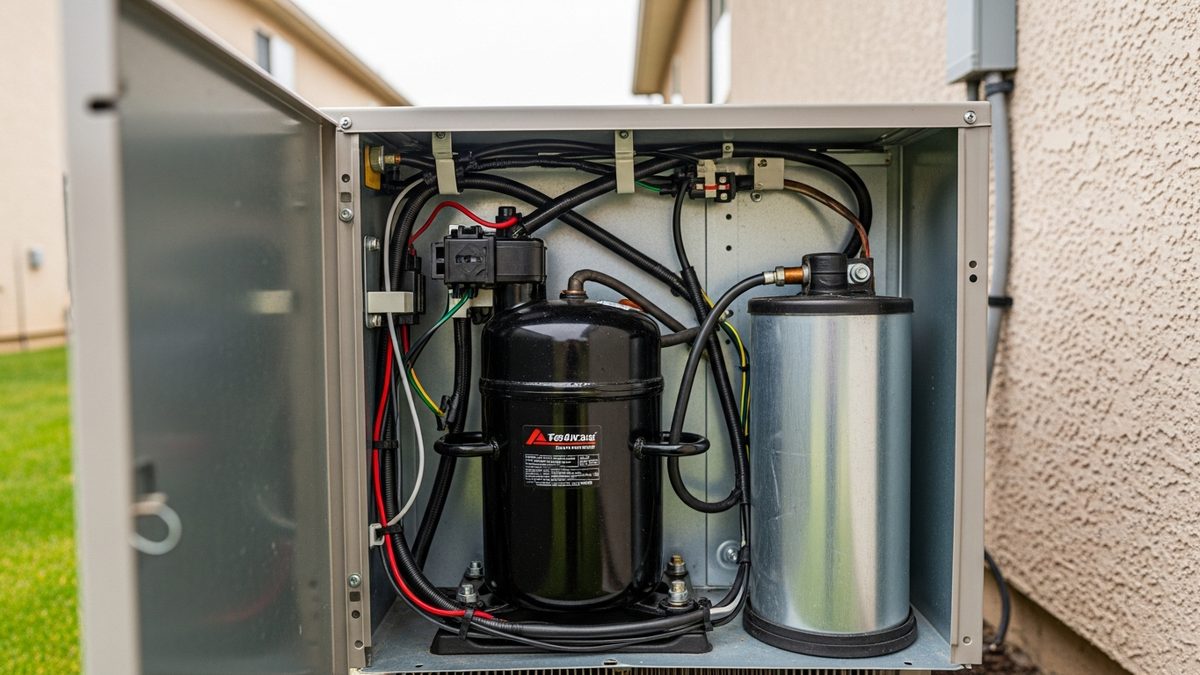
Step outside during a heat wave and find the AC compressor completely silent — no hum, no fan, nothing. The outside unit is just sitting there dead while your house gets warmer. This is one of the most stressful HVAC problems a homeowner can face, but in many cases the fix is straightforward.
The compressor is the heart of your cooling system. It pressurizes refrigerant and sends it through the system to pull heat out of your home. When it doesn't start, you get zero cooling. But the compressor itself is often fine — it's just not getting the signal or the power it needs.
If nothing inside or outside responds at all, start with our guide on if the whole AC won't turn on.
Most likely causes
1. Failed run or start capacitor (most common) The capacitor delivers the jolt of electricity the compressor and fan motor need to start. When it fails, the compressor may hum briefly and then go quiet, or it may not make a sound at all. According to Trane, a bad capacitor is one of the most common reasons a compressor won't kick on. Capacitors typically last 5–10 years and wear faster in hot climates.
2. Worn or burned contactor The contactor is a relay switch that receives a low-voltage signal (24 volts) from the thermostat and closes to allow 240-volt power to reach the compressor. Over time, the contacts pit and burn, preventing a solid electrical connection. A bad contactor is a very common service call, especially on units that are five or more years old.
3. Tripped circuit breaker or blown disconnect fuse Your outdoor unit runs on a dedicated 240-volt circuit. A power surge, a brief short, or an overloaded system can trip that breaker. Check your main panel for a tripped breaker, then check the outdoor disconnect box (the gray box on the wall near the unit) for a blown fuse.
4. Thermostat not calling for cooling If the thermostat isn't set to "Cool" or the set temperature is higher than the current room temperature, the thermostat never sends the signal that energizes the contactor. Batteries can also die in digital thermostats, cutting off all communication with the system.
5. Overheated compressor in thermal lockout On extremely hot days, the compressor's built-in thermal overload switch can trip if the unit has been running hard or if airflow is restricted. The compressor shuts itself off and won't restart for 30–60 minutes. The U.S. Department of Energy notes that a tripped high-pressure limit switch on hot days can stop the compressor without a breaker tripping.
6. Low refrigerant causing a pressure switch trip If refrigerant has leaked out, the low-pressure switch will prevent the compressor from starting to avoid damaging it. This is a pro-only repair — refrigerant handling requires EPA Section 608 certification.
7. Dead compressor motor After many years of service, the compressor motor itself can fail. This is the most expensive outcome and often leads to a system replacement conversation, especially on older units.
Troubleshoot it yourself (safely)
Step 1 — Check the thermostat. Set it to "Cool," drop the set temperature 3–5 degrees below the current indoor reading, and confirm the display is lit. Replace batteries if the display is dim or blank. Wait two minutes and listen for the outdoor unit to start.
Step 2 — Check the circuit breaker. Go to your main electrical panel. Look for a breaker labeled "AC," "condenser," or "compressor." If it's tripped (the toggle sits between On and Off), switch it fully to Off and then back to On. If it trips again within a few minutes, do not reset it a third time — call a technician. Repeated tripping means something in the system is drawing excessive current.
Step 3 — Check the outdoor disconnect. Open the gray box on the wall near the outdoor unit. Pull out the disconnect block and look for any visibly blown fuses (dark residue inside the glass, or a broken filament). Replace with the same amperage rating fuse if you're comfortable doing so, or call an electrician.
Step 4 — Let an overheated system cool down. If the unit was running recently and then just stopped, it may be in thermal lockout. Turn the thermostat to "Off," wait 30 minutes, then try again. If it starts, the problem is likely restricted airflow — check your filter and clear any debris from the outdoor unit.
Step 5 — Listen for a hum. With everything set correctly, if you hear a brief hum or buzz from the outdoor unit when the thermostat calls for cooling but then nothing happens, that strongly suggests a capacitor problem. Note this for the technician.
Safety first
- The outdoor unit runs on 240 volts. Always turn off the breaker at the main panel before opening any panels on the outdoor unit. The disconnect box does not fully de-energize the line side — you need the breaker off.
- Capacitors store a lethal charge even after power is cut. A run capacitor can hold 370–600 volts. Never touch capacitor terminals without proper discharge procedures.
- Do not keep resetting a repeatedly tripping breaker. A breaker that trips over and over is telling you there is a fault somewhere. Forcing it on can cause serious damage or a fire.
- Refrigerant is regulated. Under EPA Section 608, only certified technicians may purchase or handle refrigerant. Attempting to add refrigerant yourself is illegal and potentially dangerous.
When to call a licensed pro
Call a technician if:
- The breaker trips again after a single reset
- The outdoor unit hums but doesn't start after ruling out the thermostat
- The unit makes no sound at all despite good thermostat settings and a live breaker
- The disconnect fuses look visibly blown
- The unit starts but shuts off again within a few minutes (short cycling)
- You suspect a refrigerant leak (hissing sound, ice on the lines, or the system has been low on cooling performance for weeks)
- The compressor is older than 10–12 years and may be at end of life
What it typically costs
| Repair | Typical 2025–2026 Range |
|---|---|
| Capacitor replacement | $200–$400 |
| Contactor replacement | $300–$500 |
| Disconnect fuse replacement | $75–$150 |
| Thermostat replacement | $150–$500 depending on model |
| Refrigerant leak repair + recharge | $500–$1,500+ |
| Compressor replacement | $1,500–$3,500+ |
Source: Angi and HomeGuide cost data, 2026.
Common mistakes
- Skipping the thermostat check. It sounds too simple, but a dead battery or wrong mode setting causes a surprising number of service calls that homeowners could have solved in two minutes.
- Repeatedly resetting a tripping breaker hoping it will "stick." It won't, and you risk damaging the compressor or wiring.
- Assuming the compressor is dead before testing the capacitor and contactor. Both of those parts fail far more often than the compressor itself, and they're much cheaper.
- Running the AC with restricted airflow (dirty filter, blocked vents). This leads to thermal lockout and, over time, compressor failure.
How to prevent it
- Replace your air filter every 1–3 months. A clogged filter forces the compressor to work harder and run hotter.
- Schedule an annual spring tune-up. A technician will test the capacitor voltage, inspect the contactor, measure refrigerant pressure, and clean the coils — all before problems become failures.
- Keep the outdoor unit clear of grass, leaves, and shrubs. Aim for at least two feet of clearance on all sides for proper airflow.
- Don't run the AC if the outdoor temperature is below about 60°F. Most residential compressors aren't designed to operate in cold conditions and can be damaged.
FAQ
My AC worked fine yesterday. Why won't it start today? Capacitors and contactors often fail suddenly with no warning. A power surge (from a storm or utility switching) can also push a marginal component over the edge. Check the breaker first, then call a tech.
The outdoor unit makes a clicking sound but nothing else happens. What is that? The contactor or a relay is receiving the thermostat's signal and trying to close but failing to send power. This is a classic sign of a worn contactor. Call a technician.
How do I know if it's the capacitor vs. the contactor? Both require a multimeter to test accurately. A capacitor failure often sounds like a brief hum that fades. A contactor failure may mean complete silence outside even with a proper thermostat call. A technician can diagnose both in minutes.
Is it worth replacing the compressor on an older unit? On systems older than 10–12 years, a failed compressor usually warrants a full system replacement rather than a $2,000+ compressor swap. Your technician can help you weigh the cost.
Can low refrigerant prevent the compressor from starting? Yes. Most systems have a low-pressure safety switch that prevents the compressor from starting when refrigerant is too low, protecting the compressor from damage. A refrigerant leak requires a certified technician to locate, repair, and recharge.
Don't sit in a hot house waiting. Connect with a licensed HVAC pro near you using the form below — free quote, no commitment required.
Sources
- Trane — Central AC Compressor Not Turning On? Find Out Why https://www.trane.com/residential/en/resources/troubleshooting/air-conditioners/ac-compressor-not-turning-on/
- Carrier — AC Unit Not Turning On? Troubleshooting Steps and Solutions https://www.carrier.com/us/en/residential/hvac-resources/air-conditioners/ac-unit-not-turning-on/
- U.S. Department of Energy — Common Air Conditioner Problems https://www.energy.gov/energysaver/common-air-conditioner-problems
- EPA — Section 608 Technician Certification Requirements https://www.epa.gov/section608/section-608-technician-certification-requirements
- Angi — How Much Does an AC Contactor Replacement Cost? (2026) https://www.angi.com/articles/ac-contactor-replacement-cost.htm
- HomeGuide — AC Capacitor Replacement Cost (2026) https://homeguide.com/costs/ac-capacitor-replacement-cost
Disclaimer
The information on this page is provided for general educational purposes only and is offered "as is" and "as available," without warranties of any kind, whether express or implied — including, without limitation, any warranties of accuracy, completeness, reliability, merchantability, or fitness for a particular purpose. It is not professional advice and is not a substitute for inspection, diagnosis, or repair by a licensed, qualified professional.
Home systems involving gas, electricity, water, refrigerant, fire, or structural components can be hazardous, and requirements vary by local code and jurisdiction. Any inspection, diagnosis, repair, installation, or other action referenced on this page should be performed by a licensed professional. You should not rely on this content to perform such work yourself. To the fullest extent permitted by law, [Company Name] and its owners, employees, and contributors assume no responsibility or liability for any injury, death, property damage, or other loss arising out of or in connection with the use of, or reliance on, this information.
If you smell gas or suspect a carbon monoxide leak, leave the area immediately and call 911 or your gas utility from a safe location.