Tankless Water Heater Not Getting Hot or Showing an Error Code?
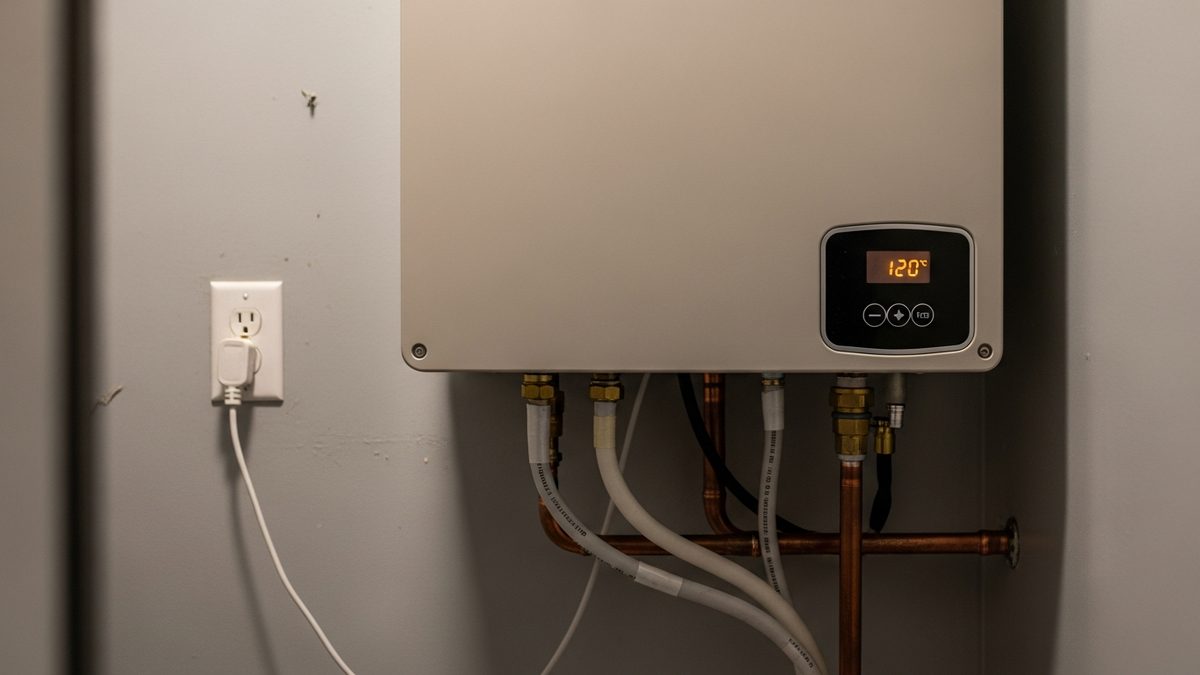
Tankless water heaters can be 24–34% more energy efficient than conventional storage tank heaters for average households and typically last more than 20 years — but when one stops producing hot water or flashes an error code, most homeowners don't know where to start. [1]
This guide covers the most common causes, what the error codes mean in plain language, and when to hand the job to a licensed plumber.
How a tankless unit works (the quick version)
Unlike a tank heater, a tankless unit holds no stored hot water. When you open a hot faucet, a flow sensor detects the water movement and fires the burner (gas) or activates the elements (electric). Water heats as it passes through the heat exchanger.
Several things must work together — minimum flow rate, adequate gas or electrical supply, a clean heat exchanger, and proper venting — or you get lukewarm water, no hot water, or an error code.
Most common causes, ranked
1. Flow rate too low or minimum not reached
Tankless units require a minimum water flow to activate — typically 0.5–0.75 GPM, though this varies by model. If the faucet or showerhead doesn't produce enough flow, the unit will not fire at all.
This is one of the most common causes of "no hot water" complaints, especially after low-flow fixtures are installed. A clogged inlet filter screen (a small mesh strainer at the cold water inlet) can also restrict flow below the threshold.
Try this: Run the hot water faucet at full open instead of a trickle. Check the inlet filter screen — shut off water to the unit, remove the cold inlet connection, and clean the screen under running water.
2. Flow sensor fouled or failed
The flow sensor tells the unit water is moving and it should start heating. Scale, sediment, or simple wear can cause it to stop working. If the unit makes no sound at all when you open a hot faucet at full flow, a flow sensor problem is likely.
Fix: a plumber can clean or replace the sensor. This is not a DIY repair.
3. Scale buildup in the heat exchanger
This is the slow killer of tankless units in hard water areas. Calcium and magnesium deposits build up inside the heat exchanger over time, reducing efficiency, restricting flow, and eventually causing faults.
Signs: water that was once scalding hot has gradually become less hot; overheating error codes; occasional gurgling from inside the unit.
The DOE recommends annual descaling in hard water areas. [1] Most manufacturers — including Rinnai and Navien — publish procedures for circulating diluted white vinegar or citric acid through the heat exchanger using a small pump. Many homeowners have a plumber handle this as part of annual service.
4. Insufficient gas supply
A whole-house tankless gas heater needs a large, fast gas supply. If the line is undersized, the unit may fire but consistently underperform — especially when multiple fixtures run at once.
Signs: good hot water at one faucet but not two simultaneously; poor performance since day one.
Fix: a licensed plumber or gas technician must verify the supply line is properly sized. This is a code-governed installation requirement.
Safety note: If you smell gas near the water heater, stop all troubleshooting immediately. Leave the house, leave a door open, and call your gas company and 911 from outside. [2]
5. Venting or combustion air problem
Gas tankless units use either a direct-vent system (outside combustion air) or a power-vent system (indoor air, outdoor exhaust). A blocked vent, separated vent joint, or improperly installed pipe can cause the unit to lock out for safety.
Signs: ignition failure or high exhaust temperature error codes; unit fires briefly then shuts down; soot marks near the vent termination outside.
Try this: Check the vent termination outside for bird nests, ice, leaves, or other debris. Check that vent pipe joints have not separated. Beyond that, venting diagnosis requires a licensed installer.
6. Cold-water sandwich
This is not a failure — it's a quirk of tankless operation. After one person finishes, hot water sits in the pipes. The next person gets that warm water, then briefly cold (pipes refilling), then hot again once the unit fires.
Nothing to repair. A recirculation system with a buffer tank eliminates it if it's a frequent annoyance.
Reading common error codes
Specific codes vary by brand, but the categories are consistent:
| Code Category | What It Usually Means |
|---|---|
| Ignition failure (e.g., Rinnai 11, Navien E003) | Gas not reaching burner, bad gas valve, failed igniter |
| Combustion / exhaust fault (e.g., Rinnai 12, Navien E012) | Venting blockage, insufficient combustion air |
| Overheat / thermal cutoff (e.g., Navien E030) | Scale in heat exchanger, very high inlet temperature |
| Flow sensor fault | Flow sensor dirty or failed |
| Water leak detected | Internal leak — shut off water supply and call a plumber |
| Gas pressure fault | Supply pressure out of spec — call your gas company or plumber |
Look up your specific code in your owner's manual or on the manufacturer's support site. Many codes require a reset (power-cycle the unit), but they will return if the underlying cause is not fixed.
Troubleshoot it yourself (safely)
- Write down the error code and look it up in the manual or on the manufacturer's website.
- Reset the unit — power off, wait 30 seconds, power back on.
- Run the hot faucet at full open to confirm you have strong cold water flow on the supply side.
- Clean the inlet filter screen — shut off the water supply to the unit, remove the cold inlet connection, and inspect the mesh screen.
- Check the gas supply — confirm other gas appliances are working normally.
- Check the vent termination outside for obvious blockages.
Do not open the unit casing, work on gas connections, or attempt heat exchanger repairs yourself.
Safety first
Gas smell: stop and leave. If you smell gas near the unit at any point, stop all troubleshooting. Leave immediately, leave a door open, and call your gas company and 911 from outside. [2]
Carbon monoxide: A venting problem on a gas tankless unit can cause CO to enter your living space. Install CO detectors on every level and test them monthly. A CO alarm means: leave, leave a door open, call 911. [2]
Electric tankless units: Operate at 240V with very high amperage. Turn off the dedicated circuit breaker before any access. Do not open the cover or touch any wiring.
Scalding: Set the output temperature to 120°F as recommended by the CPSC. [2] Tankless units can deliver very hot water very quickly when set higher.
When to call a licensed plumber
- Error code recurs after resetting
- Any gas-related fault code
- Venting problems beyond a simple outdoor blockage
- Unit hasn't been descaled in 2-plus years in a hard water area
- Output temperature has gradually declined over months
- Water leak error code
- Unit is 15-plus years old with recurring faults
What it typically costs
| Service | Typical Range (2025–2026) |
|---|---|
| Professional descaling | $150 – $300 |
| Flow sensor replacement | $200 – $400 |
| Gas valve / igniter service | $200 – $500 |
| Venting inspection and repair | $150 – $350 |
| New gas tankless (whole-house, installed) | $1,500 – $4,500 |
| New electric tankless (installed) | $800 – $2,000 |
Common mistakes
Ignoring descaling. Scale buildup is silent until it causes a fault. In hard water areas, annual descaling is what makes 20-year lifespan possible — not optional maintenance.
Resetting codes without fixing the cause. A code that keeps coming back means something is actually wrong. Repeated resets without a root cause diagnosis will eventually lead to more expensive damage.
Running too many fixtures at once. Every tankless unit has a maximum GPM output. Know your unit's rated flow and plan simultaneous use accordingly.
Skipping the inlet filter. A clogged inlet screen looks exactly like a flow sensor failure — the unit simply won't fire. Always check the screen first before assuming a bigger problem.
How to prevent problems
- Descale annually (hard water) or every two years (soft water). [1]
- Clean the inlet filter screen every 6 months.
- Have a plumber inspect the unit every 2–3 years — burner, igniter, venting, connections.
- Install a water softener or scale inhibitor upstream of the unit if water is hard.
- Maintain CO detectors near the unit and on every floor.
FAQ
Why do I get a cold burst in the middle of a shower? Likely a cold-water sandwich (see above). If it lasts more than a minute, the unit may not be keeping up with demand, or gas supply may be inadequate.
My unit is 3 years old and showing scale errors. Normal? In very hard water areas, yes. Scale builds based on water hardness and total volume, not just age. Descale now to prevent heat exchanger damage.
Can I descale it myself? Many manufacturers publish DIY instructions using a small pump, bucket, hoses, and white vinegar. It takes about an hour. Annual plumber-performed descaling is the more reliable option.
Is every error code a big repair? Not always. Some codes are maintenance reminders. The rule: if it comes back after a reset, get it diagnosed by a plumber.
Get a free quote
Tankless water heater issues are usually fixable fast when a licensed plumber diagnoses them correctly. Contact Local Service Group for a free, no-obligation quote.
Sources
- https://www.energy.gov/energysaver/tankless-or-demand-type-water-heaters
- https://www.navieninc.com/support
- https://www.energy.gov/energysaver/storage-water-heaters
Disclaimer
The information on this page is provided for general educational purposes only and is offered "as is" and "as available," without warranties of any kind, whether express or implied — including, without limitation, any warranties of accuracy, completeness, reliability, merchantability, or fitness for a particular purpose. It is not professional advice and is not a substitute for inspection, diagnosis, or repair by a licensed, qualified professional.
Home systems involving gas, electricity, water, refrigerant, fire, or structural components can be hazardous, and requirements vary by local code and jurisdiction. Any inspection, diagnosis, repair, installation, or other action referenced on this page should be performed by a licensed professional. You should not rely on this content to perform such work yourself. To the fullest extent permitted by law, [Company Name] and its owners, employees, and contributors assume no responsibility or liability for any injury, death, property damage, or other loss arising out of or in connection with the use of, or reliance on, this information.
If you smell gas or suspect a carbon monoxide leak, leave the area immediately and call 911 or your gas utility from a safe location.