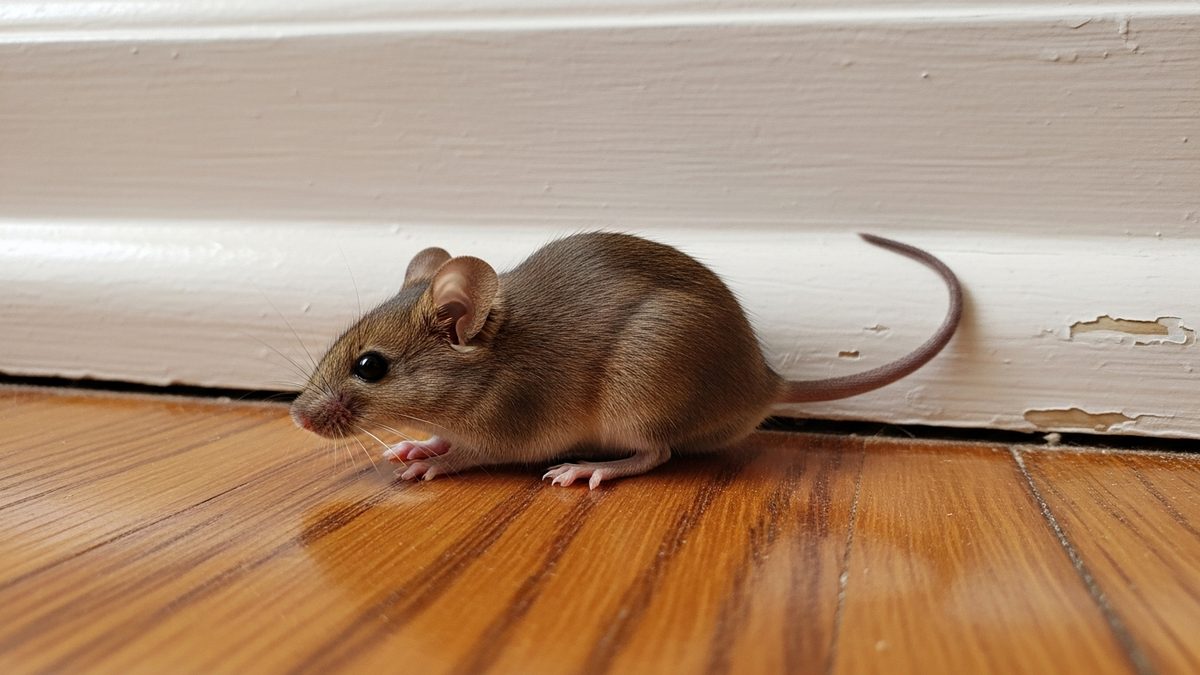
You found droppings behind the stove. Or maybe you heard scratching in the wall at 2 a.m. Either way, you need to figure out what you are dealing with before you set a single trap, because mice and rats behave differently, travel at different heights, prefer different baits, and require different strategies to eliminate.
This guide walks through the physical evidence—droppings, gnaw marks, tracks, sounds, nesting, and entry holes—so you can make a confident ID and take the right next step. If you have confirmed mice, also see our guide on how to get rid of mice.
Why the Identification Matters
House mice (Mus musculus) and Norway rats (Rattus norvegicus) are the most common rodent intruders in American homes. They are not interchangeable pests. Rats are much larger and stronger, can gnaw through softer metals, and are harder to trap because they are neophobic—suspicious of new objects in their environment. Mice are curious and easier to trap but reproduce faster. A pair of mice can produce 10 litters per year, with 5 to 6 young each time.
Treatment differences are practical: standard snap traps come in mouse-size and rat-size, and using the wrong size either misses the rodent or fails to kill it humanely. Bait placement matters too—mice rarely travel more than 10 to 30 feet from their nest, so traps go near nesting areas; rats range 100 to 300 feet and travel along walls in established runways.
Droppings: The Most Reliable Clue
Fresh droppings are dark and moist. Old droppings are gray, dry, and crumble when pressed.
Mouse droppings are small—about 1/8 to 1/4 inch long, roughly the size of a grain of rice, with pointed ends. A mouse leaves 40 to 100 droppings per day, scattered widely, because mice defecate as they move.
Rat droppings are much larger—about 1/2 to 3/4 inch long, with blunt or rounded ends. Norway rat droppings are often described as looking like large raisins or olive pits. Rats deposit 20 to 50 droppings per day, clustered near feeding sites and runways.
If you find both small and large droppings, you may have both. That is not unusual in a heavily infested structure.
Gnaw Marks
Both rodents gnaw constantly—their teeth never stop growing, so they must file them down.
Mouse gnaw marks are small and irregular, with tiny tooth marks. Mice typically gnaw to enlarge a small existing gap or to access food packaging. The damage pattern looks nibbled rather than chewed through.
Rat gnaw marks are larger and often show distinct parallel incisor grooves. Norway rats can gnaw through lead pipes, aluminum sheeting, cinder block, and even thin concrete given enough time. Fresh gnaw marks on wood have a clean, pale appearance. Old marks are darker. If you see large chunks of material missing—not just surface scratches—it is probably a rat.
Tracks and Runways
Rodents follow the same paths repeatedly, and those paths leave evidence.
Tracks. Sprinkle a thin layer of talc, flour, or baby powder near suspected activity. Mouse footprints are about 3/8 inch wide; rat footprints measure closer to 3/4 to 1 inch and show a tail drag mark in between. Rat tail drag marks are usually more pronounced because the tail is heavier.
Runways. Rats establish fixed routes along walls, pipes, and structural beams, and those paths accumulate grease from their fur over time. If you see a dark, greasy smear along a wall at baseboard level, that is a rat runway. Mice use walls too but tend to be less consistent in their paths and leave lighter grease marks.
Sounds
Mice produce high-pitched squeaking and light scratching sounds. You typically hear mice in walls or ceilings at night. The scratching is rapid and light.
Rats make louder, deeper scratching, gnawing, and thumping sounds. Norway rats prefer lower areas—under floors, in basements, inside walls near the ground level. Roof rats (Rattus rattus, less common in northern states) prefer upper areas and are often heard in attics and ceilings.
If the sounds are heavy enough to suggest something substantial moving around, lean toward rats.
Nesting Material
Mice build compact nests from shredded paper, fabric, insulation, and other soft materials. Nests are usually tennis-ball to softball-sized and found in hidden, sheltered spots—inside appliances, in wall insulation, behind stored boxes in closets.
Rats build larger, bulkier nests from similar materials but may also burrow underground near a foundation or under a concrete slab.
Entry Holes
Mouse entry holes can be as small as 1/4 inch in diameter. Mice can compress their skull and body to squeeze through any gap they can get their head into. Check where utility pipes and wires enter the home, gaps under doors, and cracks in the foundation.
Rat entry holes are at least 1/2 inch in diameter and usually have smooth, rounded edges worn by repeated use. Look for burrow openings in the soil along the foundation and gnawed holes at the base of walls.
Health Risks: What the CDC Says
Both rodents carry pathogens and should be treated as a health concern, not just a nuisance.
The CDC identifies hantavirus pulmonary syndrome (HPS) as a primary concern linked to rodent infestations. In the United States, the deer mouse is the most common carrier, but white-footed mice, rice rats, and cotton rats also carry hantaviruses. The virus spreads when people breathe in air contaminated with rodent urine, droppings, or nesting material—often during cleanup activities.1
The CDC recommends these precautions before and during rodent cleanup:
- Wear rubber or plastic gloves
- Do not vacuum or dry-sweep droppings—this aerosolizes the virus
- Wet the area thoroughly with a bleach solution (1.5 cups of bleach per gallon of water) and let it soak for 5 minutes before wiping up1
- Bag and dispose of all material in a sealed trash bag
- Wash hands thoroughly with soap and water after removing gloves
Rats also carry leptospirosis (through urine), salmonella (through droppings contaminating food surfaces), and can introduce fleas that carry other pathogens.
When to Call a Pro
DIY rodent control works well for minor mouse activity with a clear entry point and a small infestation. Consider calling a pest management professional if:
- You are finding droppings in multiple rooms
- You have identified rat activity (rats are much harder to eliminate without professional exclusion work)
- You have sealed entry points but activity continues
- The infestation appears to involve more than 5 to 10 animals
- There are signs of nesting inside wall cavities or under floors
A professional will do a full exclusion inspection—sealing all entry points—in addition to placing traps or bait stations. Without exclusion, you will keep getting new animals.
What It Typically Costs
A professional rodent control visit (inspection plus initial treatment) typically runs $150 to $450 depending on the size of the home and severity of the infestation. Full exclusion work—sealing all entry points—can add $200 to $600 or more depending on how many gaps need sealing. Most pest control companies offer follow-up visits as part of a treatment plan.
Common Mistakes
Setting traps along open walls instead of against walls. Rodents hug the perimeter. Traps placed perpendicular to the wall with the trigger end against the baseboard catch far more than traps set in open areas.
Using too few traps. One trap for a mouse problem rarely works. Set traps in clusters of 2 to 3 at each known activity site.
Giving up after a few days. Rats, especially, are neophobic—they may avoid new traps for 3 to 5 days before investigating them. Be patient.
Relying on poison alone without exclusion. Rodenticide bait kills individual rodents but does nothing to stop new animals from entering. Always combine bait or trapping with sealing entry points.
How to Prevent Rodent Infestations
- Seal all gaps 1/4 inch or larger around pipes, wires, and structural penetrations with steel wool or hardware cloth embedded in caulk or foam.
- Store all food in hard-sided, sealed containers—not bags or cardboard boxes.
- Keep pet food sealed and do not leave it out overnight.
- Eliminate clutter in garages, basements, and crawl spaces that provides nesting material.
- Maintain a clean perimeter around your home—stack firewood away from the foundation, trim shrubs back from the house, and keep the area under decks clear.
- Fix leaks promptly. Water sources attract rodents as much as food does.
Frequently Asked Questions
Can I have mice and rats at the same time? Yes, though it is less common than a single-species infestation. Rats will sometimes drive out mice. However, in larger buildings or homes with multiple entry points, both can coexist.
How do I know if the infestation is active? Fresh droppings are dark and moist. Old droppings are gray and dry. If you are finding fresh droppings or hearing sounds at night, the infestation is active.
Why do I smell something but not see any droppings? Rodents may be active in a wall cavity, crawl space, or area you have not checked. A strong ammonia-like odor often indicates rodent urine. Search all possible hiding spots, including inside appliances, under insulation batts, and inside cabinetry.
My cat brought in a rodent. Does that mean I have an infestation? Not necessarily. Cats can catch outdoor rodents that have not entered the home. But if your cat is consistently finding them indoors, it is worth doing a thorough inspection for entry points.
Are snap traps or live traps better? For most homeowners, snap traps are more effective and more humane than glue traps, which cause prolonged distress. Live traps work but require you to release the animal at least a mile away, and rodents can find their way back. For rats, larger-sized snap traps or electric traps are more reliable.
Get a Free Quote
If you have found signs of rodents and want a professional evaluation, a local pest control pro can identify exactly what you are dealing with and recommend the right treatment plan. Request your free estimate today.
Sources
Disclaimer
The information on this page is provided for general educational purposes only and is offered "as is" and "as available," without warranties of any kind, whether express or implied — including, without limitation, any warranties of accuracy, completeness, reliability, merchantability, or fitness for a particular purpose. It is not professional advice and is not a substitute for inspection, diagnosis, or repair by a licensed, qualified professional.
Home systems involving gas, electricity, water, refrigerant, fire, or structural components can be hazardous, and requirements vary by local code and jurisdiction. Any inspection, diagnosis, repair, installation, or other action referenced on this page should be performed by a licensed professional. You should not rely on this content to perform such work yourself. To the fullest extent permitted by law, [Company Name] and its owners, employees, and contributors assume no responsibility or liability for any injury, death, property damage, or other loss arising out of or in connection with the use of, or reliance on, this information.
If you smell gas or suspect a carbon monoxide leak, leave the area immediately and call 911 or your gas utility from a safe location.
Footnotes
-
U.S. Centers for Disease Control and Prevention — Hantavirus Prevention ↩ ↩2