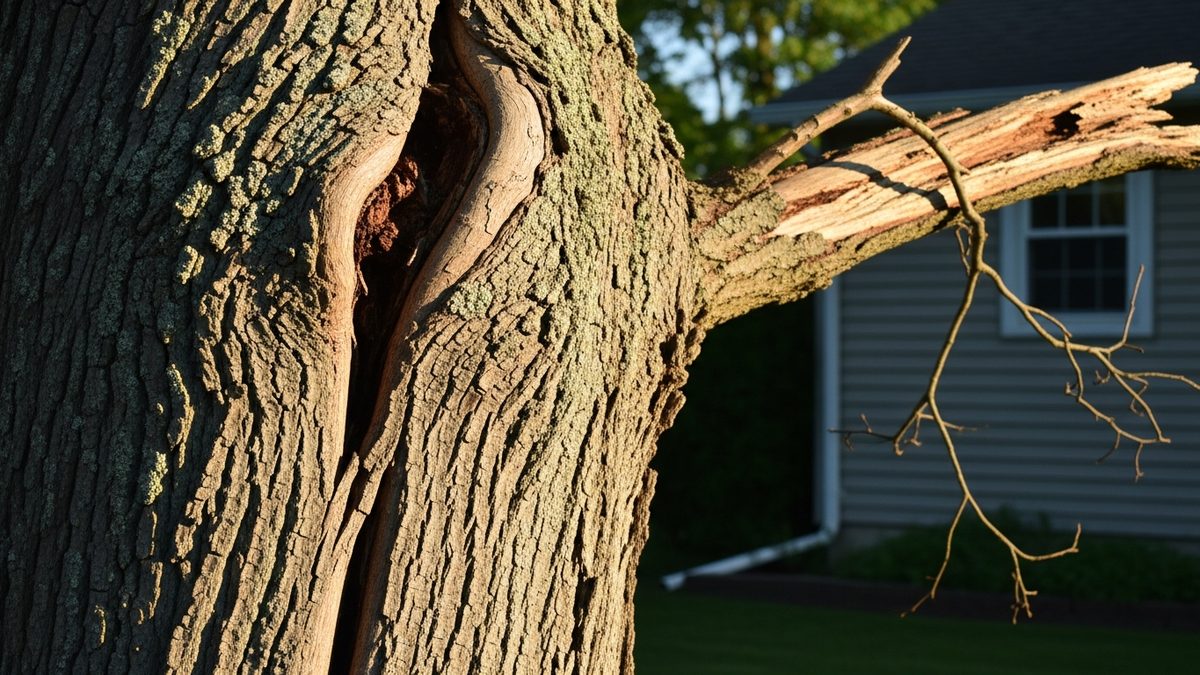
Most trees live for decades without ever posing a serious risk. But trees do fail—and when they do, they can take out a roof, crush a car, or bring down a power line in seconds. The trick is catching the warning signs before the storm does.
This guide covers the red flags that suggest a tree may be dangerous, when to call a certified arborist, and what professional tree services typically cost.
Why Trees Fail
Trees fail when internal decay, structural defects, root damage, or external stressors weaken their ability to support their own weight. Wind, ice, and heavy rain can bring down a tree that looked fine from the outside for years. The USDA Forest Service notes that most hazardous trees show external clues—you just have to know what to look for.1
The risk depends on two things: how likely is the tree to fail, and what would it hit if it did? A dead tree in a remote corner of your yard is a lower priority than a leaning tree directly over your roof.
Warning Signs That Demand Attention
Dead or hanging limbs. Large dead branches—called "widow makers"—can fall without warning, even in calm weather. The USDA notes that shelf fungi or polypore fungi growing on branches indicate the wood inside is already dead and likely to drop.1 Look for branches that have no leaves in season, bark that is peeling away, or limbs that are visibly cracked.
A lean that is getting worse. Some trees naturally grow at an angle, and that is fine. What is not fine is a lean that has developed or increased recently, or one that points toward your house, power lines, or a neighbor's structure. A sudden lean after a storm or heavy rain often indicates root damage or soil heaving on one side.
Trunk cracks and cavities. Vertical cracks, large splits, or hollow sections in the trunk are serious red flags. A cavity means the tree has lost structural wood at its core. Even if the outer layers still look healthy, a hollow trunk can buckle under wind load or ice weight. Multiple cracks running in the same direction are especially concerning.
Root heaving and exposed roots. If the soil near the base of the tree is lifting, cracking, or the root ball is visibly shifting, the tree's anchor is compromised. This can happen after a prolonged wet season when soil becomes saturated, or after root damage from construction, trenching, or grade changes nearby.
Fungus or mushrooms at the base. Mushrooms and conks (shelf fungi) growing at or near the base of a tree are a strong indicator of internal rot. The USDA Forest Products Laboratory documents that fungal bodies at the base often signal decay in the root system or lower trunk, significantly reducing the tree's ability to withstand load.1 Decay at the root zone is one of the most dangerous failure points because it is largely invisible.
Bark abnormalities. Sunken, loose, or missing bark patches—especially if accompanied by oozing sap or a foul odor—can indicate cankers (fungal or bacterial infections that kill the cambium layer). The USDA Forest Service identifies canker symptoms as a significant precursor to branch dieback and structural failure.1
Codominant stems with a tight V-crotch. When two main trunks grow from a single base in a tight V shape, bark grows between them rather than solid wood joining them. This "included bark" is a structural weak point. These stems are prone to splitting apart under wind or heavy snow load.
Proximity to targets. A tree's risk level increases dramatically based on what it could hit. Power lines, roofs, cars, driveways, and areas where children play all raise the stakes. A tree that might rate as low-risk in an open field becomes high-risk when it overhangs your house.
When to Call an ISA-Certified Arborist vs. When It's an Emergency
Schedule a professional assessment if you see any of the warning signs above but the tree is still standing with no immediate threat. An ISA-certified arborist is trained to evaluate tree structure, root health, and failure probability. Look for the ISA (International Society of Arboriculture) certification credential, not just a general tree-trimming company. ISA Tree Risk Assessment Qualified (TRAQ) arborists follow a standardized risk evaluation process.2
Treat it as an emergency if:
- The tree is actively leaning and recently shifted
- Large limbs are hanging over occupied areas after a storm
- The trunk has cracked open
- The tree has partially uprooted (you can see the root ball lifting)
- A tree has already fallen onto a structure or power line
If a tree has hit power lines, do not approach. Call your utility company first, then a tree service.
What It Typically Costs
A professional tree inspection or risk assessment runs roughly $100 to $250 for a standard evaluation, and $150 to $700 for a detailed written report.3
Tree removal costs vary based on tree size, location, and complexity. The typical range is:
- Small trees (under 30 feet): $200 to $450
- Medium trees (30 to 60 feet): $450 to $1,000
- Large trees (60 feet and up): $1,000 to $2,000 or more
Emergency removal after storm damage can carry a 50 to 200 percent premium, with same-day or after-hours calls starting higher.3
Stump grinding adds another $75 to $300 depending on stump size. Many companies include it in removal quotes if you ask.
Common Mistakes
Waiting until a storm forces the issue. Storm-season tree removal prices spike and wait times grow. Address a suspected hazard tree in late winter or early fall when demand is lower.
Hiring unlicensed climbers. Tree work is consistently ranked among the most dangerous occupations in the U.S. An unlicensed worker injured on your property may create liability. Verify ISA certification and ask for proof of insurance.
DIY pruning of large limbs. Cutting a large limb without understanding fall direction and hinge cuts can cause the limb to kick back or drop unexpectedly. For anything larger than what you can handle with a pole pruner from the ground, hire a pro.
Ignoring one warning sign because others look fine. A tree can look lush and green on top and still be severely compromised at the root zone. A single significant red flag—root heaving, large fungal conks at the base, or a new lean—is enough to warrant a professional look.
How to Prevent Tree Hazards
- Have mature trees near your home assessed by an ISA-certified arborist every three to five years, or after any major storm.
- Water trees during dry spells. Drought stress weakens a tree's defenses against disease and pests.
- Avoid parking heavy equipment or doing construction within the drip line of a tree (the circle defined by the outermost branches). Root compaction from heavy vehicles can kill a tree within a few years.
- Do not top trees. Topping—cutting back main branches to stubs—creates large wounds that decay faster than the tree can compartmentalize them, eventually leading to structural failure.
- Plant new trees at appropriate distances from structures. Most large shade trees should be planted at least 20 feet from a foundation.
Frequently Asked Questions
How can I tell if a dead branch will fall soon? There is no guaranteed timeline. Dead branches can fall in calm weather, but wind and ice dramatically increase the risk. If a dead branch is large (more than 2 to 3 inches in diameter) and hangs over a structure or frequently used area, have it removed rather than waiting.
My neighbor's tree is leaning toward my house. What can I do? Start with a friendly conversation. If the neighbor is unresponsive and the tree shows clear hazard signs, document the issue in writing and consult your local municipality—some areas have ordinances about hazard trees. Your homeowner's insurance agent can also advise you.
Can a leaning tree be saved? Sometimes. A tree that has always grown at a slight angle is usually stable. A tree that recently shifted or whose root ball is visibly lifting is generally a removal candidate. An ISA-certified arborist can tell you whether cabling, bracing, or corrective pruning can make a leaning tree safe long term.
Is a hollow tree always dangerous? Not automatically. The amount of remaining sound wood around the hollow, the tree's height and lean, and what it could fall on all factor into the risk. A small hollow in a short tree in an open area may not require action; a large hollow in a tall tree over your roof is a different situation.
Do I need a permit to remove a tree? Many municipalities require a permit to remove trees above a certain diameter. Check with your local planning or zoning department before scheduling removal.
Get a Free Quote
If you have a tree that is worrying you, a local tree service pro can walk your property and tell you exactly what you are dealing with. Request your free assessment today.
Sources
Disclaimer
The information on this page is provided for general educational purposes only and is offered "as is" and "as available," without warranties of any kind, whether express or implied — including, without limitation, any warranties of accuracy, completeness, reliability, merchantability, or fitness for a particular purpose. It is not professional advice and is not a substitute for inspection, diagnosis, or repair by a licensed, qualified professional.
Home systems involving gas, electricity, water, refrigerant, fire, or structural components can be hazardous, and requirements vary by local code and jurisdiction. Any inspection, diagnosis, repair, installation, or other action referenced on this page should be performed by a licensed professional. You should not rely on this content to perform such work yourself. To the fullest extent permitted by law, [Company Name] and its owners, employees, and contributors assume no responsibility or liability for any injury, death, property damage, or other loss arising out of or in connection with the use of, or reliance on, this information.
If you smell gas or suspect a carbon monoxide leak, leave the area immediately and call 911 or your gas utility from a safe location.
Footnotes
-
USDA Forest Service — Hazard Trees ↩ ↩2 ↩3 ↩4
-
International Society of Arboriculture — Recognizing Tree Risk ↩
-
HomeAdvisor — How Much Does It Cost to Hire an Arborist? 2025 ↩ ↩2