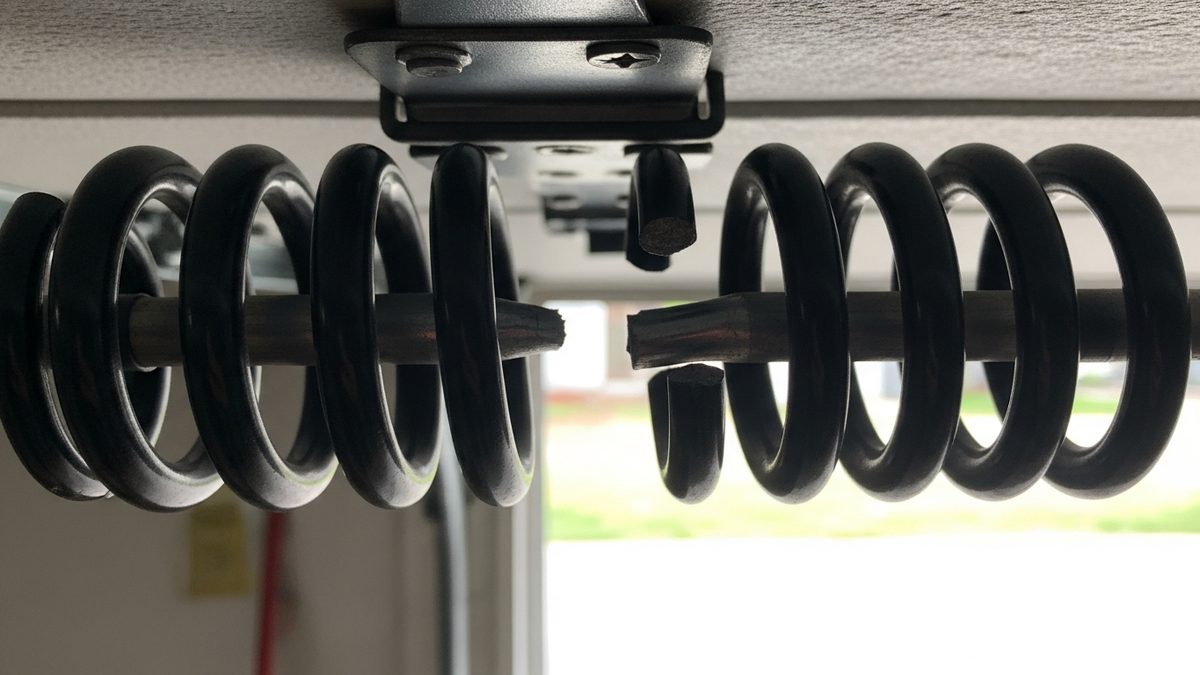
Something went bang in the garage last night. Or the door refused to open this morning and the opener sounds like it's straining. Either way, a broken spring is one of the most common garage door failures — and one of the most dangerous to mishandle. Here's what's happening, what you can safely do right now, and why the repair belongs with a pro.
How to tell a spring broke
You don't need any tools to spot these signs.
A loud bang from the garage is often the first clue. When a torsion spring snaps, it releases enormous stored energy in a fraction of a second — the result sounds like a firecracker going off inside the wall, even with no one near the door.
The door won't lift, or only rises a few inches. Without the spring counterbalancing the door's weight (150 to 400 pounds on a typical residential door), the opener can't budge it, or reverses immediately as if it hit something. That reversal is the opener's safety response, not a sign the opener itself is broken.
The opener runs but nothing happens. You hear the motor moving, but the door barely shifts. Running the opener repeatedly in this state can burn out the motor — turning a spring repair into a larger job.
A visible gap in the torsion spring. Look above the door opening at the horizontal spring on the metal shaft. A clear break or separation in the coils means that spring has failed.
Slack or hanging cables. The cables on the sides of the door are driven by the spring. When the spring snaps, those cables often go limp or fall off their drums.
The door opens unevenly or looks crooked. Heavier double-car doors often have two springs. If only one breaks, the door may still move — but crookedly, with one side rising faster. That uneven loading damages tracks and cables quickly.
Can you still use the door?
No — not safely. A door with a broken spring can drop suddenly if a cable slips. The opener can burn out. Hardware can buckle under the unbalanced load.
Stop running the opener immediately. Disconnect it from the door by pulling the red emergency release cord — but only when the door is fully closed. If it's stuck partway open, leave it alone and keep everyone away from the opening.
To get your car out safely: With the door fully closed, pull the emergency release cord to disengage the opener. Then, with another adult helping, lift the door manually with both hands — it will feel extremely heavy. Get it just high enough to drive out, lower it carefully, and leave it closed until a technician arrives. Skip this if the door is already crooked, stuck mid-travel, or you have back or shoulder limitations.
Keep kids and pets away from the area until the door is repaired. An unbalanced door can move without warning.
Why you shouldn't DIY a spring replacement
Torsion spring replacement is one of the few home repairs where serious injury is a realistic outcome, not just a legal disclaimer.
A torsion spring stores concentrated rotational energy. When fully wound, it has enough force to cause severe lacerations or broken bones if it releases unexpectedly. Clopay — one of the country's largest garage door manufacturers — states in its installation documentation that springs and attached hardware are under extreme tension at all times, and that all tension must be safely released before any work is performed. Professional installation is explicitly recommended.
The job requires specialized winding bars matched to the spring's exact diameter. Using an improvised substitute — a screwdriver, as some online videos suggest — can cause the winding cone to slip violently. Extension springs (along the tracks on older or lighter doors) carry similar risk: when they snap, they can whip across the garage with significant force, which is why safety cables are required on them.
This isn't about skill level. It's a repair with almost no margin for error.
Safety first
Keep the door closed and leave the springs, winding cones, cables, and drums completely alone. Do not prop an open door — a door without spring support can drop without warning. Keep children and pets out of the garage until the repair is done.
When to call a pro
Call as soon as you notice any of the symptoms above. A partially working door puts compounding stress on cables, tracks, and the opener. Most garage door companies offer same-day service for broken springs — it's one of the most routine calls they get. Mention the spring type if you know it, the door's approximate age, and anything else you noticed.
What it typically costs
Based on 2025–2026 pricing data:
- Extension spring replacement: $150–$250 installed
- Torsion spring replacement: $200–$350 installed (heavier doors run higher)
- Replacing both springs at once: Recommended even if only one broke — the second is at roughly the same wear point. Doing both in one visit adds minimal cost vs. a second service call.
- Emergency or after-hours surcharge: $50–$100 above the standard rate
- Extension-to-torsion conversion: $400–$800 for homeowners who want to upgrade to the more durable system
For reference, a full garage door replacement runs $750–$1,700 or more. Addressing the spring while it's still just the spring is almost always the better financial outcome.
Common mistakes to avoid
Continuing to run the opener. It's not built to lift a dead-weight door. Even a few cycles can burn out the motor or strip the drive.
Propping the door open. Chairs, ladders, and boxes are not structural supports. A door without spring tension can fall.
Replacing only the broken spring. If both springs are the same age, the other is close to failure too. Replace both while the technician is already on site.
Ordering parts and watching a video. The tutorials exist, but a mistake here isn't a failed project — it's a spring releasing with real force. Even confident DIYers report this repair feels unlike anything else they've tackled.
How to make springs last longer
Springs are rated by cycles (one open, one close). Average use burns through roughly 1,500 per year. A few habits extend their lifespan.
Lubricate two to three times a year with a lithium- or silicone-based garage door lubricant — not WD-40, which can degrade metal over time. Focus on the spring coils, rollers, and hinges.
Test balance periodically. Disconnect the opener, lift the door to waist height by hand, and let go. A balanced door stays put. If it falls or shoots upward, have a technician adjust the tension.
Inspect visually each season. Rust, stretched coils, fraying cables, or new noises are early warnings worth addressing before something snaps.
FAQ
Can I manually open my garage door if the spring is broken? Yes, carefully. Pull the red emergency release cord only when the door is fully closed, then lift with two hands and another adult helping. The door will feel very heavy. Lower it gently and leave it down until the spring is replaced.
How long do garage door springs last? Standard torsion springs are rated for about 10,000 cycles — roughly 7 to 10 years of typical household use. Higher-cycle springs (20,000+) are available and worth asking about at replacement time.
Do I need to replace both springs if only one broke? Usually yes. Both springs were installed at the same time and wear at the same rate. Replacing only the broken one often leads to a second service call within months.
Is the opener broken, or is it the spring? Most likely the spring. When a spring fails, the opener can't move the unbalanced door and stops or reverses. Once the spring is replaced, the opener usually works normally — unless it was run repeatedly against the dead-weight door.
How do I tell if I have torsion or extension springs? Torsion springs are horizontal, above the door opening on a metal shaft. Extension springs run along the tracks on either side of the door. Most newer homes use torsion; older setups often use extension.
A broken spring is one of those problems that sounds worse than it is — as long as you stop using the door and get the right person on it. The repair is straightforward and relatively affordable. It's only when it gets forced or ignored that things get complicated.
Ready to get it sorted? Use the form below to get a free quote from a vetted garage door pro near you. No obligation, no pressure — just someone who can give you a straight answer on what it'll take to fix.
Sources
-
Clopay Corporation. "Garage Door Spring Systems: A Buying Guide for Homeowners." https://www.clopaydoor.com/residential/buyingguide/garage-door-spring-system
-
Clopay Corporation. "Supplemental Instructions — Torsion Spring Installation." https://cdn.clopay.com/public/documents/supplementtorsionspring.pdf
-
Angi. "How Much Does Garage Door Spring Replacement Cost? [2026 Data]." https://www.angi.com/articles/how-much-should-garage-door-spring-replacement-cost.htm
-
Lee Company. "7 Garage Door Broken Spring Symptoms and How to Spot Them." https://www.leecompany.com/resources/7-garage-door-broken-spring-symptoms-and-how-to-spot-them/
-
HomeGuide. "How Much Does Garage Door Spring Replacement Cost? (2026)." https://homeguide.com/costs/garage-door-spring-replacement-cost
-
This Old House. "Garage Door Spring Replacement Cost (2026)." https://www.thisoldhouse.com/garages/garage-door-spring-cost
Disclaimer
The information on this page is provided for general educational purposes only and is offered "as is" and "as available," without warranties of any kind, whether express or implied — including, without limitation, any warranties of accuracy, completeness, reliability, merchantability, or fitness for a particular purpose. It is not professional advice and is not a substitute for inspection, diagnosis, or repair by a licensed, qualified professional.
Home systems involving gas, electricity, water, refrigerant, fire, or structural components can be hazardous, and requirements vary by local code and jurisdiction. Any inspection, diagnosis, repair, installation, or other action referenced on this page should be performed by a licensed professional. You should not rely on this content to perform such work yourself. To the fullest extent permitted by law, [Company Name] and its owners, employees, and contributors assume no responsibility or liability for any injury, death, property damage, or other loss arising out of or in connection with the use of, or reliance on, this information.
If you smell gas or suspect a carbon monoxide leak, leave the area immediately and call 911 or your gas utility from a safe location.