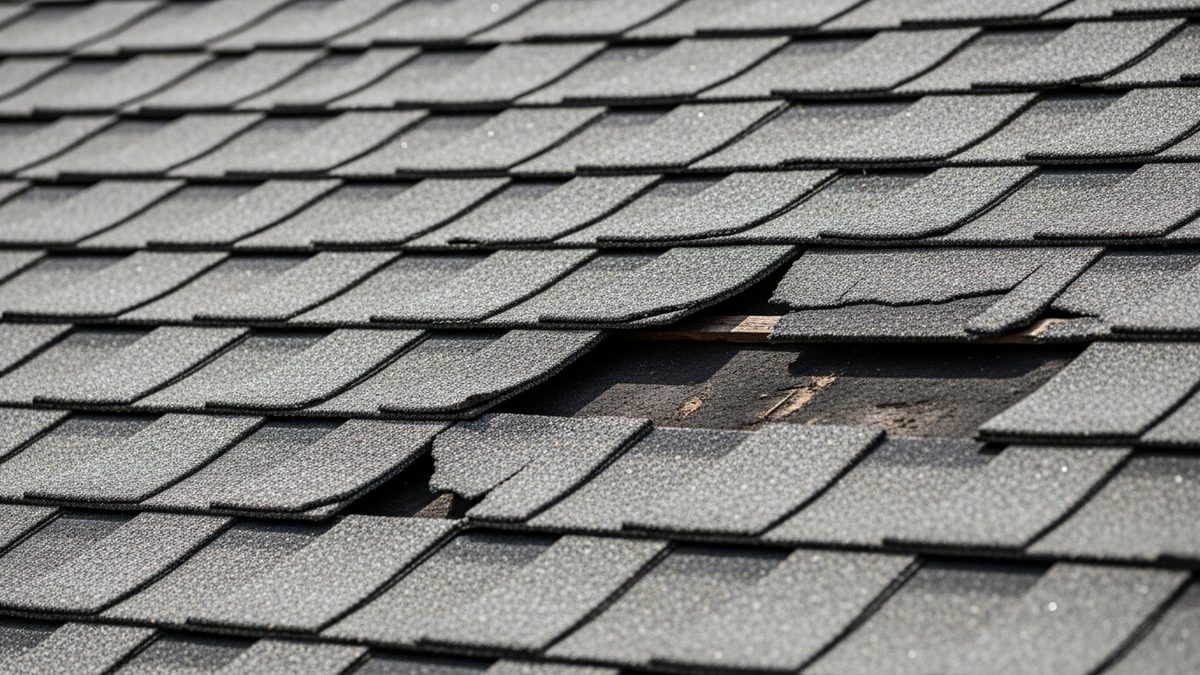
Two things drive almost every roof decision: how old the roof is, and how much of it is damaged. Get those two answers right and the repair-or-replace question usually answers itself.
A few missing shingles on a six-year-old roof? That is a repair. Widespread curling, granule-filled gutters, and a roof pushing 25 years? That is a replacement conversation.
Signs You May Need a New Roof
Age. Most 3-tab asphalt shingles last around 20 years. Architectural (dimensional) shingles typically go 25 to 30 years, and premium lines like Owens Corning Duration can push past 30 with proper attic ventilation. If your roof is approaching those ranges, even small problems are worth taking seriously — you may be buying time rather than solving the issue.
Curling or cupping shingles. Shingles that curl upward at the edges (cupping) or bow up in the middle have lost their elasticity and can no longer seal out wind-driven rain. If curling covers more than a small section, the material has aged out.
Cracked or brittle shingles. A cracked shingle here and there may be patchable. Widespread cracking across multiple slopes means the asphalt has dried out and the whole roof is near failure.
Bald spots and granules in the gutters. Asphalt shingles are coated with mineral granules that protect the asphalt from UV damage. When those granules loosen and wash into your gutters, the shingles are degrading. According to InterNACHI, once granule loss becomes widespread, the exposed asphalt deteriorates quickly.
Missing shingles after a storm. Occasional wind damage is normal. If your roof loses shingles in moderate storms regularly, the fastening system may be failing — a sign of overall age, not just isolated bad luck.
Sagging roofline. A roof that dips between rafters or shows a wave along the ridge points to a structural problem — rotted decking or damaged framing. This goes beyond a shingle issue and almost always means replacement, possibly with deck repairs added.
Daylight or leaks in the attic. Pinpoints of light through the roof boards, water stains on rafters, or wet insulation all mean water is getting in. Multiple leak spots scattered across the attic suggest a systemic problem. For tracking a single leak, see our guide on how to find the source of a roof leak.
Moss, algae, or rot. Dark streaks are usually algae — more cosmetic than structural. Thick, spongy moss holds moisture against the shingles and accelerates wear. Soft or crumbling sheathing underneath means rot has reached the deck, and replacement is unavoidable.
Multiple existing shingle layers. Most states allow up to two layers of shingles. If your roof already has two layers, a full tear-off and replacement is the only legal path forward.
Repair vs. Full Replacement
A repair makes sense when:
- Damage is isolated to a small, clearly defined area
- The roof is under 15 years old and the rest of the shingles are in good shape
- The underlying deck is dry and structurally sound
Replacement is the better call when:
- The roof is past its expected lifespan
- More than roughly 30% of the surface shows damage or significant wear
- You have had leaks in multiple locations over the past few years
- The repair estimate runs to 50% or more of replacement cost — at that point, most contractors recommend replacing instead of patching
How to Inspect from the Ground (Safely)
Do not walk a steep or wet roof without professional equipment and training. Falls from roofs are among the most common home-injury causes in the U.S.
From the ground with binoculars. Stand back far enough to see each full slope. Look for curling or lifted shingles, dark patches of granule loss, sagging sections, and moss. Check all sides of the roof if possible.
From the attic. On a bright day, go into your attic, turn off any lights, and let your eyes adjust. Look for pinpoints of daylight through the decking. Then use a flashlight to scan rafters and sheathing for water stains, soft spots, or mold near vent penetrations and the chimney base.
Take photos of anything that looks off. It helps when comparing contractor estimates.
What a Roof Inspection Covers
A professional inspection by a licensed roofer or an InterNACHI-certified home inspector covers: condition of all roofing materials, flashing around chimneys and penetrations, gutter condition, soffit and fascia, attic ventilation, and the structural integrity of the roof deck. Most roofing contractors offer free inspections. An independent home inspector typically charges around $240 on average (Angi, 2026).
Cost: Repair vs. Replacement
These are rough national ranges for 2025-2026 and vary by region, roof size, and material:
Roof repairs: Most jobs run $360 to $1,750, with minor patches often under $500. Extensive repairs can reach $3,000 or more. Costs vary widely with the extent of the damage and your roofing material.
Full roof replacement: Averages $9,530 nationally, with most homeowners paying between $5,870 and $13,223 (Angi, 2026). By material:
- Asphalt shingles: $5,800 to $20,000 installed
- Metal roofing: $5,700 to $25,000
- Tile (concrete or clay): $8,500 to $26,400
Labor makes up about 65% of total project cost, so local labor rates affect your final number significantly.
Insurance and Storm Damage
Homeowners insurance typically covers roof damage from a covered peril — wind, hail, a falling tree — but not age-related wear and tear.
Key points:
- Document everything. Take dated photos of all storm damage before any repairs begin.
- Replacement cost vs. actual cash value. Replacement cost pays what it costs to re-roof today. Actual cash value deducts for depreciation — an aging roof may get a much smaller payout.
- Separate wind/hail deductibles. Many policies in storm-prone states carry a higher deductible for wind and hail claims. Check your declarations page before filing.
- If a contractor shows up right after a storm and pressures you to sign quickly, work directly with your insurer first.
How Long Different Roofs Last
| Material | Typical Lifespan |
|---|---|
| 3-tab asphalt shingles | 15 to 20 years |
| Architectural asphalt shingles | 25 to 30 years |
| Metal (corrugated or panels) | 40 to 70 years |
| Concrete or clay tile | 50 to 100 years |
| Slate | 75 to 100+ years |
Climate matters: roofs in regions with extreme heat, frequent hail, or heavy snowpack wear faster than the same materials in mild climates.
FAQ
My roof is 18 years old and I have one leak. Do I need a full replacement? Not necessarily. If the leak source is isolated — failed flashing, a cracked vent boot, a small patch of damaged shingles — a targeted repair can buy several more years. Get an inspection first. If the rest of the roof is still in decent shape, a repair is reasonable.
Can I put new shingles over my old ones? One overlay is permitted in many areas if you already have only one layer, but most professionals recommend a full tear-off so the deck can be inspected and any rotted sheathing replaced before new shingles go on.
Will my insurance cover a roof that has just aged out? Generally, no. Insurance covers sudden damage from a covered event, not gradual wear and tear or age-related deterioration.
How do I find a trustworthy roofer? Look for licensed, insured contractors established in your area. Manufacturer certifications like GAF Master Elite or Owens Corning Platinum Preferred indicate additional training and better warranty terms. Get at least two or three written estimates.
Not sure if your roof needs a repair or a full replacement? Get a free roof inspection and quote from vetted local roofing pros — no commitment required.
Sources
- Owens Corning — 3 Signs That It's Time to Replace Your Roof
- Angi — How Much Does Roof Replacement Cost? (2026 Data)
- Angi — How Much Does Roof Shingle Repair Cost? (2026 Data)
- This Old House — New Roof Cost Guide (2026)
- InterNACHI — Granule Loss Inspection Narrative
- InterNACHI — Home Inspection Standards of Practice
- Progressive Insurance — Does Home Insurance Cover Roof Damage?
Disclaimer
The information on this page is provided for general educational purposes only and is offered "as is" and "as available," without warranties of any kind, whether express or implied — including, without limitation, any warranties of accuracy, completeness, reliability, merchantability, or fitness for a particular purpose. It is not professional advice and is not a substitute for inspection, diagnosis, or repair by a licensed, qualified professional.
Home systems involving gas, electricity, water, refrigerant, fire, or structural components can be hazardous, and requirements vary by local code and jurisdiction. Any inspection, diagnosis, repair, installation, or other action referenced on this page should be performed by a licensed professional. You should not rely on this content to perform such work yourself. To the fullest extent permitted by law, [Company Name] and its owners, employees, and contributors assume no responsibility or liability for any injury, death, property damage, or other loss arising out of or in connection with the use of, or reliance on, this information.
If you smell gas or suspect a carbon monoxide leak, leave the area immediately and call 911 or your gas utility from a safe location.