Waking Up Itchy? Here's How to Tell If You Actually Have Bed Bugs
Finding suspicious bites when you wake up is unsettling, to say the least. Before you panic — or before you assume it's nothing — there are real, concrete clues you can look for right now to find out whether bed bugs are actually in your home. This guide walks you through every sign to check, how to do a thorough inspection yourself, and when it makes sense to call in a professional.
Signs you might have bed bugs
Not all signs are created equal. Some are almost definitive proof; others are easy to misread. Here they are, ranked from most to least reliable.
1. You spot a live bug. This is the gold standard. Adult bed bugs are roughly the size of an apple seed — flat, wingless, and reddish-brown. After a blood meal they swell and darken. Young bugs (nymphs) are smaller and almost see-through. If you find one alive on or near your bed, you have your answer.
2. You find shed skins. Bed bugs molt five times as they grow, leaving behind translucent, empty "shells." These pale husks turn up in mattress seams, headboard joints, and crevices in furniture. Even without a live bug in sight, a cluster of shed skins is strong evidence that bed bugs have been living — and probably still are — very close by.
3. You notice tiny eggs or hatched shells. Bed bug eggs are about 1 mm long, pale yellow, and glued to surfaces in the seams and cracks where bugs hide. Hatched eggshells look similar but are open at one end. Clusters of eggs or shells in mattress piping or furniture joints mean the bugs are reproducing — a sign of an active, established infestation.
4. You see dark specks on the mattress or bedding. Bed bug droppings look like tiny dark dots — about the size of a period at the end of a sentence — and may smear like old ink when rubbed. The EPA describes them as "dark spots (about the size of a bullet tip)." Lines or clusters of these specks along mattress seams or on pillowcases are a reliable red flag.
5. You find rusty or reddish stains on sheets. These reddish-brown marks are dried blood — either from a bug that got crushed while you slept or from droppings that contain digested blood. A few small spots aren't conclusive on their own (other things can cause stains), but combined with other signs, they raise the alarm considerably.
6. There's a sweet, musty smell in the room. A heavy infestation can produce a faint, sweet odor — often compared to coriander or overripe fruit. Because this only shows up when bugs are very numerous, it's a late-stage sign. If you notice it, things have likely been building for a while.
7. You have unexplained bite marks (least reliable). Itchy red welts on your arms, neck, or back after sleeping? Bed bug bites are a common reason people start investigating — but bites alone can't confirm bed bugs. Reactions vary widely from person to person, and the marks look nearly identical to mosquito bites, flea bites, and some allergic rashes. The CDC and EPA both stress that bites are a poor indicator without other physical evidence. Use bites as a reason to inspect, not as a conclusion.
How to check your home (step by step)
A thorough inspection takes about 30–45 minutes. Do it during the day with good lighting.
What you'll need: A bright flashlight, a stiff card (an old credit card works well), and ideally a magnifying glass.
Step 1 — Strip the bed. Pull off all bedding and look at every inch of the fitted sheet, pillow covers, and mattress pad before tossing them aside. Dark spots or stains here are worth noting.
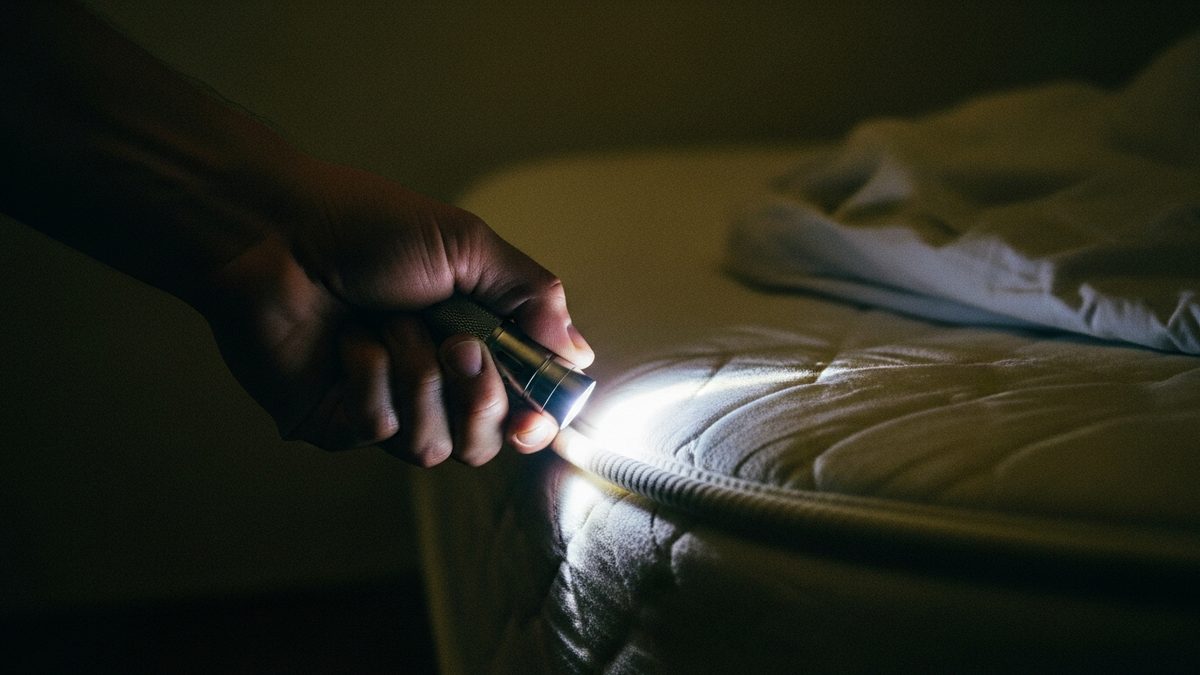
Step 2 — Inspect the mattress. Run your fingers and the flashlight beam along every seam, the piping around the edges, any tufts, and the tag. Use your card to gently lift the piping and peek underneath. Flip the mattress and repeat on the other side. Look for live bugs, shed skins, eggs, and fecal spots.
Step 3 — Check the box spring. The box spring is one of the most common hiding spots. Inspect the seams on the outside, then try to look inside — many box springs have a thin dust cover on the bottom that can be gently pulled back.
Step 4 — Move to the bed frame and headboard. Examine all joints, screw holes, cracks, and hollow legs. Headboards — especially upholstered ones — are popular hiding places. Use your flashlight and card to probe any gap that could fit a credit card, because bed bugs can squeeze into spaces that thin.
Step 5 — Widen your search. Check the nightstand (inside drawers, along the back), nearby upholstered chairs or sofas, curtains, baseboards, electrical outlet covers, and the edges of carpet near the bed. In heavier infestations, bugs spread to picture frames, loose wallpaper edges, and even the heads of screws.
Step 6 — Set interceptors and monitor. Passive pitfall traps — often called ClimbUp interceptors — sit under each bed leg and catch bugs as they try to climb up or down. Research from Rutgers University found that interceptors catch roughly six times more bugs than a visual inspection alone. Leave them in place for at least a week and check them daily.
What your findings mean: Any live bug, shed skin, egg, or cluster of fecal spots confirms an infestation. Finding nothing after a careful search is a good sign, but if bites keep appearing, repeat the inspection or consult a professional — small numbers of bugs can be very hard to spot.
How to tell bed bugs apart from look-alikes
A few other critters get mistaken for bed bugs fairly often.
Fleas are even smaller than bed bugs and jump. Their bites tend to cluster around the ankles and lower legs, while bed bug bites more often show up on the arms, neck, and back. Fleas leave behind "flea dirt" — tiny black specks — in pet bedding and carpet rather than on mattress seams.
Carpet beetles are small and rounded, often with a mottled brown-black-white pattern. Their larvae are fuzzy. Critically, carpet beetles do not bite people — they eat wool, carpet fibers, and clothing. If you're finding holes in fabric and fuzzy grubs but no bites, you're likely dealing with carpet beetles, not bed bugs.
Bat bugs are nearly identical to bed bugs under a regular light. The only reliable difference requires a microscope: bat bugs have longer hairs on the thorax. They show up in homes that have — or recently had — bats roosting in the attic or chimney. If someone identifies "bed bugs" in your home and you've also noticed bats, it's worth having an expert confirm which species you have.
Other bites: Mosquito bites are usually single, round welts from outdoor exposure. Chigger bites cluster around ankles and waistbands. Spider bites are rare and typically produce one or two larger, distinct marks. The key takeaway: no bite pattern is definitive for any pest. Finding the insect itself — or its physical evidence — is the only way to know for sure.
Why DIY usually isn't enough
It's tempting to grab a can of spray from the hardware store and handle it yourself. Here's why that rarely works.
Bed bugs are extraordinarily good at hiding. They tuck themselves into wall voids, deep inside furniture joints, under carpet edges, and in spots that a spray can simply can't reach. The EPA has noted that pesticides alone generally will not eliminate a bed bug infestation. Consumer foggers ("bug bombs") are even less effective — research has shown they don't penetrate hiding spots and can pose real health risks. The CDC documented cases of pesticide poisoning, including one fatality, linked to people misusing foggers to fight bed bugs.
Even thorough vacuuming and washing bedding — while genuinely helpful as supporting steps — won't reach every egg or hiding bug on their own. DIY attempts often push bugs deeper into walls or into adjacent rooms, making the problem worse and harder to treat later.
When to call a pro
Call a professional exterminator when:
- You've found live bugs, shed skins, eggs, or fecal spots.
- Bites keep appearing despite thorough cleaning and inspecting.
- You've tried DIY methods and the problem continues or gets worse.
- The infestation has spread beyond one room.
- You live in a multi-unit building and suspect the bugs are traveling between units.
A professional inspection typically covers the entire sleeping area with specialized tools and trained eyes — some inspectors use scent-detection dogs, which are highly accurate. Treatment options include:
- Heat treatment: The room is raised to around 130–140°F and held there long enough to kill every life stage, including eggs. It's chemical-free and highly effective when done correctly.
- Chemical treatment: Licensed technicians apply registered insecticides — including contact sprays and long-lasting dusts — only in the cracks and harborage areas where bugs actually live. This is very different from an over-the-counter spray.
- Integrated approach: Most pros combine methods — vacuuming, steaming, insecticide application, mattress encasements, and follow-up monitoring — for the best results.
Professionals also advise on mattress encasements and follow-up monitoring to prevent re-infestation.
What it typically costs
Bed bug treatment costs vary widely depending on your location, the size of your home, and the severity of the infestation. Based on 2025–2026 data:
- Initial inspection: $75–$200 for a visual inspection; $300–$600 for a canine inspection.
- Single-room treatment: Roughly $300–$650 for a one-bedroom home.
- Whole-home treatment: Typically $1,000–$4,000, with severe infestations running higher.
- Average total cost: Around $2,500 for a mid-sized home, according to Angi's 2026 data.
- Multiple visits: Most infestations require two to four treatment visits within a six-week period, each running $415–$625 per visit.
Heat treatments tend to be on the more affordable end per square foot ($1–$3/sq ft), while fumigation is pricier ($4–$8/sq ft) and best reserved for severe cases. Emergency same-day service typically adds $200–$500 to the bill.
Catching an infestation early — while it's still confined to one room — is the single best way to keep costs manageable.
What to do right now if you find them
Finding bed bugs is stressful, but your first moves matter a lot. Here's what to do — and what not to do.
Do:
- Strip bedding immediately and seal it in plastic bags before carrying it to the laundry. Wash and dry everything on the hottest settings available (at least 130°F for 30 minutes kills all life stages).
- Vacuum the mattress, box spring, and surrounding floor thoroughly. Seal the vacuum bag in a plastic bag and throw it away outside.
- Install interceptor traps under every bed leg.
- Encase your mattress and box spring in bed-bug-proof zippered covers. Any bugs still inside will eventually die, and no new ones can get in.
- If you live in an apartment, notify your landlord right away. Prompt treatment prevents spread to neighboring units.
Don't:
- Move furniture, mattresses, or bedding to other rooms without sealing them first. This is the fastest way to spread an infestation to new areas.
- Throw out your mattress before consulting a pro — it's often treatable, and replacing it without treating the room first just means buying a new mattress that will get infested again.
- Use foggers or "bug bombs." They don't work on bed bugs and can be dangerous.
- Sleep in a different room to avoid the bugs — they will find you, and you'll spread them there too.
How to prevent bed bugs
Bed bugs don't care how clean your home is — they hitchhike on people and belongings. Good habits dramatically reduce your risk.
When you travel: Before settling in, use a flashlight to check the mattress seams and headboard of any hotel or rental. Keep your luggage on the rack (off the floor and bed). Store worn clothes in sealed bags. When you get home, run every piece of clothing through a hot dryer cycle and inspect your suitcase before storing it.
With used furniture and clothing: Never bring a used mattress into your home. If you're buying secondhand furniture, inspect every seam, joint, and crevice before it comes through the door. Wash any secondhand clothing immediately on hot.
At home: Reduce clutter — stacks of paper, clothes on the floor, and piles of books all create perfect hiding spots. Vacuum regularly, especially along baseboards and under the bed. Use zippered mattress encasements as a permanent precaution; they make future inspections much easier and give bugs nowhere to establish a colony.
FAQ
Q: Can bed bugs make me sick? No. Bed bugs are not known to transmit any disease to humans. Their main health effects are itching, occasional allergic reactions, and the anxiety and sleep loss that come with an infestation. If you're having a severe allergic reaction to bites, contact your healthcare provider.
Q: How long can bed bugs survive without feeding? A very long time. In lab settings, adult bed bugs have survived more than 400 days without a blood meal. In a typical home, they can go many months. Leaving a room empty or going on an extended trip will not solve the problem.
Q: Do bug bombs work on bed bugs? No. Consumer foggers (total-release foggers) are consistently ineffective against bed bugs because they don't reach the hidden spots where bugs actually live. They also pose real health risks — the CDC has documented illnesses and at least one death linked to improper fogger use for bed bugs. Skip them entirely.
Q: I only have bites — no other signs. What should I do? Inspect your sleeping area carefully using the steps above. If you find no physical evidence after a thorough check (no bugs, no skins, no fecal spots), it may not be bed bugs. Other insects, allergies, or skin conditions can cause similar-looking marks. If bites keep appearing and you still find nothing, consider having a professional take a look.
Q: What if I only find one bug? Does that mean it's a small infestation? Not necessarily. One bug you can see may mean dozens more you cannot. Bed bugs are experts at staying hidden, especially during the day. A single live bug or cluster of eggs warrants a full inspection and likely professional attention.
Q: Will my landlord pay for treatment? Responsibility varies widely by state and city, and can also depend on your lease and how the infestation started. In some places landlords are responsible for treating bed bugs in rental units; in others the duty is shared or unclear. Check your local tenant-protection laws and your lease, and notify your landlord in writing as soon as you suspect or confirm an infestation.
Ready to get a professional opinion?
If you've found signs of bed bugs — or you're just not sure — the smartest next step is having a vetted pest control professional take a look. Early detection makes treatment faster, cheaper, and far less disruptive.
Get a free quote from a licensed pest control pro near you. Local Service Group connects homeowners with vetted professionals who specialize in bed bug inspection and treatment. There's no obligation, and a quick conversation could save you a lot of headaches down the road.
Sources
- CDC — About Bed Bugs (identification and signs): https://www.cdc.gov/bedbugs/about/index.html
- EPA — How to Find Bed Bugs (signs and hiding places): https://www.epa.gov/bedbugs/how-find-bed-bugs
- EPA (PDF) — Bed Bug Prevention, Detection and Control brochure: https://www.epa.gov/sites/default/files/2014-02/documents/bed-bug-prevention-detection-control.pdf
- Ohio State University Extension — The Bed Bug Threat (2025): https://ohioline.osu.edu/factsheet/hyg-2105
- Virginia Tech Cooperative Extension (via VDACS) — How to Identify a Bed Bug Infestation: https://www.vdacs.virginia.gov/pdf/bb-identify1.pdf
- UC IPM — Bed Bugs Pest Note: https://www2.ipm.ucanr.edu/PMG/PESTNOTES/pn7455.html
- Rutgers Extension — Detecting Bed Bugs Using Monitors: https://njaes.rutgers.edu/fs1117
- EPA — Bed Bugs: A Public Health Issue: https://www.epa.gov/bedbugs/bed-bugs-public-health-issue
- CDC MMWR — Illnesses from Insecticides Used for Bed Bugs: https://www.cdc.gov/mmwr/preview/mmwrhtml/mm6037a1.htm
- Terminix — Bed Bug vs Carpet Beetle (identification): https://www.terminix.com/bed-bugs/identification/bed-bug-vs-carpet-beetle/
- EPA — Preparing for Treatment Against Bed Bugs: https://www.epa.gov/bedbugs/preparing-treatment-against-bed-bugs
- Angi — How Much Does Bed Bug Treatment Cost? (2026 data): https://www.angi.com/articles/how-much-does-bed-bug-extermination-cost.htm
- Thumbtack — Bed Bug Extermination Cost (2025): https://www.thumbtack.com/p/bed-bugs-cost
Disclaimer
The information on this page is provided for general educational purposes only and is offered "as is" and "as available," without warranties of any kind, whether express or implied — including, without limitation, any warranties of accuracy, completeness, reliability, merchantability, or fitness for a particular purpose. It is not professional advice and is not a substitute for inspection, diagnosis, or repair by a licensed, qualified professional.
Home systems involving gas, electricity, water, refrigerant, fire, or structural components can be hazardous, and requirements vary by local code and jurisdiction. Any inspection, diagnosis, repair, installation, or other action referenced on this page should be performed by a licensed professional. You should not rely on this content to perform such work yourself. To the fullest extent permitted by law, [Company Name] and its owners, employees, and contributors assume no responsibility or liability for any injury, death, property damage, or other loss arising out of or in connection with the use of, or reliance on, this information.
If you smell gas or suspect a carbon monoxide leak, leave the area immediately and call 911 or your gas utility from a safe location.