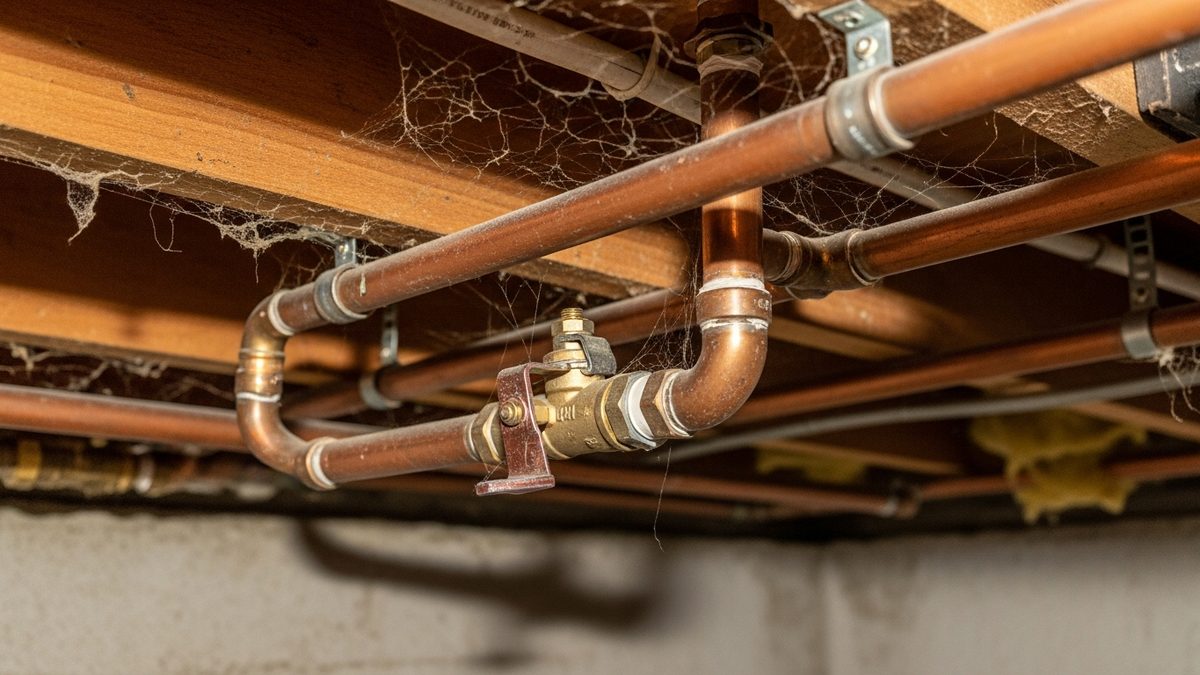
A loud bang, thump, or rattling sound from inside your walls when you turn off a faucet, flush a toilet, or hear the washing machine stop filling — that is water hammer. It sounds alarming, and for good reason: over time it can loosen pipe fittings, damage valves, and stress the joints in your supply lines. The good news is that most water hammer problems have a clear cause and a reliable fix.
Here is what is happening inside your pipes and how to make it stop.
What water hammer actually is
Water flowing through a pipe has momentum. When a valve closes quickly — the solenoid valve in a washing machine or dishwasher, a fast-closing ball valve, or the valve inside a toilet fill mechanism — that column of moving water has nowhere to go instantly. It slams into the closed valve with significant force. The American Society of Plumbing Engineers notes that the pressure spike from water hammer can reach several times normal line pressure, even from a single fast valve closure.
The bang you hear is the pressure wave radiating through the pipe and into the wall framing. The same wave bounces back, sometimes creating a series of clanking sounds rather than a single bang. In old plumbing textbooks this is also called hydraulic shock.
Water hammer is different from pipes that rattle because they are loose — though both can happen together. Banging only when a valve closes suddenly is classic water hammer. Banging or rattling while water is running (not just when it stops) is almost always a loose pipe that needs to be secured.
Most likely causes, ranked
1. Fast-closing solenoid valves on appliances
Modern washing machines, dishwashers, ice makers, and boiler fill valves use electric solenoid valves that open and close almost instantaneously. They do not ease the flow down gradually the way a hand-turned faucet does. This is the most common cause of water hammer in homes built after the 1990s. You will hear the bang at the start or end of a washing machine fill cycle, when the dishwasher shuts off its water intake, or when the fridge ice maker fills.
2. Waterlogged air chambers
Older homes — generally those built before the 1980s — were often fitted with air chambers: short capped extensions of vertical pipe near fixtures. These chambers hold a pocket of air that acts as a cushion, absorbing the pressure wave when a valve closes. Over months and years, water slowly absorbs the air in the chamber, and the cushion disappears. When the air chamber is full of water rather than air, it provides no shock absorption at all, and water hammer returns even on a system that was quiet for years.
Recharging air chambers is straightforward and is described in the troubleshooting section below.
3. High water supply pressure
Water hammer is amplified by high supply pressure. The higher the line pressure, the greater the momentum of the water column, and the bigger the pressure spike when a valve closes. The Plumbing-Heating-Cooling Contractors Association (PHCC) recommends that residential water supply pressure stay between 40 and 80 psi. Many municipal systems deliver water at 100 psi or higher, especially in neighborhoods downhill from a water tower. Pressure above 80 psi makes water hammer worse and also increases the risk of pipe and fitting damage over time.
You can test supply pressure with a simple gauge that threads onto a hose bib (outdoor spigot). They cost $10–$20 at any hardware store.
4. Loose pipe straps and hangers
Water hammer creates a physical shock wave that travels through the pipe. If the pipe is not securely fastened to framing at regular intervals, that shock causes the pipe to move, and the pipe then contacts the wood framing or other pipes around it — creating a separate rattling or banging sound that is often mistaken for water hammer itself. Copper supply lines in particular expand and contract with temperature changes, which can work loose the straps that hold them.
Standard plumbing practice calls for hangers or straps every six to eight feet on horizontal runs of copper or plastic supply pipe, and at every floor penetration.
5. Faulty or worn pressure-reducing valve (PRV)
Most homes with high municipal pressure have a pressure-reducing valve (also called a pressure regulator) installed where the main supply enters the house. This valve is typically set between 50 and 70 psi. PRVs wear out over time — they typically last 10–15 years. A failing PRV can allow supply pressure to creep upward, making existing water hammer worse, or it can chatter and cause its own banging. Testing line pressure with a gauge will show whether pressure has crept above safe levels.
Troubleshoot it yourself — safely
Step 1: Identify when it happens. Does the bang happen at a specific appliance (washing machine, dishwasher, ice maker)? Only when a faucet is turned off quickly? At one location in the house or everywhere? Pinpointing the trigger narrows the cause significantly.
Step 2: Test your water pressure. Thread a pressure gauge onto an outdoor hose bib. Open the bib and read the gauge. Over 80 psi is elevated. Over 100 psi is high enough that a PRV adjustment or replacement is probably needed.
Step 3: Try recharging air chambers (if your home has them). Air chambers are found on older homes and look like short capped pipe stubs, often behind walls near fixtures. To recharge them:
- Turn off the main water supply valve.
- Open every cold-water faucet in the house, starting from the lowest floor, to drain the pipes completely. Flush toilets once to drain tank lines.
- Leave faucets open for two to three minutes.
- Turn the main supply back on slowly.
- Close faucets from the lowest floor upward as water reaches them.
The idea is to let air re-enter the chambers before water fills them. Once the system refills, test by operating the valve that was causing the bang.
Step 4: Check pipe straps in accessible areas. In a basement, crawl space, or utility room where supply pipes are exposed, look for pipes that have moved away from framing or have loose straps. Plastic pipe strap clips cost a few cents each at hardware stores. Secure any pipe that has clearance to move when you push it.
Step 5: Listen for the appliance connection. If the bang happens only during washing machine operation, the problem is almost certainly the solenoid valve on the machine. The solution is a water hammer arrestor (see below) — not a plumbing repair.
The main fix: water hammer arrestors
A water hammer arrestor is a small device with a sealed air chamber and a piston that absorbs the pressure spike when a valve closes. Unlike a pipe-stub air chamber, the arrested chamber cannot become waterlogged because the air pocket is sealed behind a piston rather than being open to the water supply.
Water hammer arrestors are rated by the Plumbing and Drainage Institute (PDI) in sizes from A through F, matched to the flow rate of the fixture. For a residential washing machine connection, a size C or D arrestor is typical. For a single faucet supply stop, size A or B works.
They install in minutes — most thread directly onto the braided supply hose connection behind the washing machine, dishwasher, or at the angle stop under a sink. Cost is $15–$40 per unit at a hardware or plumbing supply store. This is one of the most cost-effective repairs in residential plumbing.
If water hammer is widespread throughout the house rather than isolated to one appliance, arrestors at each problem fixture plus a PRV adjustment (if pressure is high) will solve it in most cases.
Safety first
Water supply work is generally among the lower-risk DIY plumbing tasks, but a few precautions apply.
Know where your main shutoff is before you start. Draining the system requires turning it off. If you have not tested your main shutoff recently, turn it now to confirm it works and know where to find it quickly.
High water pressure is a slow-moving hazard. Sustained pressure above 80 psi stresses every fitting, joint, and valve in your supply system. Braided supply hoses on washing machines and dishwashers are a frequent failure point under elevated pressure. The Consumer Product Safety Commission has documented cases of supply hose failures causing significant water damage. Correcting high pressure is not just about eliminating the banging — it is about protecting the whole system.
Do not attempt PRV replacement yourself unless you have plumbing experience. The PRV is on the main supply, and replacing it requires shutting off the main, cutting into the supply line, and soldering or pressing new fittings. This is a standard plumber task, not a typical DIY job.
When to call a plumber
Call a licensed plumber when:
- Water pressure tests above 80 psi and the PRV is past 10–15 years old or appears corroded.
- Recharging air chambers and installing arrestors does not eliminate the banging.
- You hear banging deep in walls on main supply runs that you cannot access to check straps.
- The banging started suddenly and is much louder than usual — this can indicate a pipe fitting that has loosened and may fail soon.
- You see moisture, staining, or wet drywall near where banging occurs. A banging pipe that has been working against a fitting for months can eventually cause a leak.
What it typically costs (2025–2026 estimates)
Water hammer arrestor (materials only): $15–$40 per unit, plus about 10–15 minutes of DIY installation per location.
Plumber-installed water hammer arrestors: $75–$200 per location (parts and labor). Worth having done at the same time as another service call.
Pressure gauge (to test line pressure yourself): $10–$20 at any hardware store. A one-time purchase.
PRV adjustment (by a plumber): $75–$150. Many PRVs have a simple adjustment screw on top that a plumber can tune in minutes.
PRV replacement: $200–$500 installed, depending on the valve size and access. A standard plumbing repair.
Pipe strap installation (accessible pipes, DIY): $5–$20 in materials.
Pipe strap installation (plumber, in-wall): Typically billed at the hourly rate — $100–$200 per hour depending on the region — plus materials. Usually bundled with another repair.
Common mistakes
Ignoring water hammer as just a noise. Repeated pressure spikes stress every fitting in the system. Joints on flexible braided supply hoses, in particular, are at elevated risk of failure when hammer goes uncorrected.
Only installing an arrestor at the washing machine when the problem is also at other fixtures. Arrestors need to be installed at each problem location. One arrestor does not protect the whole house.
Assuming the problem is fixed after recharging air chambers if the chambers themselves are aging. Old-style pipe-stub air chambers become waterlogged again within months. An arrestor with a sealed piston is a permanent solution.
Tightening pipe straps so hard that copper pipe cannot expand. Copper expands and contracts with hot and cold water. Straps should hold the pipe snugly but not rigidly compress it. Use full-loop plastic or rubber-lined metal straps rather than bare metal clips on copper.
Not checking pressure after adjusting the PRV. Always re-test with the pressure gauge after any PRV adjustment to confirm the new setting.
How to prevent it
- Install water hammer arrestors on all fast-closing valve connections when appliances are first installed. This is cheap insurance that takes minutes.
- Test water pressure at least every two to three years. Replace the PRV proactively at around the 10–15 year mark.
- Use braided stainless steel supply hoses on washing machines and dishwashers (not rubber hoses) and replace them every five years regardless of visible condition.
- Secure supply pipe runs in basements, crawl spaces, and utility rooms with proper strap spacing when you have access during a renovation.
FAQ
Is water hammer dangerous? Long-term, yes. A single event will not rupture a pipe, but repeated pressure spikes over months and years fatigue fittings, loosen joints, and can cause supply hose failures. A washing machine supply hose that fails can release 500–1,000 gallons of water per hour while you are not home. Fixing water hammer is a reasonable precaution against a costly water-damage claim.
Does water hammer damage the washing machine? It can shorten the life of the solenoid valve inside the machine. Manufacturers recommend water hammer arrestors at washing machine connections specifically because of this.
My pipes only bang in winter — why? Cold water is denser and has slightly higher momentum for the same flow rate, which can make water hammer marginally worse in winter. More often, temperature changes cause copper pipes to contract, pulling them slightly away from pipe straps that were snug in summer. Loose straps cause more audible rattling in cold months.
Can I use foam pipe insulation to stop the banging? Foam insulation around a pipe reduces contact noise if the pipe is hitting framing, but it does not absorb the hydraulic shock wave of water hammer. If the pipe is loose and banging against wood, foam insulation plus a proper strap is the fix. Foam alone on a water-hammer problem will reduce noise slightly but not solve the underlying pressure issue.
How do I know if my PRV is failing? Signs of a failing PRV include: pressure that tests above the PRV set point on your gauge, pressure that fluctuates widely, a slight hissing or chattering sound near the valve, and water hammer that has recently gotten worse without any change in your appliances. A plumber can test and assess the valve on a service call.
Get a free quote
If water hammer arrestors and pressure adjustments have not solved your banging pipe problem, or if you want a professional to assess your system pressure and PRV condition, a licensed plumber can diagnose the issue quickly. Get a free, no-obligation quote from a local professional today.
Sources
- https://www.phccweb.org/tools-resources/technical-solutions/
- https://www.epa.gov/watersense/how-we-use-water
- https://www.cpsc.gov/Safety-Education/Safety-Guides/Home/Washing-Machine-Hose-Safety
- https://www.awwa.org/Portals/0/AWWA/ETS/Resources/WaterHammerPreventionGuidance.pdf
- https://www.nachi.org/plumbing-inspection.htm
- https://www.aspe.org/
- https://www.iapmo.org/uniform-plumbing-code/
- https://www.energy.gov/energysaver/plumbing
Disclaimer
The information on this page is provided for general educational purposes only and is offered "as is" and "as available," without warranties of any kind, whether express or implied — including, without limitation, any warranties of accuracy, completeness, reliability, merchantability, or fitness for a particular purpose. It is not professional advice and is not a substitute for inspection, diagnosis, or repair by a licensed, qualified professional.
Home systems involving gas, electricity, water, refrigerant, fire, or structural components can be hazardous, and requirements vary by local code and jurisdiction. Any inspection, diagnosis, repair, installation, or other action referenced on this page should be performed by a licensed professional. You should not rely on this content to perform such work yourself. To the fullest extent permitted by law, [Company Name] and its owners, employees, and contributors assume no responsibility or liability for any injury, death, property damage, or other loss arising out of or in connection with the use of, or reliance on, this information.
If you smell gas or suspect a carbon monoxide leak, leave the area immediately and call 911 or your gas utility from a safe location.